.png)


Posted on
August 14, 2026
Custom Rubber Extrusions: Co-Extruded, Multi-Durometer and Reverse-Engineered Profiles
Custom rubber extrusions beyond the catalogue: co-extruded multi-durometer profiles, reverse-engineered obsolete seals, and tolerancing what actually matters.
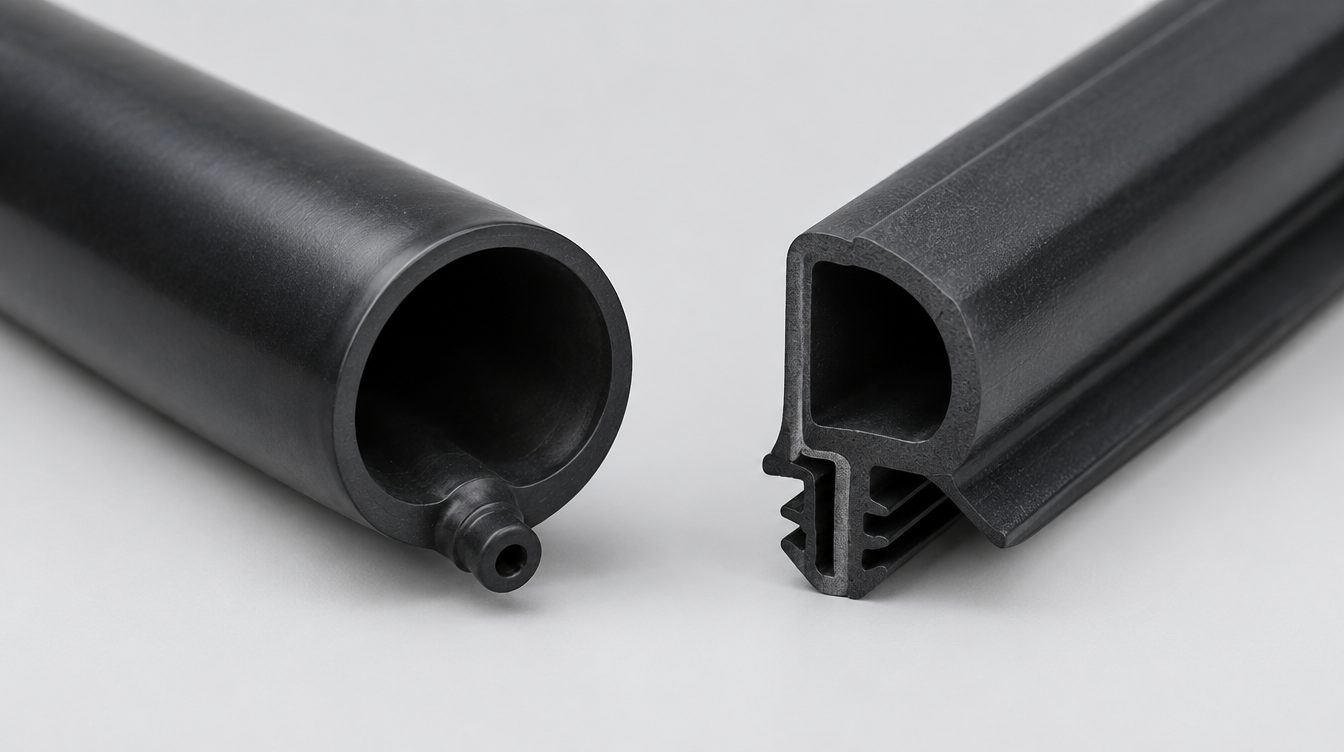
Standard cords and strips solve standard problems. But engineered applications — a bespoke facade gasket, a rigid carrier married to a soft sealing bulb, a reverse-engineered OEM seal with no surviving drawing — need a cross-section that does not exist in any catalogue. That is the domain of custom rubber extrusion, where the profile is designed around the application rather than the application compromised to fit a stock shape.
This article covers the two capabilities that most often make a custom extrusion worth commissioning: co-extruding multiple durometers into a single profile, and reproducing obsolete parts from a physical sample. If you want the underlying process — how extrusion works, how dies compensate for swell and shrinkage, how compounds are selected and tested — our definitive guide to rubber extrusion covers it, and this article assumes it.
When a custom profile is justified
A custom extrusion earns its tooling cost whenever a standard profile forces a compromise: the sealing gap is an unusual size, the profile must integrate a retention feature or two different hardnesses, the part replaces an obsolete component with no drawing, or the performance envelope rules out off-the-shelf compounds. In each case the cost of designing a purpose-built profile is repaid by better sealing, simpler assembly and longer service life. Where it is not justified — a simple groove, a low volume, a forgiving application — a stock cord is the honest answer, and we will tell you so.
Co-extrusion and multi-durometer profiles
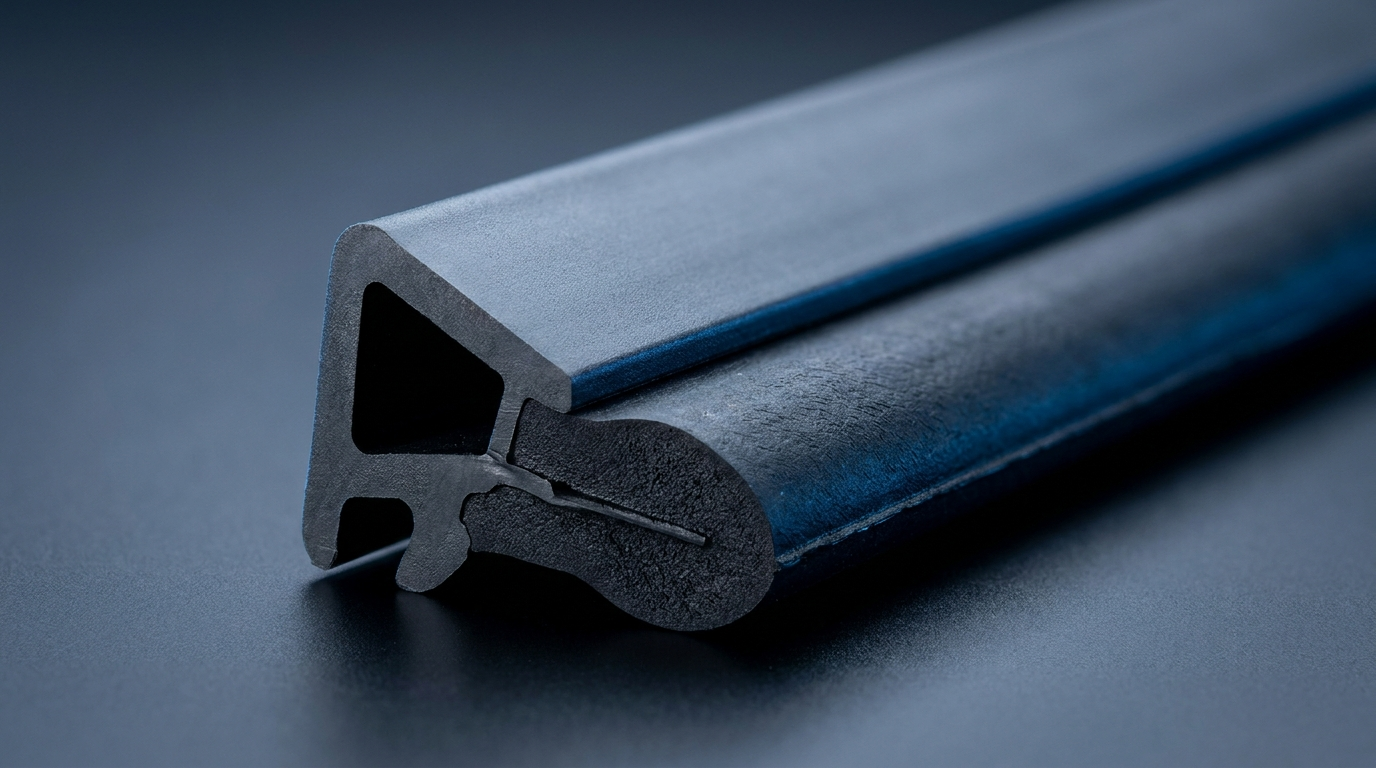
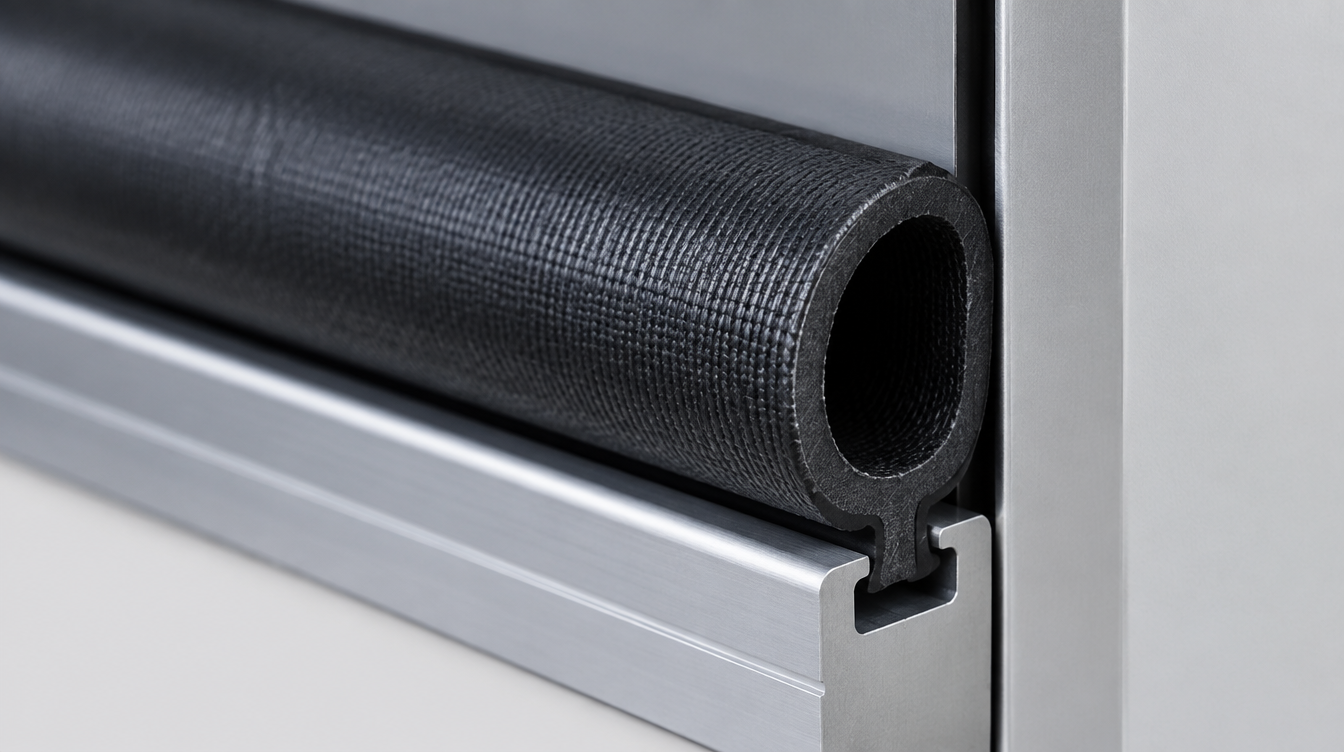
Some engineered applications need more than one hardness in a single profile. A facade gasket may need a firm foot that locates positively in an aluminium channel and a soft bulb that seals against glass under minimal closing force. A door seal may need a rigid carrier that resists deformation and a pliable wiping lip that follows an imperfect frame. Traditionally that means two parts, an assembly step, and a joint between them that becomes a leak path.
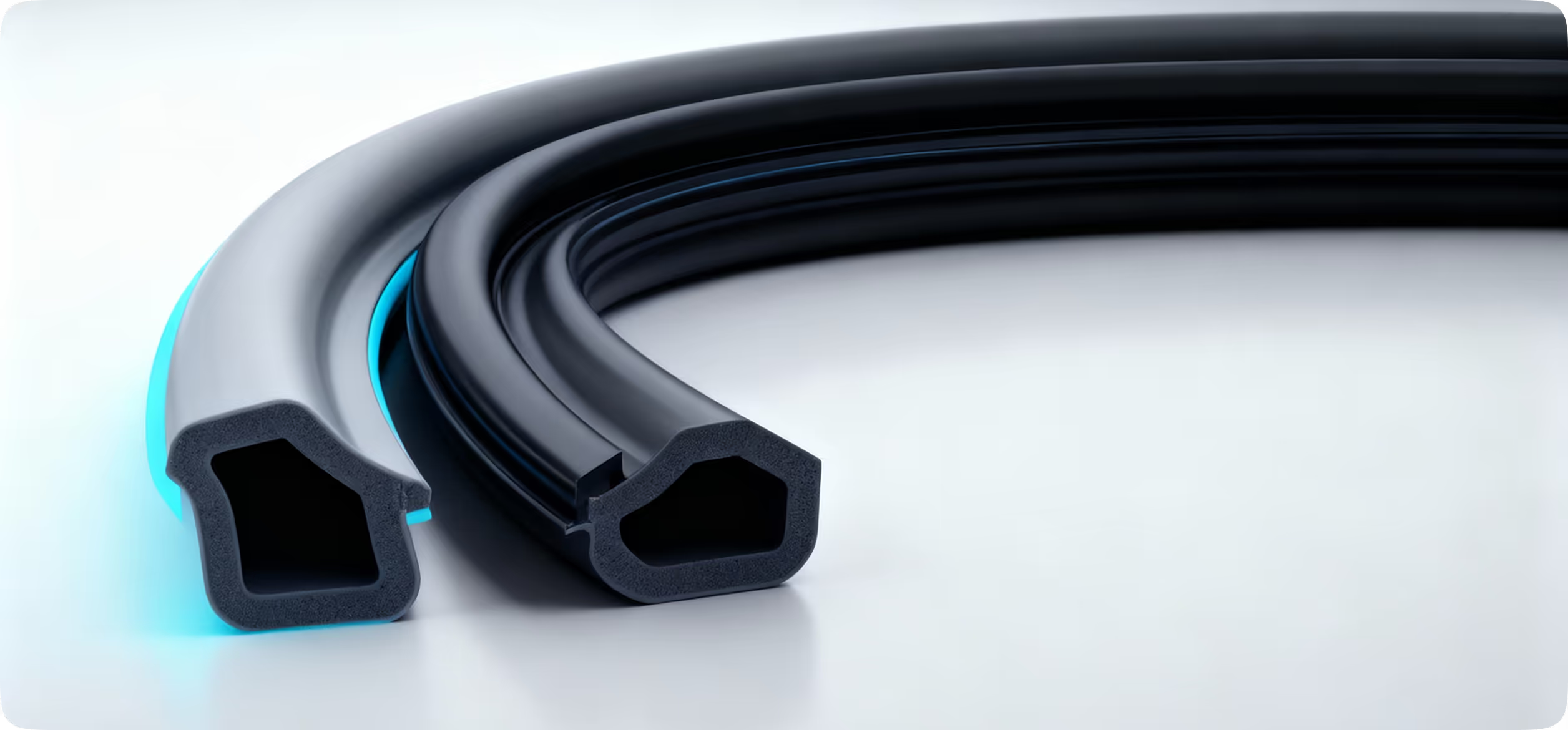
Co-extrusion solves it by extruding two or more compounds together through a shared die so they cure into one continuous profile with a permanent bond at the interface. A single part then delivers both structural retention and pliable sealing. The engineering benefits compound:
Co-extrusion also supports combinations beyond hardness: solid and sponge sections in one profile, where the sponge compresses under light closing force while the solid section carries load; and colour differentiation, where a contrasting strip aids correct orientation during fitting. The constraint to design against is cure compatibility — the two compounds must cross-link under the same conditions and bond reliably to each other, which is a formulation question best settled at the concept stage rather than after the die is cut.
Where a design currently uses a hard carrier and a separate soft seal, it is worth asking whether a co-extruded profile could consolidate them. The answer is often yes, and the saving is usually larger than the part price suggests because it removes an assembly operation as well.
Reverse-engineering an obsolete profile
The other common driver for custom extrusion is the part you can no longer buy. A profile whose original supplier has exited the market, a seal for a machine that has outlived its manufacturer, a fifteen-year-old facade system with no surviving documentation — the equipment is fine, the seal has perished, and there is no drawing anywhere.
Working from a physical sample, the reproduction route runs as follows:
Two things are worth saying plainly about this route. First, a worn sample is still a usable starting point — it is normal, and reconstructing as-new geometry from a compressed or weathered part is a routine part of the work. Second, reproduction is an opportunity, not just a rescue: if the original failed because the compound was wrong for the environment, matching it exactly would only repeat the failure. We would rather match the geometry and upgrade the material.
For framed seals — door and window perimeters, hatch surrounds — the reproduced profile can then be spliced and vulcanised into the original closed geometry, which is how a like-for-like replacement is delivered for an assembly that was never available as a straight length.
What 'precision' actually means in extrusion
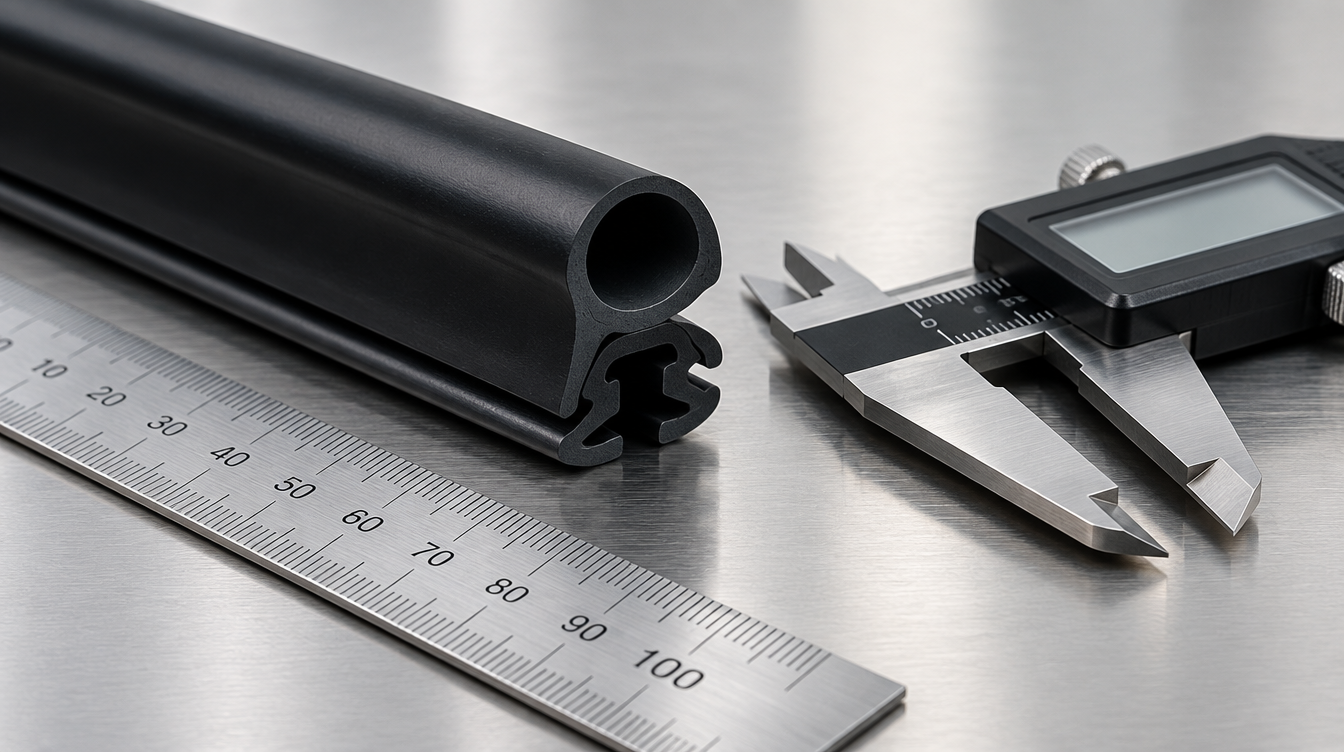
Precision is not uniform tightness across every dimension — that is expensive, unachievable on complex sections, and usually unnecessary. Precision is identifying which dimensions make the part function and controlling those.
On a sealing profile, that is typically the lip thickness that determines contact force, the retention groove width that determines whether it stays in the channel, and the overall height that determines compression at closure. Those get tight tolerances, purpose-cut tooling and continuous in-process measurement. Non-critical features get appropriate latitude. A manufacturer who tells you which dimensions they will hold tightly, and which are inherently looser on your geometry, is being more useful than one who promises everything equally.
Prototyping and hand-off to volume
Rapid prototyping proves the design before tooling is committed to volume. A prototype run confirms the die produces the intended geometry, the compound meets the performance targets, and the profile assembles and seals as designed. Catching a geometry or material issue at the prototype stage costs a die adjustment; catching it after a production run costs a production run.
With the design proven, the profile moves to volume with the die, compound recipe, critical dimensions and QC criteria all locked — which is what turns a custom development into a repeatable, documented part rather than a one-off nobody can reproduce in three years' time.
Custom extrusion is where rubber engineering earns its keep: a profile shaped exactly to the problem, in a compound matched to the environment, held to the tolerances that matter and proven before it scales. It turns a sealing challenge that stock parts cannot solve into a production component you can rely on.
Key takeaways
Have an engineered sealing challenge, a two-part seal worth consolidating, or an obsolete profile to revive? Send us your drawing or sample and we will design the die, select the compound and validate a precision extrusion built for your application.
Need a custom sealing solution?
Talk to our engineers about inflatable seals, rubber diaphragms and custom extrusions built to your exact spec. We respond within one business day.
Frequently asked questions
Can you co-extrude sponge and solid rubber in one profile?
Yes. A solid section carrying load with a sponge section sealing under light closing force is a common and effective combination — the constraint is that both compounds must cure compatibly and bond reliably, which is a formulation decision made at the design stage.
How worn can a sample be and still be usable for reverse engineering?
More worn than most people expect. Compressed, weathered and partially perished samples are routine — reconstructing the as-new cross-section from a degraded part is a normal part of the work. Send what you have.
Should a reproduced profile use the same compound as the original?
Not necessarily, and often it should not. If the original perished because the material was wrong for the environment, matching it exactly reproduces the failure. We match geometry as a requirement and treat the compound as an opportunity to improve service life.

Need a quote?
For custom rubber sealing solutions contact us. We will respond to you within 1 business day


.avif)