.png)


Posted on
September 21, 2026
EN 45545-2 Explained: Hazard Levels, Operation and Design Categories
How EN 45545-2 classifies rail vehicles by operation and design category, sets hazard levels HL1 to HL3, and what that means for fire-safe rubber seals.
EN 45545-2 sets the fire behaviour requirements for materials and components used in rolling stock across Europe. It does not treat every vehicle the same way. A component acceptable in a regional daytime commuter carriage can fail outright in a driverless underground vehicle, because the standard scales its requirements to how exposed passengers actually are to a fire event, not to a single fixed pass or fail bar. For manufacturers of rubber extrusions, gaskets and diaphragms supplying rail door, window and equipment bay applications, understanding that scaling is the difference between a component that clears design review and one returned six months into a rolling stock programme.
This guide walks through the classification logic behind EN 45545-2: how a vehicle is categorised by how it operates, how that combines with vehicle design to set a hazard level, and how that hazard level determines which requirement set a rubber seal, gasket or diaphragm must satisfy. Western Sealtech supplies fire-safe sealing for rail and mass transit, written for engineers and buyers who specify those components.
What is EN 45545-2?
EN 45545-2 is one part of the wider EN 45545 series, EN 45545-1 through EN 45545-7, published by CEN, the European Committee for Standardization, and it is the part that specifies fire behaviour requirements for materials and products used throughout a vehicle's interior, underframe and equipment bays. It sets pass criteria for flame spread, heat release, smoke production and the toxicity of combustion gases, tested to defined methods referenced within the standard and its supporting test standards. The series as a whole covers vehicle level fire safety requirements (EN 45545-1), material and product requirements (EN 45545-2), fire barrier resistance (EN 45545-3), rolling stock design (EN 45545-4), electrical equipment including cables (EN 45545-5), fire control and management systems (EN 45545-6), and flammable liquid and gas installations (EN 45545-7).
EN 45545-2 touches the greatest number of individual components on a vehicle, since almost every non-metallic material inside, underneath and around a passenger vehicle falls under one of its product categories, including seating, flooring, wall and ceiling panels, cable insulation and, critically here, elastomeric seals, gaskets, extrusions, diaphragms and hoses used in doors, windows, HVAC ducting and equipment enclosures. Compliance is demonstrated component by component, compound by compound, against the requirement set for that product category at the hazard level required, supported by a test report from an accredited laboratory, not a one line datasheet statement.
Operation categories and design categories
Before EN 45545-2 tells you which fire performance a material needs, EN 45545-1 first tells you how to classify the vehicle itself. This classification runs on two independent axes, operation category and design category, and the combination of the two is what ultimately drives the hazard level.
Operation category reflects how passengers would realistically evacuate in the event of a fire. Category 1 covers vehicles that can stop and evacuate quickly, such as regional and suburban trains with frequent stops and short distances between platforms. Category 2 covers vehicles with longer distances between safe evacuation points, such as intercity and long distance trains that may run for extended periods between stations. Category 3 covers vehicles running mostly underground or in tunnels, where evacuation is inherently harder and slower and where smoke behaves differently than in open air. Category 4 covers driverless or automated vehicles, including many metro systems, where there may be no onboard staff available to assist an evacuation, which raises the baseline risk profile even for a vehicle that otherwise resembles a Category 1 or 2 service. The logic is straightforward: the harder and slower it is to get passengers out, the less margin there is for a fire to develop before everyone is clear, and so the stricter the material requirements need to be.
Layered onto operation category is design category, reflecting how physically exposed a passenger compartment is to fire spread and smoke. Design categories range from Design Category N, the standard single deck, single section configuration, up to more exposed configurations including double deck vehicles, vehicles with sleeping compartments, and other layouts where compartmentalisation, sightlines or evacuation routes make a fire event more dangerous than a standard single level layout. A double deck intercity vehicle and a single deck regional vehicle can share the same operation category, but the double deck vehicle's design category typically pushes it toward a higher hazard level, since a fire on the lower deck is harder to escape than the same fire in a single level saloon.
Operation category and design category are set by the vehicle operator or integrator, not the component supplier. A seal or gasket manufacturer's job is to supply material qualified to the hazard level and requirement set specified, not to reclassify the vehicle.
Hazard levels HL1, HL2 and HL3
The combination of operation category and design category is mapped, via a table inside EN 45545-1, to one of three hazard levels: HL1, HL2 or HL3. HL1 represents the lowest fire risk exposure, applying where evacuation is comparatively fast and straightforward. HL2 sits in the middle, applying to configurations with either a harder evacuation profile or a more exposed design category, but not both together. HL3 represents the highest fire risk exposure, typically applying to configurations that combine a difficult evacuation profile, such as Category 3 or 4 operation, with a more exposed design category.
A higher hazard level does not mean "more fire resistant" in a vague, general sense. It means the material has to meet a stricter, specific combination of test requirement sets for flame spread, heat release, smoke production and toxicity, at correspondingly lower pass thresholds for each measured property. The test methods used are frequently the same across hazard levels for a given product category, but the numerical threshold each material must clear becomes tighter as hazard level increases. A supplier who says a compound is "EN 45545-2 compliant" without stating a hazard level has told you almost nothing useful, since a compound qualified only at HL1 may be entirely unsuitable for an HL3 metro application. Buyers evaluating o-rings, rubber profiles or rubber cord for a rail application should always ask which hazard level a stated compliance claim actually supports.
Materials and elastomer options for fire-safe rail sealing
Fire behaviour under EN 45545-2 is a material property, not a product shape property, so the base polymer family a seal is compounded from matters enormously. Ethylene propylene diene monomer rubber, EPDM, is widely used in rail door seals, window glazing gaskets and HVAC duct seals because of its strong ozone, UV and weathering resistance, good compression set behaviour across a broad temperature range, and compatibility with the outdoor and semi exposed environments a rail vehicle experiences over its service life. Standard EPDM compounds are not inherently fire rated, so flame retardant fillers and additive packages are formulated in specifically to reach the flame spread, heat release, smoke and toxicity thresholds a given hazard level requires.
Silicone rubber offers a wide operating temperature range, low smoke generation relative to many organic elastomers, and generally favourable toxicity characteristics when it does combust, which makes it a frequently specified material for high hazard level applications, including cable insulation, gaskets in equipment bays, and extruded seals near sources of heat. Fluoroelastomers such as FKM, often referred to by the trade name Viton, and fluorosilicone blends offer excellent chemical resistance and high temperature performance, used selectively where a seal is exposed to fuels, hydraulic fluids or lubricants alongside a fire performance requirement. These materials carry a higher unit cost than EPDM or general purpose silicone, so they are typically reserved for locations where chemical resistance is genuinely needed alongside the fire rating. Closed cell sponge extruded seals and spliced and joined sponge seals are used where compression set behaviour and low closing force matter, such as door edge and window perimeter seals, and because a cellular structure changes the surface area exposed to flame compared with a solid section of the same polymer, sponge and cellular constructions are generally treated as their own tested configuration.
Two EPDM door seals that look identical to the eye can behave completely differently under EN 45545-2. The base polymer, the flame retardant package, the plasticiser system and even the carbon black or mineral filler loading all affect flame spread, smoke density and toxic gas yield. A compound qualified for HL3 service is a genuinely different formulation from one only qualified for HL1, not the same rubber with a different label. Western Sealtech's own EN 45545-2 fire testing was carried out by CREPIM, the Centre de Recherche et d'Expertise sur les Polymeres et Materiaux in Bruay-la-Buissiere, France, under report number DO-25-7151/A-R1, dated 13 May 2025. The reported compound toxicity value came in at 0.07, below the specified limit of 0.075, meaning the compound meets the specified toxicity requirement.
Requirement sets and where rubber sits
Hazard level maps onto specific requirement sets, denoted R1 through R26 across EN 45545-2 Table 6, with each requirement set number tied to a defined product category, such as interior wall and ceiling panels, floor coverings, seating components, electric cable, or seals and gaskets. For elastomeric seals, gaskets and similar rubber components, the requirement sets most commonly cited are in the R22 to R24 range, which govern items classed broadly under seals and sealing components used across a range of interior and equipment locations. The exact requirement set that applies to a specific rubber part depends on both the product category the part is classified under, a function of where and how it is used, and the hazard level of the vehicle it is fitted to.
When a supplier quotes "R22" or "R23" without also stating the hazard level achieved, ask for both. A pass at HL1 thresholds is not the same evidence as a pass at HL3 thresholds against the same requirement set number, because pass criteria for flame spread, heat release, smoke density and toxicity tighten as hazard level rises. Western Sealtech's current qualified compounds, commercial reference EPDM70-0005 and SL-40, are both qualified against the R22/R23 requirement set at Hazard Level 3, our internal compound index cross references each against its test report so procurement teams can match a project's requirement set directly to a named Western Sealtech compound.
Applications across the vehicle
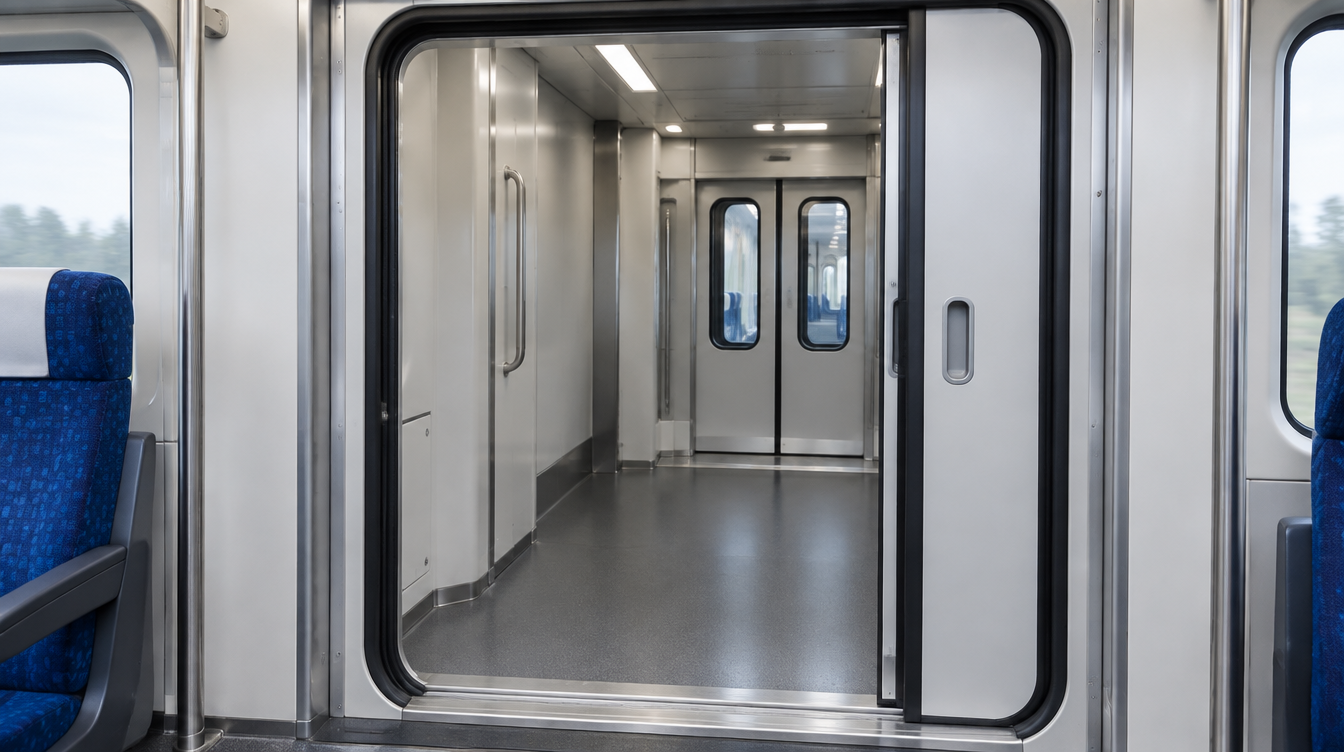
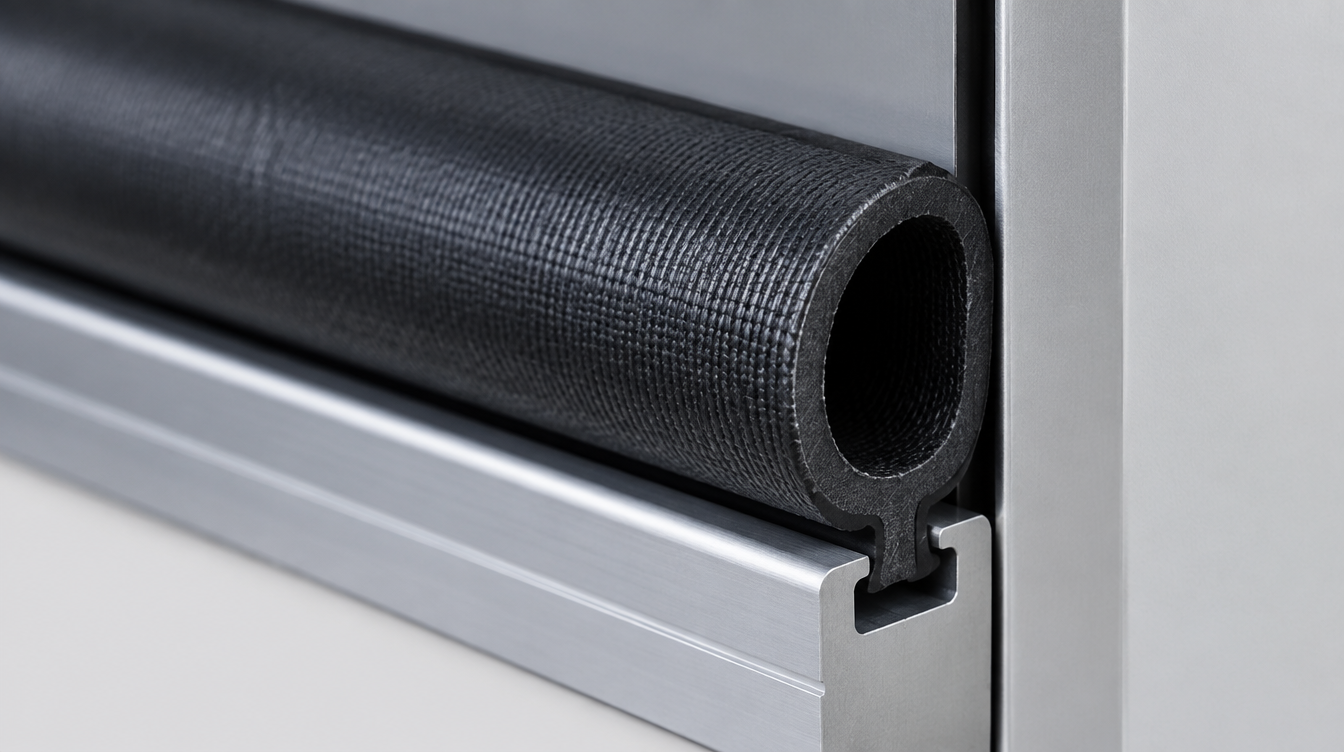
EN 45545-2 requirements follow the component, not just the room it sits in, so fire-rated rubber sealing turns up in more places on a rail vehicle than most non specialist buyers expect. Passenger door edge seals, threshold seals and vestibule gap seals see constant mechanical cycling alongside fire performance requirements, since a worn door seal can change how it performs in a fire test if its geometry no longer matches the qualified sample. Dovetail seals and snap-in seals allow field replacement without adhesives, and window perimeter seals and glazing gaskets, often supplied as spliced and vulcanised seals forming a continuous endless loop, must satisfy weathering and fire performance requirements simultaneously across years of UV and thermal cycling exposure.
Gaskets and extruded profiles used in HVAC ducting, filter housings and damper seals are frequently specified in silicone or fire rated EPDM given the temperature exposure and the fact that ducting runs through concealed spaces where fire could spread undetected. Enclosure gaskets, cable gland seals and metal bonded seals around electrical and traction equipment must satisfy EN 45545-2 while also meeting environmental sealing requirements against water, dust and, in some locations, oil or hydraulic fluid, which is where FKM and fluorosilicone are more often specified alongside EPDM.
How to specify a fire-safe rail seal
Specifying a rubber seal or gasket for a rail programme means working through several linked variables at once, and getting one wrong tends to surface late, often at vehicle level fire testing or homologation, the most expensive point in the programme to discover a mismatch. Before discussing compound chemistry, hardness or colour, confirm in writing which hazard level and which requirement set applies to the specific product category your seal falls under. This should come from the vehicle operator's or integrator's technical specification, not be assumed from the general vehicle type.
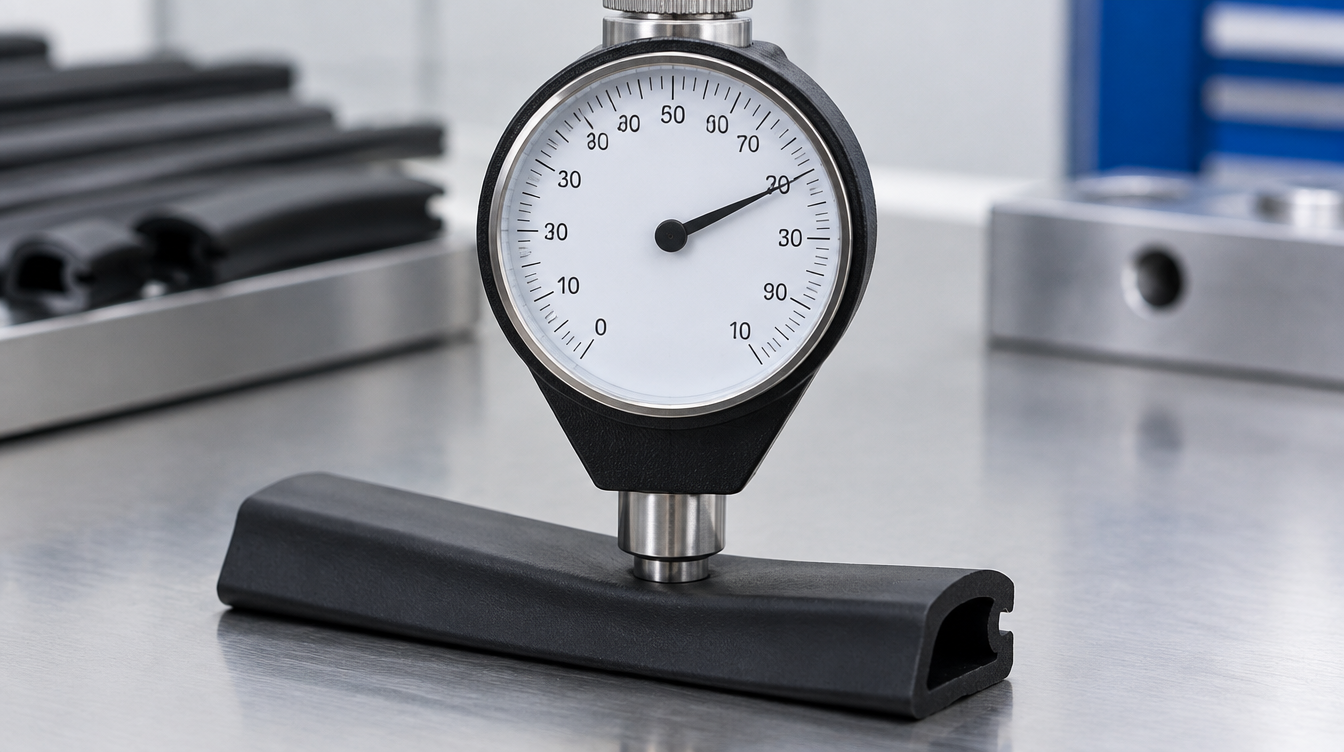
Once the fire performance requirement is fixed, the seal still has to do its mechanical job. Shore A hardness, compression set, tensile strength and elongation at break all need to suit the sealing geometry, the compression range in service, and the expected service temperature range, since a compound that is fire rated but mechanically wrong for the joint will fail on sealing performance regardless of its EN 45545-2 result. A test report generated on a flat sheet sample does not automatically transfer to an extruded hollow profile or a dovetail cross section of different wall thickness, so confirm the tested sample construction matches, or has been formally justified as equivalent to, the actual part.
Manufacturing and customisation for rail programmes
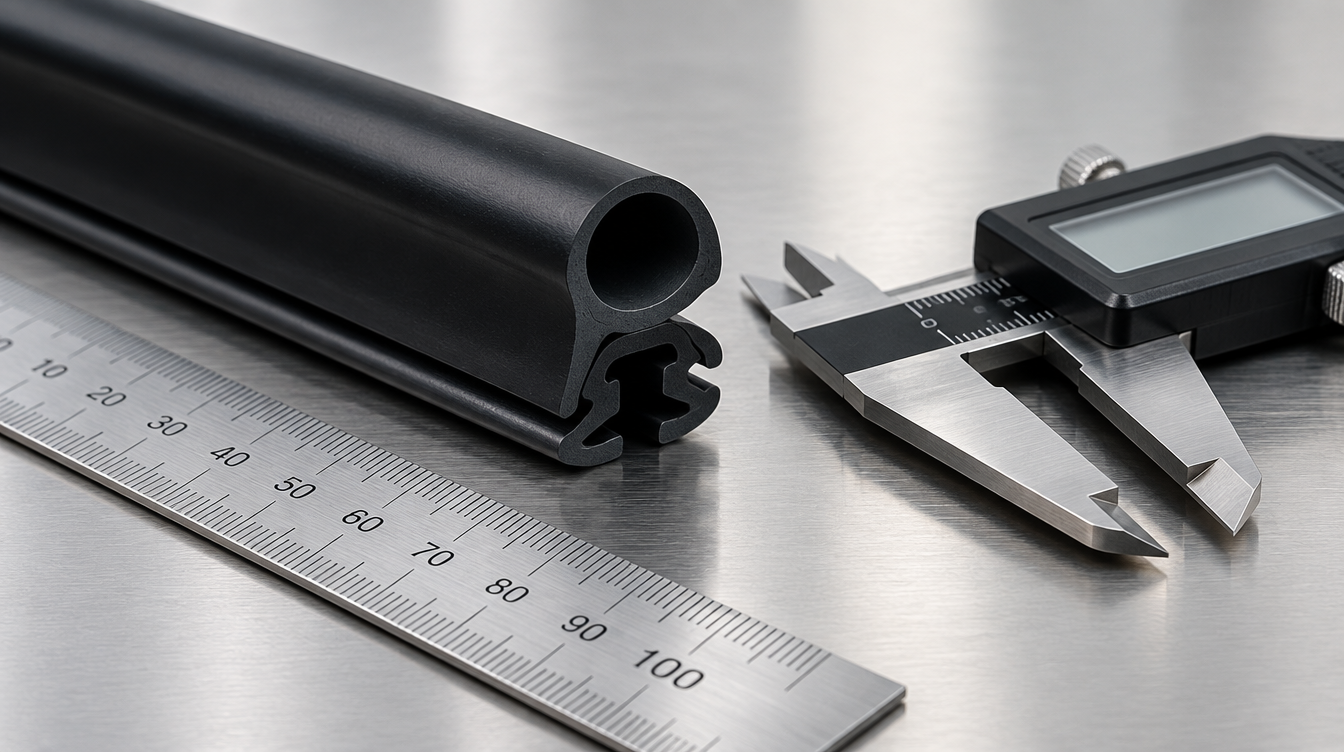
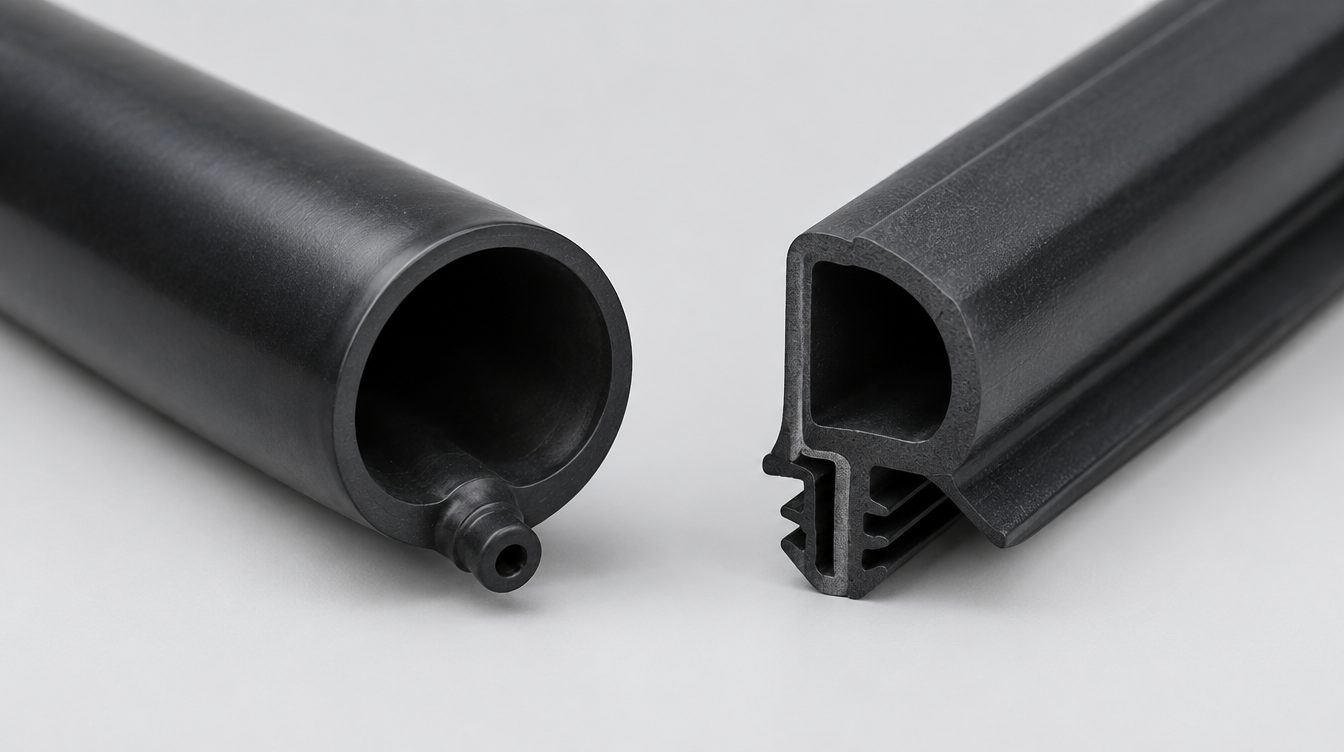
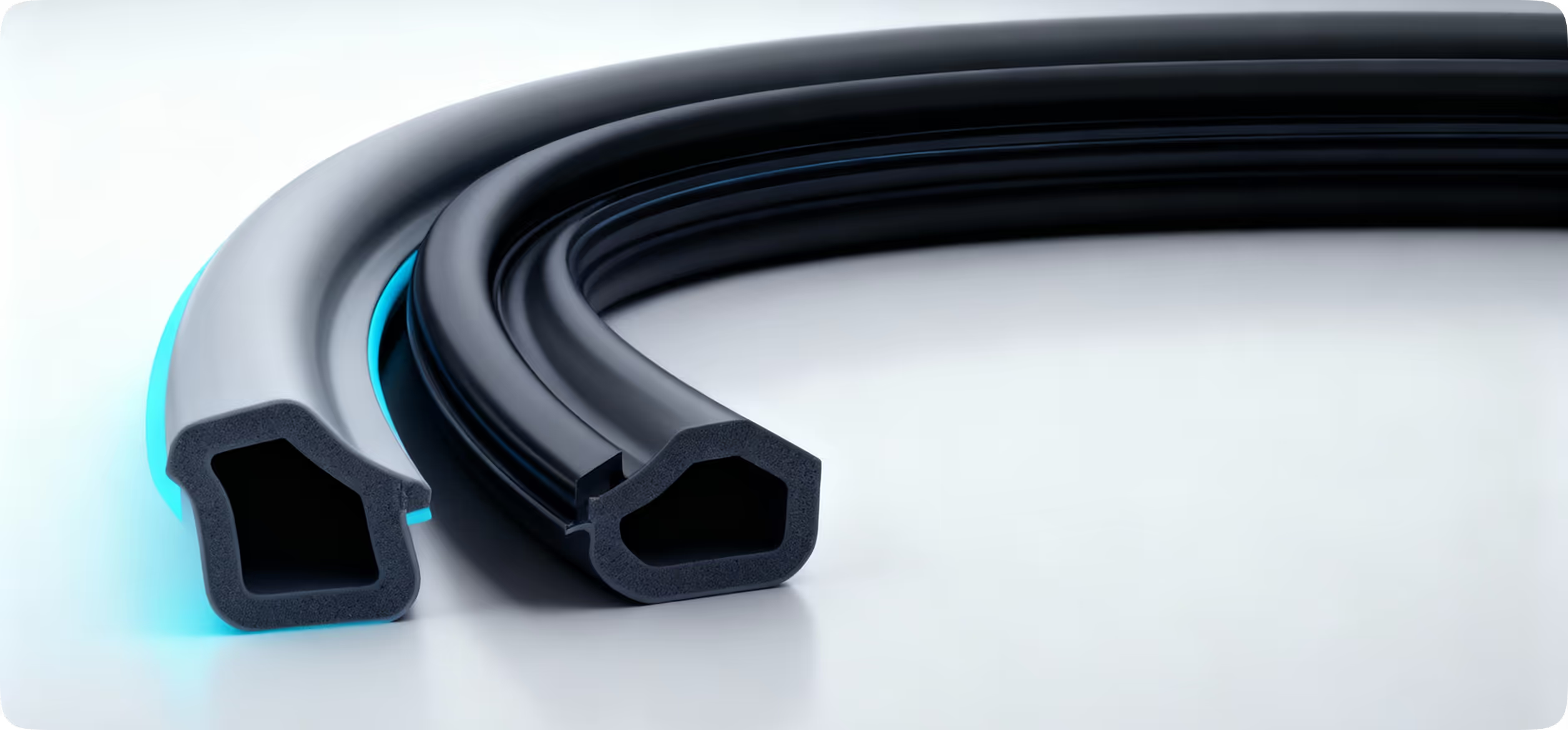
Fire rated rail seals are typically produced through extrusion for continuous profile lengths, followed by vulcanised splicing to form a continuous endless loop for door and window openings, or through compression or injection moulding for more complex, non continuous shapes such as grommets and equipment bay gaskets. Extruded profiles are cut to length and joined using a vulcanised splice to form a seamless loop, avoiding the mechanical and fire performance weak point an unbonded cut joint would otherwise create, and tooling has to reproduce the exact cross section originally fire tested.
Custom moulded seals combine multiple functions, such as a sealing lip and a mounting feature, in a single component, reducing part count versus cut and joined extrusion. Rail programmes typically run low to medium volumes but over long production lifecycles, sometimes decades of spares supply, so tooling investment, minimum order quantities and compound traceability need planning around that full lifecycle, since a reformulation years into a spares contract would require re-qualification against the original test basis.
Quality, testing and compliance
Because EN 45545-2 compliance is demonstrated at the compound and product category level rather than as a blanket company wide certificate, quality systems around fire rated rail sealing need to track compound identity, test report validity and formulation changes over time, not just dimensional and mechanical QC at shipment. Every batch of a fire rated compound should be traceable back to the specific internal compound code that was tested, so a change control process can flag if a formulation adjustment, whether for cost, availability or performance reasons, would require re-testing before the changed compound can continue to be supplied under the same compliance claim.
Rail sealing compounds are also commonly tested against general elastomer standards from bodies such as ISO and ASTM for baseline mechanical properties. The EN 45545 series itself is published and maintained through CEN, the European Committee for Standardization, referenced within the interoperability framework maintained with rail sector bodies including the International Union of Railways (UIC).
Key takeaways
EN 45545-2 does not ask every rail vehicle to meet the same bar. It scales fire performance requirements to how a vehicle operates and how exposed its passengers are, and that scaling flows all the way down to which requirement set and hazard level a rubber seal or gasket must be qualified against. Specifying correctly means confirming hazard level in writing, matching mechanical performance to the joint, and working with a supplier who can show a named compound against a named test report, not a general compliance claim.
Talk to our engineers about EN 45545-2 tested compounds for your next rolling stock programme, and we will help you match hazard level, requirement set and mechanical performance to your specification before tooling begins.
Need a custom sealing solution?
Talk to our engineers about inflatable seals, rubber diaphragms and custom extrusions built to your exact spec. We respond within one business day.
Frequently asked questions
What is the difference between EN 45545-1 and EN 45545-2?
EN 45545-1 sets out the classification system, including hazard levels and the operation and design category framework used to place a vehicle in context. EN 45545-2 applies that framework to specify the actual fire behaviour requirements for materials and products used in the vehicle, including elastomeric seals, gaskets and diaphragms.
Can the same rubber compound be qualified at more than one hazard level?
Yes, provided it has been tested against the requirement set for each hazard level being claimed, with a traceable test report for each. Western Sealtech's current qualified compounds, EPDM70-0005 and SL-40, are qualified for the R22/R23 requirement set at Hazard Level 3, making our current range single hazard level qualified based on the qualifications currently available.
Who decides which hazard level a specific rail project requires?
The vehicle operator or rolling stock manufacturer, based on the vehicle's operation category and design category as defined in EN 45545-1, typically confirmed in the project's technical specification, interoperability documentation, or National Technical Rules where applicable.

Need a quote?
For custom rubber sealing solutions contact us. We will respond to you within 1 business day


.avif)