.png)


Posted on
September 23, 2026
EN 45545 Compliant Compounds: What Changes in the Formulation and What It Costs in Performance
What actually changes inside a rubber formulation to make it EN 45545 fire compliant, and the mechanical trade-offs that follow if it is not engineered properly.
Making a rubber compound EN 45545 compliant is not a coating or an additive sprayed on at the end of the process. It is a change to the formulation itself, and every one of those changes pulls on some other property of the compound. Anyone specifying rail rubber needs to understand this trade-off, because "just make it fire compliant" is not a request a compounder can fulfil without consequences elsewhere in the part's performance.
This matters most in the parts that see the most duty cycles over a vehicle's service life: door seals, window seals, and the gaskets and profiles behind interior panels and HVAC ducting. A seal that passes fire testing on day one but loses contact force by year two has not actually solved the problem it was specified to solve. This article walks through what changes inside an EN 45545 formulation, why those changes create real trade-offs, and how to write a specification that protects both the fire performance and the mechanical performance a rail operator actually needs.
What is an EN 45545 compliant rubber compound?
EN 45545 is the European standard for fire protection on railway vehicles, and Part 2 of the standard is the section that sets material level requirements: flammability, flame spread, heat release, smoke production and toxicity of combustion gases. A compound is described as EN 45545 compliant when it has been tested against the relevant requirement set, labelled R1 through R26, each tied to a specific component category such as seals, gaskets, floor coverings or cable insulation, and hazard level HL1, HL2 or HL3, corresponding to increasing severity of the operating scenario, with HL3 covering the worst case such as underground and tunnel running vehicles.
That distinction matters because EN 45545 compliant is not a single pass or fail gate. A compound qualified for a door seal under one requirement set and hazard level is not automatically qualified for a different component category or a higher hazard level. A supplier's generic claim of EN 45545 compliant rubber without a stated requirement set and hazard level is not a specification a rail integrator can actually rely on. The full method definitions and pass and fail criteria are published by CEN-CENELEC, the European standards body responsible for EN 45545.
How fire compliance is engineered into a formulation
Rubber compounding is a balancing act even before fire performance enters the picture. A compounder is already juggling hardness, tensile strength, elongation, compression set, ozone and UV resistance, and processability, all from the same recipe of base polymer, fillers, plasticisers, curatives and additives. Fire compliance adds another axis to that balance, and it is not a free one.
The physical mechanisms a formulation can use to pass fire testing generally fall into a few categories: reducing the amount of combustible material available to burn through dilution with inert or mineral filler, interrupting the combustion chemistry itself through flame retardant chemistry that either releases water vapour under heat or interferes with the free radical chain reaction of combustion, and promoting char formation on the surface, which insulates the material underneath from further heat and starves the flame of fuel. Halogen-free approaches, which the rail industry strongly prefers because halogenated flame retardants tend to generate more toxic and corrosive smoke, rely heavily on the first and third mechanisms: high loadings of mineral fillers that both dilute the combustible fraction and decompose endothermically to release water vapour and promote char. Every one of those mechanisms changes the physical structure of the cured rubber network, and higher filler loading stiffens the compound and increases the volume fraction of non-elastomeric material in the matrix. That is the root of the trade-off explored through the rest of this article, and it is why fire compliance has to be designed into a compound from the start rather than treated as a checkbox added after mechanical properties have already been optimised.
Base polymer choice: EPDM, silicone and FKM
Before flame retardant packages even enter the discussion, the base polymer sets a ceiling on what is achievable. EPDM is the workhorse elastomer for rail door and window seals because of its excellent weathering, ozone and UV resistance, good low temperature flexibility and reasonable cost. As a fully organic, hydrocarbon based polymer, however, it is inherently combustible, which means reaching EN 45545 hazard levels, particularly HL3, requires a substantial flame retardant filler package. That package is exactly what creates the mechanical trade-offs discussed later in this article.
Silicone tends to perform well on smoke and toxicity criteria because of its inorganic, silicon-oxygen backbone. When silicone does combust, it tends to form a silica based char rather than releasing the dense, toxic smoke associated with many organic polymers under fire conditions, sometimes allowing a lighter flame retardant additive package to reach the same hazard level compared with EPDM. Silicone's trade-offs lie elsewhere, in generally lower tear strength and higher material cost, which is why it tends to be specified selectively rather than as a universal replacement for EPDM across every seal on a vehicle. FKM brings excellent chemical and heat resistance and is used where fluid or extreme temperature exposure rules out EPDM, but it is a significantly more expensive polymer and less commonly the default choice for standard door and window seal applications. Where a rail application combines fire rated exposure with aggressive fluid or lubricant contact, such as certain actuator and valve sealing applications adjacent to the traction and braking systems, FKM becomes a genuine candidate worth evaluating against the fire and mechanical requirement together.
What actually changes in an EN 45545 formulation
With the base polymer chosen, four things in the formulation typically change when a compound is engineered to pass EN 45545-2, and each one has a downstream mechanical consequence. Halogen-free mineral fillers, most commonly aluminium trihydrate or magnesium hydroxide, are loaded at levels far higher than a standard industrial compound would use, specifically to physically suppress combustion and reduce smoke generation, decomposing endothermically at elevated temperature to release water vapour that cools the material and dilutes the combustible gases while leaving a mineral residue that supports char formation. Many standard plasticisers used to improve processability and low temperature flexibility are themselves flammable or contribute meaningfully to smoke and toxicity under fire exposure, so in an EN 45545 formulation these are reduced in overall loading or replaced with lower smoke alternative plasticiser chemistries, which can shift low temperature flexibility and processing behaviour and requires re-optimisation elsewhere in the recipe.
The dramatically higher filler loading also changes the compound's cure kinetics: cure rate, scorch safety and the ultimate crosslink density achieved can all shift when the filler to polymer ratio moves this far from a standard formulation, which often requires the cure package, accelerator type and loading, sulfur or peroxide level, and cure time and temperature, to be re-balanced specifically to maintain proper crosslink density in the presence of the higher filler loading. Skipping this step is one of the most common causes of a fire compliant compound that underperforms mechanically. Carbon black and pigment levels are adjusted to manage both the compound's physical properties, reinforcement, UV protection, colour, and in some formulations to contribute to char formation behaviour under fire exposure, and because the flame retardant filler package already occupies a large share of the compound's total filler budget, carbon black and pigment loading has to be re-optimised around it rather than simply added on top. The core trade-off in one sentence: every mechanism used to improve fire performance works by changing the ratio of elastomer to non-elastomeric filler in the cured network, and that same ratio is what governs compression set, tensile strength and elongation.
Key properties and performance criteria
A compound engineered well will minimise the trade-offs described above through cure system balancing and careful filler selection, but a compound where fire compliance was simply added on late in development will show these effects clearly, often failing compression set requirements even though it passes the fire tests. This is the single most important thing to understand about EN 45545 compounds: passing the fire test and performing well in service are two different engineering outcomes, and one does not guarantee the other. The properties that matter most for verifying a fire rated compound has been properly engineered are compression set at a stated temperature and duration, the single best indicator of how well a seal will hold contact force over years of duty cycles; tensile strength and elongation at break, which indicate whether crosslink density and filler dispersion are properly balanced rather than over-loaded to the point of embrittlement; hardness on the Shore A durometer scale, since higher filler loading tends to raise hardness; low temperature flexibility, particularly relevant where plasticiser systems have changed; and tear strength, especially for extruded profiles with thin sections where a nick can propagate.
Applications: door seals, window seals and beyond
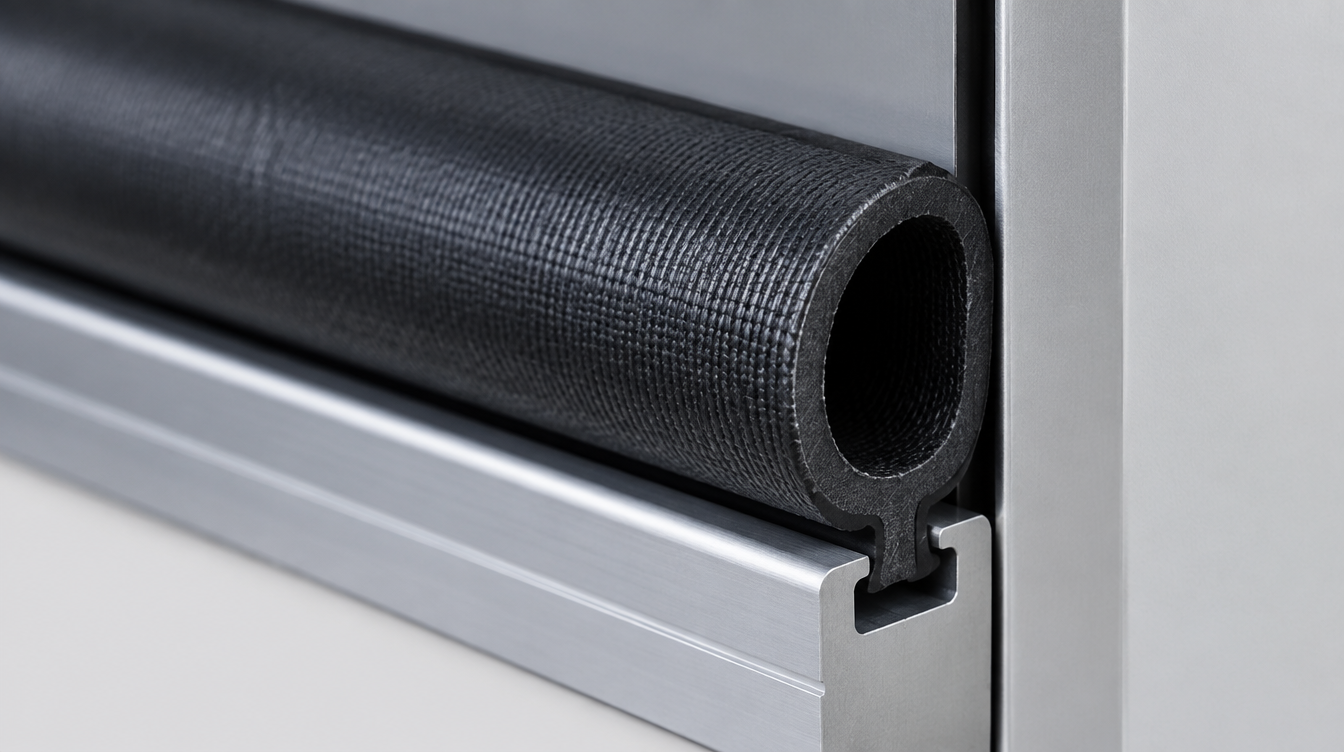
Compression set is the property most directly tied to real world sealing performance, because a seal that takes a permanent set loses contact force and starts leaking, whistling or admitting water. Door seals on passenger rolling stock cycle thousands of times per year, and the seal has to maintain acoustic and weather sealing performance under that duty cycle while also carrying an EN 45545 rating on many programmes. An EN 45545 compound formulated purely to pass fire testing, without equal attention to compression set, can pass certification and still underperform in service within a year or two, showing up as whistling at speed, water ingress, or draughts that passengers and maintenance teams notice long before scheduled replacement. Window seals and glazing gaskets see less mechanical cycling but are exposed to sustained UV, thermal cycling and, on many vehicle designs, direct sun loading through glass that raises local temperature significantly above ambient, and a compound with marginal compression set performance under these conditions gradually loses grip on the glazing. Beyond visible seals, EN 45545 rated gaskets, extruded profiles and rubber cord appear throughout HVAC ducting joints, underfloor equipment enclosures and interior trim assembly, each carrying its own requirement set and hazard level.
Material comparison for EN 45545 compliance
EPDM, silicone and FKM typically compare as follows when engineered for EN 45545 compliance in rail door and window seal applications. EPDM requires a substantial additive package to reach favourable smoke and toxicity behaviour, carries a high flame retardant filler burden, offers excellent weathering and good low temperature flexibility, good tear strength, and sits at the lower end of relative material cost, making it the typical choice for door and window seals and general profiles. Silicone starts from a favourable inorganic backbone needing a lower to moderate additive burden, offers excellent weathering, very good low temperature flexibility, lower tear strength, and higher relative cost, making it a selective choice for zones where smoke and toxicity criticality is highest. FKM sits at moderate additive burden with excellent weathering, fair and grade dependent low temperature flexibility, good tear strength, and the highest relative cost, making it suited to fluid or heat exposed components adjacent to fire rated zones.
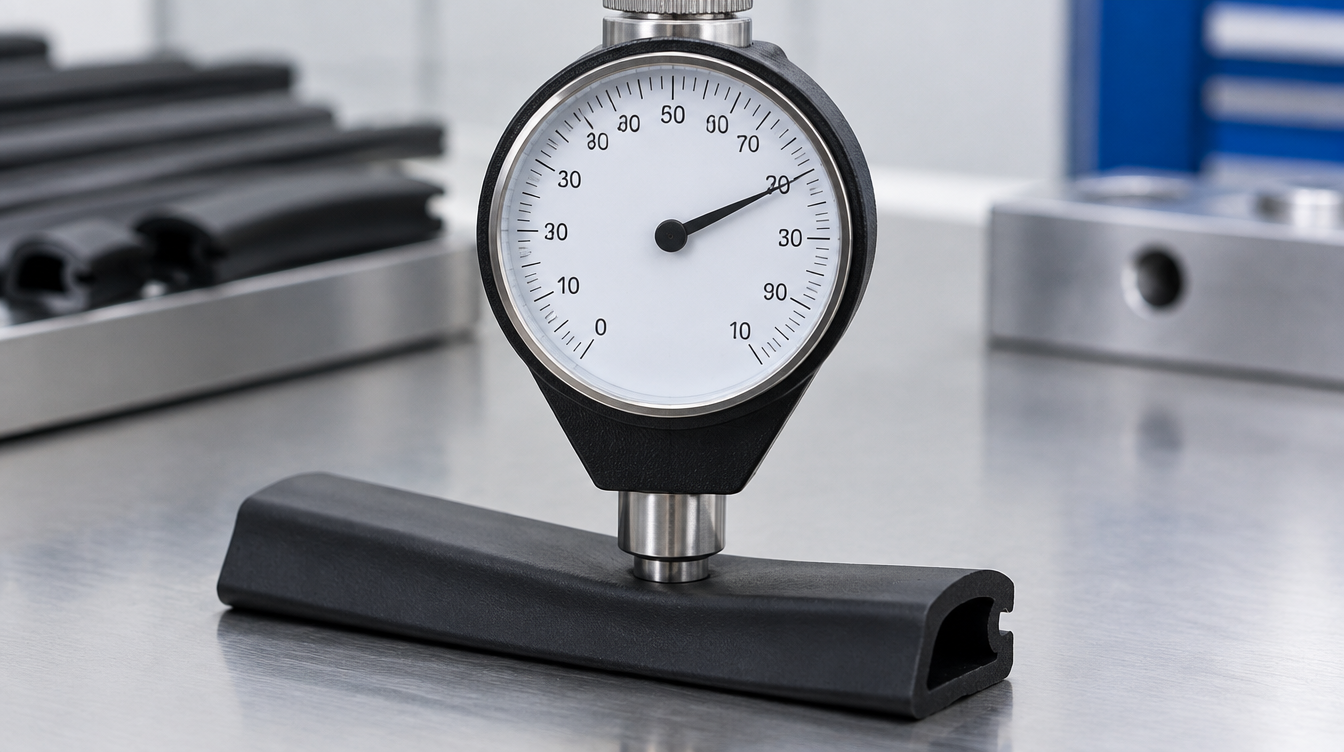
As a worked example of the compression set and tensile trade-off in practice, one of our qualified EN 45545 EPDM compounds tests at 69 Shore A hardness against a 70 plus or minus 5 specification, 4.5 MPa tensile strength, 3.43 MPa modulus at 300% elongation, and 550% elongation at break, all measured to ASTM D 2240 and ASTM D 412. These figures illustrate a properly cure balanced fire rated EPDM, not an over-filled compound that has simply been pushed until the fire test passes.
How to specify around the trade-off
Rather than specifying EN 45545 compliant EPDM and leaving the mechanical trade-off to chance, a specification should state both halves of the requirement explicitly: the exact fire requirement set and hazard level, not a generic fire rated callout; minimum compression set at a stated temperature and duration relevant to the vehicle's service environment; minimum tensile strength and elongation at break; and a hardness range appropriate to the sealing force the design assumes. Then ask the supplier to confirm all of these properties from actual test data on the same compound batch that was fire tested, not generic published figures for the base polymer in its non-fire-rated form. This single request separates suppliers who have genuinely engineered around the trade-off from those who have simply added flame retardant filler until the fire test passed.
Our own compound is prepared in a two-stage mixing process. In the first stage, a master batch is prepared using a kneader, incorporating the required filler, processing aid, antioxidant and activator. In the second stage, the required curative and cure package is added on a two-roll mill to produce the final compound, which is then allowed to age for 24 hours before further processing or testing. Specific formulation details and ingredient ratios beyond this outline are maintained as proprietary information.
Manufacturing and customisation
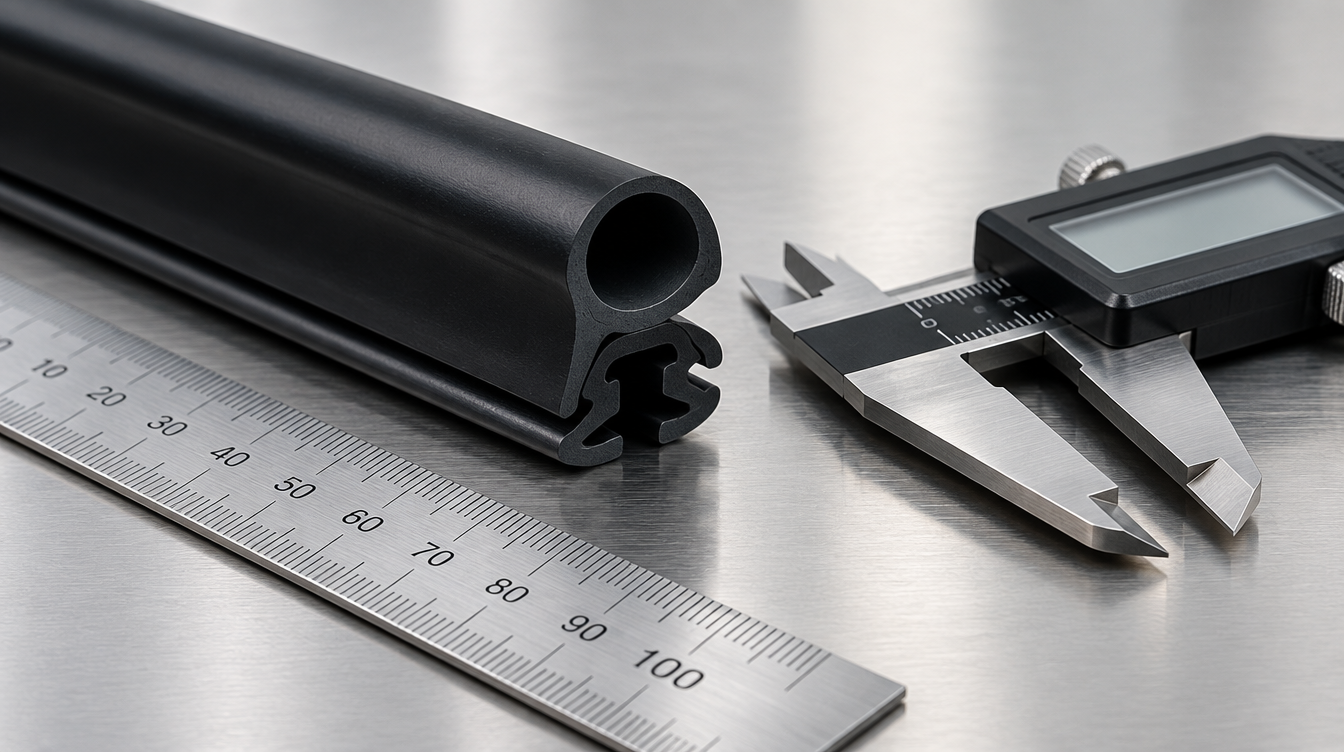
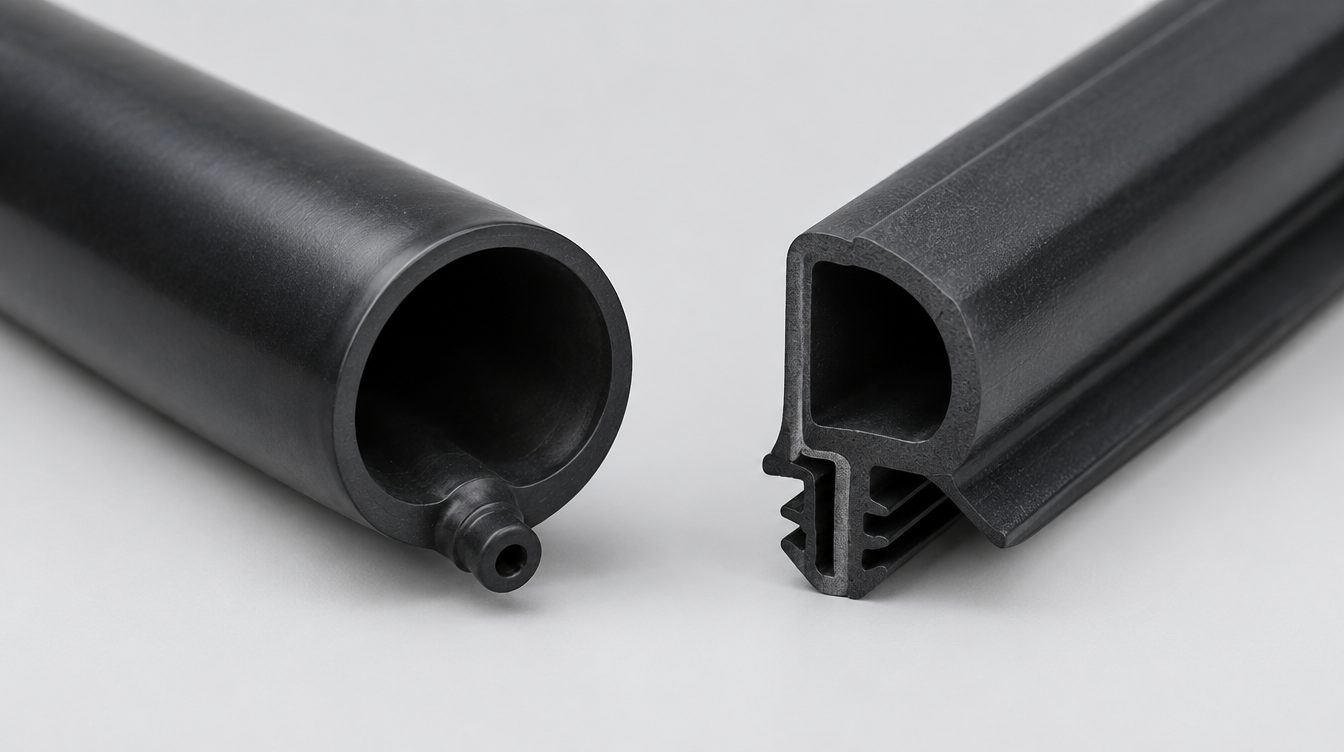
Fire rated compounds behave differently in processing as well as in service, and this affects how they should be manufactured. The higher filler loading typically increases compound viscosity, which can affect flow into mould cavities for custom moulded seals with fine detail or thin sections, and can change extrusion die swell and surface finish for extruded profiles such as dovetail, snap-in and ribbed dovetail seal profiles commonly used on rolling stock door and window frames. For longer continuous seal runs and corner joints, splicing and vulcanised joining introduces another variable, since the joint area needs to achieve both the fire performance and the mechanical integrity of the parent profile. Tooling for fire rated compounds sometimes needs adjustment, venting, gate design, cure time, specifically because of the changed flow and cure behaviour, and minimum order quantities and lead times can be affected where a compound needs to be custom developed or requalified rather than pulled from an existing qualified formulation.
Quality, testing and compliance documentation
EN 45545-2 testing is conducted against defined methods for flame spread, heat release, smoke density and toxic gas generation, and a compound's compliance is only as good as the batch traceability behind the test report. Full method definitions and the underlying calculation approach are published through CEN-CENELEC, and the international rail sector body UIC publishes broader guidance relevant to fire safety across European and international rail operations. Where a formulation also needs to demonstrate general material performance beyond the fire specific tests, standard elastomer test methods published by ASTM International and ISO typically govern compression set, tensile and hardness testing referenced in the specification. Because many EN 45545 formulations rely on halogen-free mineral flame retardants rather than halogenated chemistries, formulators also track relevant substance restrictions under frameworks such as REACH, administered by the European Chemicals Agency, which is a further reason the halogen-free mineral filler route has become the industry default for rail interior and sealing components.
Key takeaways
Fire compliance and mechanical performance are engineered together or not at all. The formulation changes needed to pass EN 45545-2, higher mineral filler loading, adjusted plasticiser systems, re-balanced cure packages, all pull on compression set, tensile strength and elongation, and a compound that was properly engineered around that trade-off will show it in the test data, not just in the fire test pass. Specify both halves of the requirement, and ask for both halves of the proof.
Send us your requirement set, hazard level and mechanical specification, and our engineers will confirm a compound and construction that meets both without the trade-offs a rushed fire-rated formulation usually carries.
Need a custom sealing solution?
Talk to our engineers about inflatable seals, rubber diaphragms and custom extrusions built to your exact spec. We respond within one business day.
Frequently asked questions
Does an EN 45545 compliant compound always cost more than a standard compound?
Generally yes, because of the higher filler loading and the additional testing and qualification burden, though the size of the premium depends on the base polymer and hazard level required.
Is compression set always worse in an EN 45545 compound?
Not necessarily, if the cure system is properly re-balanced around the higher filler loading. Poorly engineered fire-rated compounds show this effect clearly, while well engineered ones minimise it through deliberate cure system and filler selection work, as our own EPDM compound data shows.
How do I know if a supplier's fire-rated compound has been optimised for mechanical performance too?
Ask for compression set, tensile and elongation data on the actual fire-rated batch, not generic figures for the base polymer, and compare it directly against the requirement stated in your specification.

Need a quote?
For custom rubber sealing solutions contact us. We will respond to you within 1 business day


.avif)