.png)


Posted on
August 14, 2026
How to Choose a Rubber Extrusion Manufacturer or Supplier
A buyer's checklist for choosing a rubber extrusion manufacturer: in-house tooling, material range, tolerances, QC, compliance and prototyping capability.
Choosing a rubber extrusion supplier is a decision you live with for the life of a product. Get it right and you have a partner who holds dimensions, meets compliance and ships on time; get it wrong and you inherit dimensional drift, failed audits and firefighting. This guide sets out the criteria that actually predict a good outcome, so you can evaluate suppliers on capability rather than price alone.
In-house tooling and die design
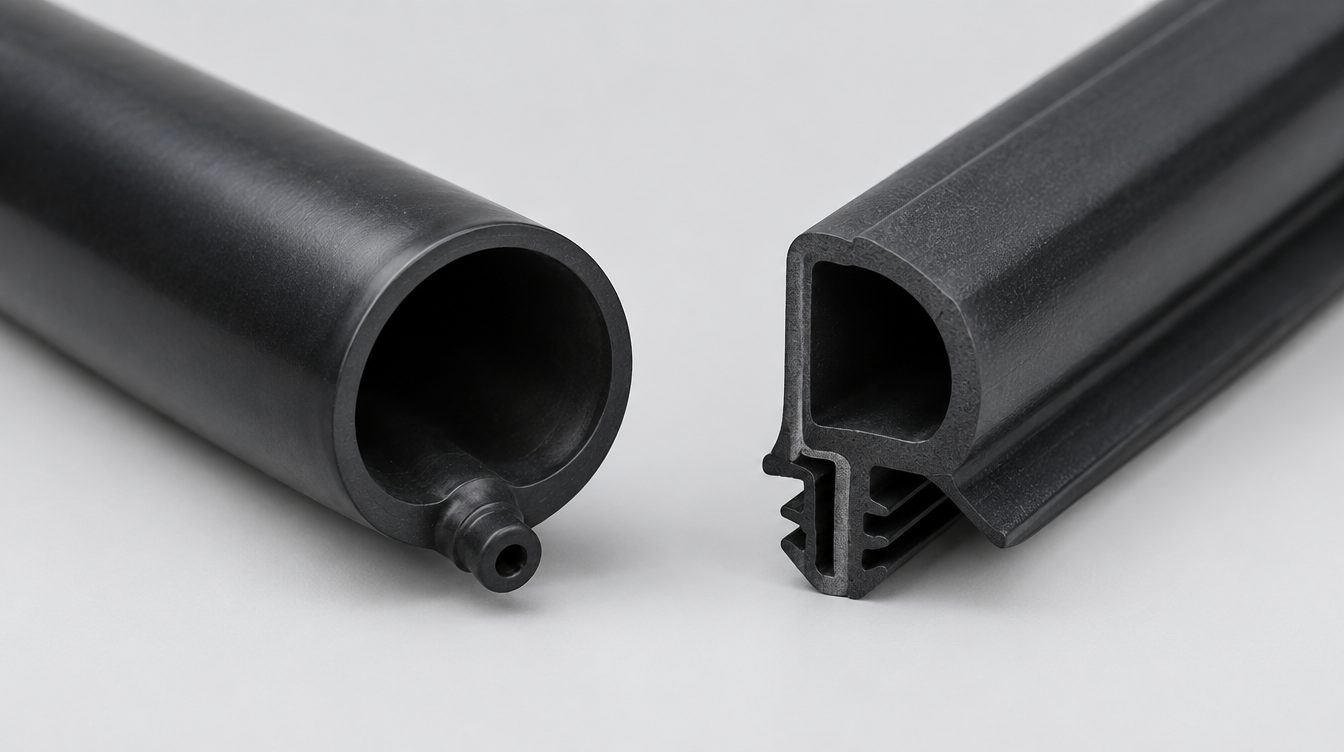
The single most revealing question is whether the manufacturer designs its own dies. Die design is where a drawing becomes a real profile, and it requires compensating for die swell, shrinkage and cure behaviour. A supplier with in-house die capability controls the whole chain from geometry to finished profile, iterates faster when a first article needs adjustment, and does not lose weeks routing tooling changes through a third party. Outsourced tooling is not disqualifying, but in-house capability is a strong signal of a serious manufacturer.
Breadth of material capability
Your application dictates the elastomer, so a supplier's material range determines whether they can serve you at all. Look for a broad portfolio — EPDM, silicone, FKM, NBR, neoprene and TPE at minimum — plus the ability to formulate custom compounds in-house. A supplier who compounds their own material controls a key variable in dimensional and performance consistency, and can tune hardness across a wide range and offer sponge variants when the application calls for them. A narrow material menu forces you to compromise the design to fit the supplier.
In-house compounding matters more than it first appears. A supplier who buys compound in is dependent on someone else's batch consistency, someone else's lead time and someone else's willingness to make a small run of a special formulation. When your application needs a compound tuned to an unusual combination of temperature, chemistry and compliance, that dependency becomes the bottleneck.
Tolerances and process control
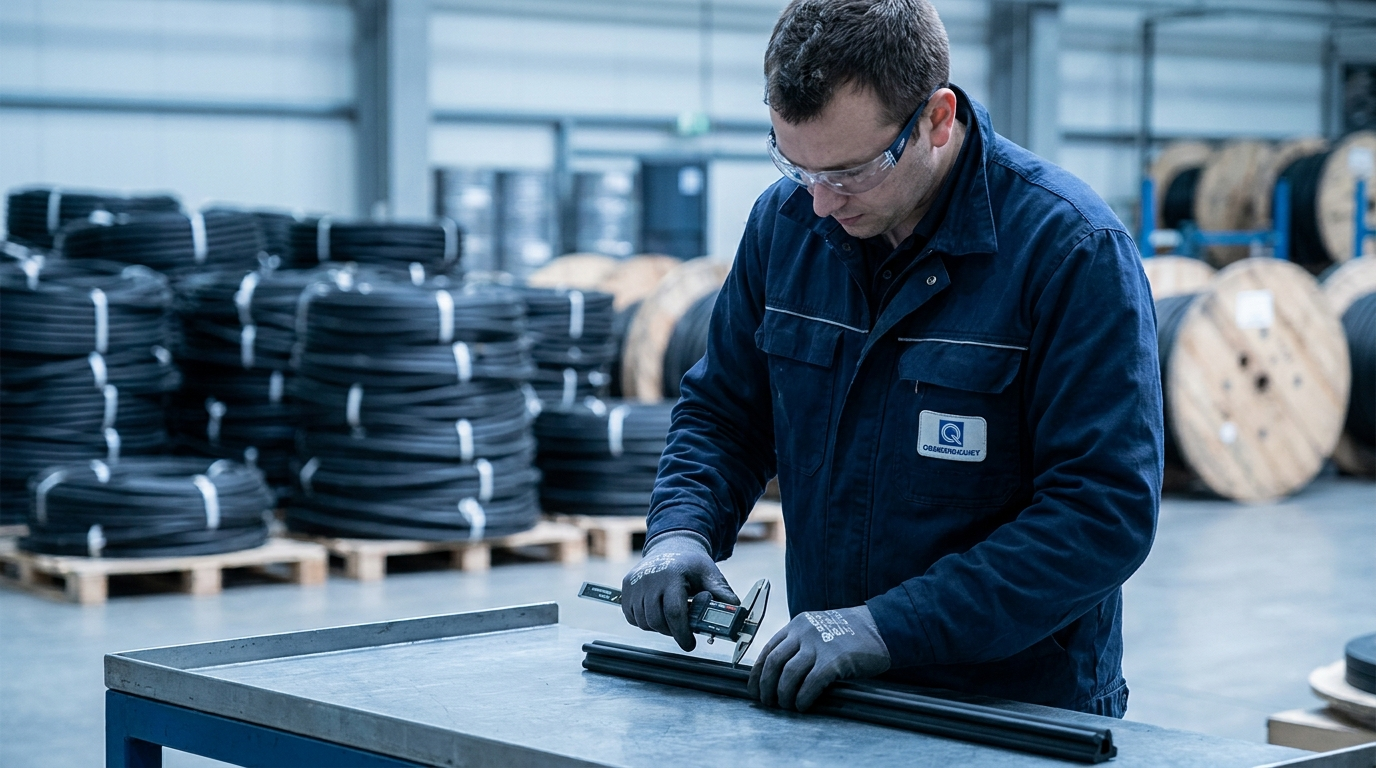
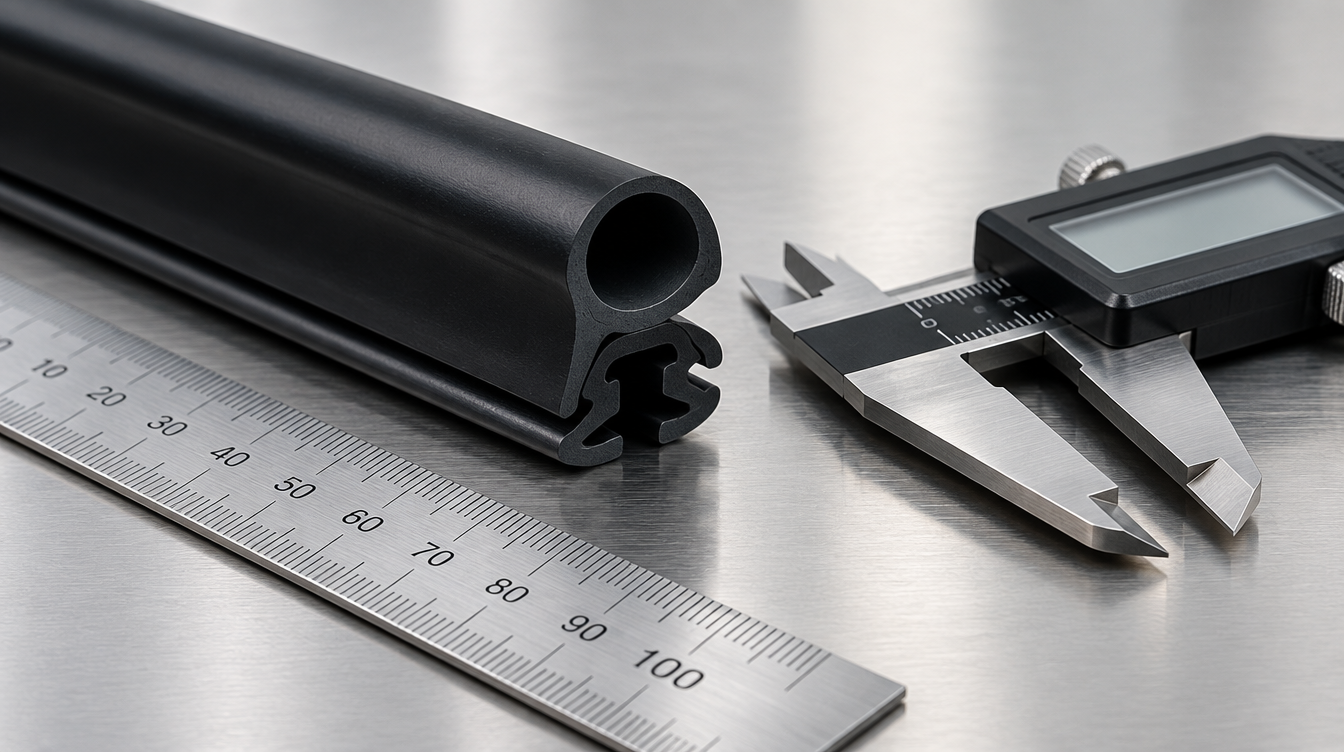
Ask how the supplier controls dimensions, not just what tolerance they quote. Good answers involve continuous in-process measurement, stable line conditions, disciplined compounding and documented QC checks. Be wary of a supplier who promises very tight tolerances on complex hollow profiles without explaining how they hold them — extruded rubber is dimensionally sensitive, and realistic, geometry-appropriate tolerances backed by measurement are worth more than optimistic numbers on a quote. A credible partner will tell you which dimensions they can hold tightly and which are inherently looser.
Quality control and testing
A profile that measures correctly can still fail if the compound is wrong. Confirm the supplier performs material-level testing — hardness, tensile and elongation, and compression set — alongside dimensional verification. Compression-set testing is particularly telling for sealing profiles, because a compound that takes a permanent set will leak regardless of how well it was extruded. Ask to see the QC documentation that ships with the product; a manufacturer confident in their process will provide it readily.
Prototyping and development capability
The best suppliers shorten your development cycle. Look for the ability to develop a profile from either a CAD drawing or a physical sample, rapid prototyping to prove geometry and compound before committing to volume, and reverse-engineering of legacy or OEM profiles where no drawing exists. This matters most when you are replacing an obsolete part or matching an incumbent supplier — a manufacturer who can work from a sample saves you the cost and delay of recreating drawings from scratch.
Compliance and industry credentials
If you operate in a regulated sector, compliance is non-negotiable and hard to retrofit. Depending on your industry you may need certified food-contact or pharmaceutical grades, EN 45545-2 fire performance for rail, UL flame ratings, or REACH and RoHS conformity. Confirm the supplier has genuine experience — not just willingness — with your specific requirements, and can supply the documentation your auditors will demand. A supplier already serving your industry has solved these problems before.
Look past the claim to the documentation
This is where a lot of supplier evaluations go wrong, because compliance language is easy to say and hard to verify. A few things worth insisting on:
A supplier who welcomes these questions is telling you something. So is one who deflects them.
Global supply, lead time and continuity
Where the supplier sits in the world affects more than freight cost. Consider whether they can hold stock or ship into your region without a customs surprise on every order, whether they have a local entity or representation for commercial and technical support in your time zone, and what happens to your supply if a single site goes down. For a profile that goes into a product with a fifteen-year service life, continuity of supply is a real risk to weigh — you want a partner who will still be making your section, from the same compound recipe, a decade from now.
Lead time deserves the same scrutiny. Ask for realistic prototype and production lead times separately, and ask what drives variability. A supplier who quotes a single optimistic number for both is either not thinking about it or not being straight with you.
Scale and communication
Finally, weigh the practical realities: can the supplier prototype quickly and also scale to your production volumes, and is their engineering team accessible when you need a design question answered? A technically excellent supplier who cannot communicate or hit dates will still disrupt your programme. The best relationships combine manufacturing capability with responsive engineering support — the ability to get a considered answer from someone who understands extrusion, rather than a quote from someone who understands spreadsheets.
Red flags to watch for
Just as certain capabilities signal a strong supplier, certain behaviours signal risk. Be cautious of a supplier who quotes very tight tolerances on complex profiles without explaining how they achieve them, who cannot provide QC or material documentation on request, who outsources both tooling and compounding and therefore controls neither key variable, or who has no genuine experience in your regulated sector yet claims compliance readily. Vague answers about process control, reluctance to prototype before volume, or lead times that seem too good to be true are all worth probing before you commit a production programme.
Questions to ask on a supplier visit or call
Weighing price against total value
Price will always be part of the decision, but it should be the last filter applied to suppliers who have already passed the capability bar — not the first. A profile that drifts out of tolerance, fails an audit, or arrives late costs far more than the few percent saved on unit price, once you count rework, downtime and lost confidence. The most cost-effective supplier over the life of a product is usually the one whose consistency you never have to think about.
A quick evaluation checklist
Score prospective suppliers against these criteria and the right partner usually becomes obvious. Buy capability, compliance and reliability first, then negotiate price within that qualified shortlist. The saving you make at the quote stage is small and certain; the cost of getting it wrong is large and arrives later, usually at the worst possible moment.
Need a custom sealing solution?
Talk to our engineers about inflatable seals, rubber diaphragms and custom extrusions built to your exact spec. We respond within one business day.
Frequently asked questions
Is it worth switching extrusion suppliers if I do not have the original drawings?
Usually yes. A manufacturer who can reverse-engineer from a physical sample removes the main barrier to switching — you send the existing part, they reconstruct the cross-section and match the compound by property.
How long should a prototype take?
Ask for it as a separate figure from production lead time and be sceptical of a single blended number. What matters more than the headline is whether the supplier can iterate quickly when the first article needs adjustment, which is largely a function of whether they control their own tooling.
What documentation should ship with a production order?
At minimum, dimensional verification against the drawing and the material test data relevant to your application — hardness, tensile and elongation, and compression set for sealing profiles. In regulated sectors, add the current compliance certification covering the specific compound and section supplied.
[TABLE 1x1]
| Call to action: Evaluating extrusion partners? Put our capability to the test — send us a drawing or a sample and see how we develop, tolerance and validate your profile. |

Need a quote?
For custom rubber sealing solutions contact us. We will respond to you within 1 business day



.avif)