.png)


Posted on
September 22, 2026
How to Read an EN 45545-2 Test Report Before You Accept a Supplier's Claim
What to actually check on a genuine EN 45545-2 test report, and why a datasheet compliance claim is not the same thing as verifiable test evidence.
"EN 45545 compliant" printed on a datasheet is a marketing claim. An EN 45545-2 test report is evidence. The two are not the same thing, and the gap between them is where non-compliant rubber components end up on vehicles that later fail an audit, or worse, are only discovered to be non-conforming after a vehicle is already in passenger service. Knowing how to read the report itself, rather than the one-line summary a supplier puts in an email or a datasheet footer, is the fastest way for a procurement or engineering team to close that gap before it becomes a programme level problem.
This guide walks through exactly what to look for on a genuine EN 45545-2 test report, in the order a specification engineer or quality manager should actually check it, using the rubber seals, gaskets and diaphragms Western Sealtech supplies for fire-safe rail and mass transit sealing as the working example throughout.
Why the datasheet claim is not enough
A datasheet claim of compliance tells you nothing about which requirement set was tested, which hazard level the result supports, which specific compound and batch were tested, or whether the sample tested is the same formulation currently being supplied. Any of those can change between the report date and the part landing on your dock, especially if a supplier has since altered a formulation for cost or availability reasons without re-testing.
This is not a hypothetical risk unique to disreputable suppliers. Formulation adjustments happen for entirely ordinary commercial reasons: a raw material becomes harder to source, a plasticiser supplier changes their own formulation, a carbon black grade is discontinued, and a well run supplier will re-test when a change is material to fire performance. The problem arises when that judgement call is made informally, without a documented change control process, and the buyer has no way to verify from the outside whether it happened correctly or at all. For rail programmes specifically, the stakes of accepting an unverified claim are higher than in many other industries, because vehicle level fire testing, homologation and entry into passenger service happen long after individual components are procured and installed. A compound level compliance gap discovered at that late stage can mean retrofitting seals across an entire fleet.
Anatomy of a genuine EN 45545-2 test report
A genuine test report is a structured technical document, not a marketing certificate, and it follows a recognisable format regardless of which accredited laboratory issued it. The header section identifies the test house, its accreditation body and accreditation number, the client the test was performed for, the report number, and the issue date, and typically states the standard and edition the test was performed against. A dedicated section describes exactly what was tested, including the material or compound reference, the product form, thickness or cross-section dimensions, colour where relevant, and sometimes the date the sample was received or manufactured. The report lists which specific test methods were applied, then presents each test method's own results table showing the individual numerical results obtained against the applicable pass threshold, not simply a single combined pass or fail statement for the whole report. A closing conclusion statement ties the individual results back to a stated requirement set and hazard level.
If a document handed to you as a "test report" does not contain a sample description, individual results tables and a stated requirement set and hazard level, it is very likely a summary certificate rather than the underlying report, and you should ask for the full document.
The seven things to check on the report itself
Once you have the actual report in hand, rather than a summary, work through seven checks in order. First, test house and accreditation: is it an accredited, recognised laboratory, and is the accreditation scope relevant to the specific tests performed, since a laboratory can be accredited for some test methods and not others. Second, report number and date: a specific, traceable reference number, not a general certificate with no report behind it, and a date recent enough to compare against any known formulation change dates. Third, requirement set tested: confirm the report states R22, R23 or R24 rather than only "EN 45545-2" in general terms. Fourth, hazard level achieved: HL1, HL2 or HL3, since a pass at HL1 does not imply a pass at HL2 or HL3. Fifth, compound or material reference: the exact internal compound code tested, since a generic description such as "black EPDM" is not sufficient traceability on its own. Sixth, sample description: thickness, construction, and whether it matches the geometry of the part you are buying, since a flat sheet result does not automatically transfer to an extruded hollow profile. Seventh, test methods and results table: the individual results against each method, not just a pass or fail summary line, since this is where marginal results become visible.
Materials context: why the compound behind the report matters
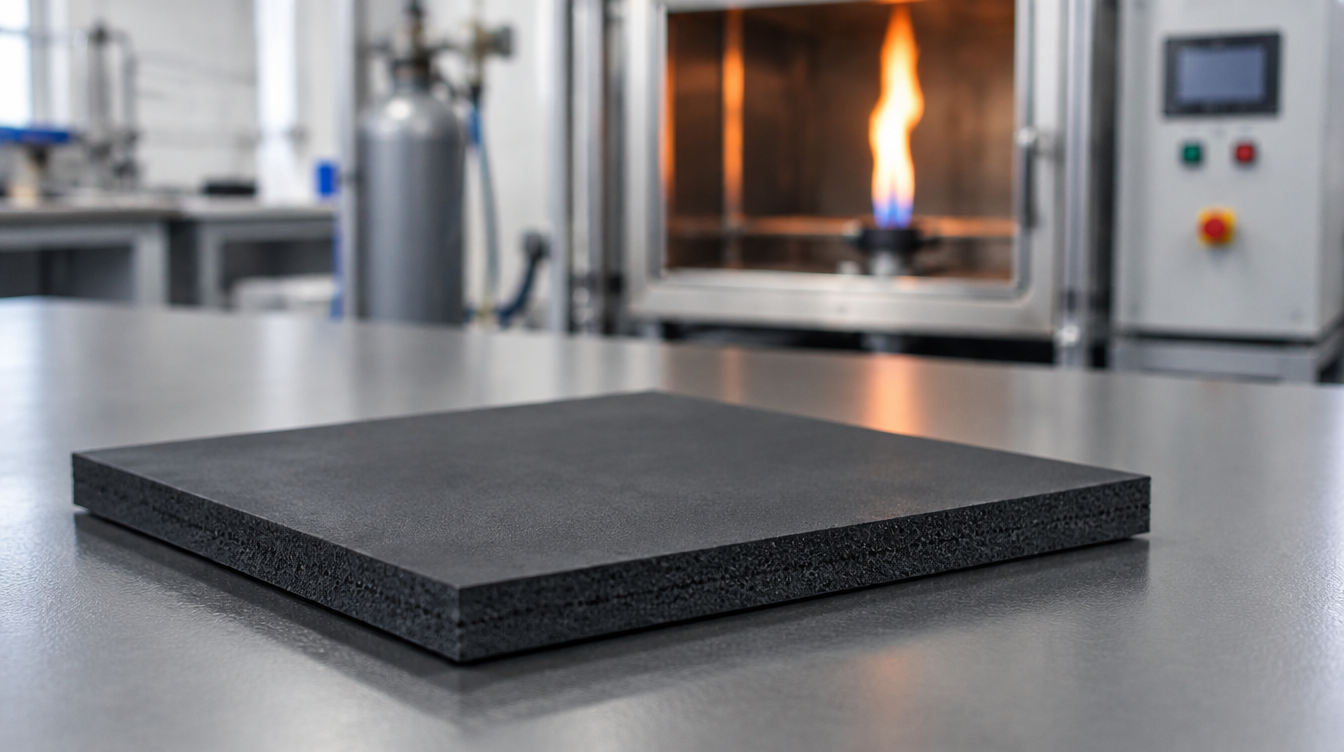
A test report is only as meaningful as the compound it was run on, and the elastomer family behind that compound shapes both its baseline fire behaviour and the kind of flame retardant system it needs to reach a given hazard level. EPDM is not inherently fire rated, so its EN 45545-2 performance depends heavily on the specific flame retardant filler package compounded into it, which is exactly why the compound reference on a report matters more than the polymer family name alone. Silicone compounds generally offer favourable smoke and toxicity characteristics relative to many organic elastomers, though individual silicone formulations still vary and still require their own test evidence. Where a seal also needs chemical or fuel resistance alongside fire performance, FKM and fluorosilicone compounds are sometimes specified, and the same rule applies: a fire test result is specific to that exact formulation, not to "FKM" as a general material category. Sponge extruded seals and spliced and joined sponge seals have a cellular structure that changes the surface area exposed to flame compared with a solid section of the same compound, which is why a cellular construction is generally tested and reported as its own configuration.
Smoke density and toxicity: the line items most often skipped
A supplier can show a passing flame spread result and quietly omit or downplay the smoke density and toxicity index results, which are frequently the harder criteria to meet, particularly at HL3. Ask specifically for these line items rather than accepting a single combined pass statement. Smoke density testing measures how much smoke a burning sample generates and how quickly visibility is reduced, which directly affects how long passengers and crew can see well enough to evacuate. Toxicity index calculations, sometimes labelled CIT or ITC depending on the specific method referenced, estimate how hazardous the combustion gases produced would be to people exposed to them during an evacuation. Both properties are heavily influenced by the specific flame retardant and filler package in a compound, sometimes trading off against each other, so they need to be reviewed individually rather than inferred from a flame spread pass alone. When a supplier's summary says only "EN 45545-2 R23 HL2, pass," ask for the individual smoke and toxicity figures against their respective thresholds.
Compound drift and matching the report to what you buy
The single most common gap between a supplier's claim and reality is compound drift, where the compound tested is no longer the compound currently in production, either because the formulation was adjusted after the original test or because the part geometry differs enough that the original result no longer applies without re-qualification. Compound drift is rarely deliberate misrepresentation. It more often happens through a chain of small, individually reasonable decisions: a raw material substitution approved for cost reasons, a tooling change approved to fix a dimensional issue, a batch record update that does not flow through to the sales team quoting against an old test report. The result is the same regardless of intent, a buyer relying on that report is relying on data that may no longer describe the part actually being shipped.
As a named, verifiable example of what a complete report package looks like, Western Sealtech's compounds EPDM70-0005 and SL-40 were tested to EN 45545-2, requirement set R22/R23, achieving Hazard Level 3. Testing was carried out by CREPIM, the Centre de Recherche et d'Expertise sur les Polymeres et Materiaux in Bruay-la-Buissiere, France, under report number DO-25-7151/A-R1, dated 13 May 2025. Any change to that qualified formulation is reviewed under our internal change control process: our R&D Head and management assess whether a change is material enough to affect EN 45545-2 performance, and where required, re-testing or requalification is initiated with their sign-off.
Datasheet claim vs test report vs full qualification package
A one-line datasheet compliance statement tells you almost nothing verifiable: no requirement set, no hazard level, no compound reference, no sample geometry. A supplier certificate of compliance is a step up, a one-page summary sometimes referencing a report number, but still does not give you the underlying results tables or re-test history. A full accredited test report gives you the test house, accreditation, report number, date, requirement set, hazard level, sample description and full results tables, though it still needs cross-checking against current production to rule out compound drift. The target standard for a rail programme is the full report plus compound traceability and a formal change control record, which closes off nearly all of that residual risk if the traceability chain is genuinely intact and current.
What to ask a supplier for, in order
When qualifying a rubber seal, gasket or diaphragm supplier for an EN 45545-2 application, request the following in order, and treat reluctance or delay at any step as a signal worth investigating further: the full test report, not a summary certificate; the compound reference on the report, cross-checked against the current production compound code; confirmation of which requirement set and hazard level the report supports; evidence the sample construction matches your part geometry, including thickness and cross-section; and the re-test or change control history if the compound has been modified since the report date. Suppliers of o-rings, rubber profile, rubber strip and similar sealing products for rail applications should be able to answer all five points without hesitation. A supplier who can only answer the first one or two, and treats the remainder as unusual questions, is telling you something important about how their internal traceability is structured.
Internal process: change control and re-testing
Beyond the individual test report, the underlying process a supplier runs internally is what determines whether that report stays valid over time. A robust process for a fire-rated rubber compound typically includes a documented compound code system, a formal review step whenever a raw material, supplier or process parameter changes, a defined threshold for when a change is judged material enough to require re-testing, and a record linking every compound code revision back to its supporting test report. Rail vehicles and their spares supply chains often run for twenty to thirty years or more, far longer than the typical raw material supply relationship in many other industries, which makes a documented, auditable change control process considerably more important for rail sealing suppliers than for a shorter lifecycle industrial application. Where a project uses custom moulded seals alongside extruded profiles, tooling revisions can also introduce a geometry change that needs to be checked against the original test sample.
Quality, testing and compliance standards referenced
EN 45545-2 test methods reference, and are used alongside, a range of other standards a rail sealing supplier's quality system should be familiar with. General elastomer mechanical properties, such as tensile strength, elongation and compression set, are commonly tested to methods published by ASTM International and ISO, while the EN 45545 series itself is developed and maintained through CEN. Chemical composition and restricted substance requirements relevant to European markets are administered by ECHA, and the wider interoperability framework for European rail is coordinated with sector bodies including the International Union of Railways (UIC). A supplier's quality documentation referencing these bodies accurately, rather than vaguely, is itself a useful signal of how seriously compliance is being managed internally.
Key takeaways
A compliance claim without a report behind it is not evidence. Reading the report properly means checking the test house and accreditation, the report number and date, the requirement set and hazard level, the compound reference, the sample description, and the individual results table, then cross-checking that report against the compound currently being supplied. That last step, ruling out compound drift, is the one most often skipped and the one that matters most on a long rail programme.
Ask us for the full EN 45545-2 report package behind your next rail sealing order, and our team will walk you through exactly what we hold and how it maps to your project's requirement set.
Need a custom sealing solution?
Talk to our engineers about inflatable seals, rubber diaphragms and custom extrusions built to your exact spec. We respond within one business day.
Frequently asked questions
Is a certificate of compliance the same as a test report?
No. A certificate is typically a one-page summary a supplier writes themselves. A test report is the document issued by the accredited test house showing the actual test methods, sample descriptions and numerical results.
How do I know if a compound has changed since the report was issued?
Ask the supplier for their change control record for that compound code, and cross-check the compound reference on the current delivery note or batch record against the reference stated on the report.
What should be on a supplier's change-control record for a fire-rated compound?
At minimum it should record the compound code, the date and nature of any formulation change, whether the change was assessed as requiring re-testing, and the report number of any re-test performed. Western Sealtech's own change control process routes any formulation or raw-material change through our R&D Head and management for that assessment, with re-testing carried out and signed off when required.

Need a quote?
For custom rubber sealing solutions contact us. We will respond to you within 1 business day



.avif)