.png)


Posted on
August 14, 2026
Rail & Mass Transit Sealing: EN 45545 Fire-Safe Solutions
How EN 45545-2 fire safety shapes rail sealing: hazard levels, R22 and R23 requirement sets, fire-safe EPDM and silicone, and seals for doors and glazing.
In rail vehicles, a rubber seal is a fire-safety component. Every elastomer in a passenger environment contributes to how a fire would start, spread and generate smoke and toxic gas — which is why European rail sealing is governed by one of the most rigorous fire-safety standards in any industry: EN 45545. This guide explains what EN 45545 demands of seals, and how compliant sealing is engineered for doors, windows, HVAC and glazing.
Why fire safety dominates rail sealing
A train is a confined space carrying many people, often underground or at speed, where evacuation takes time. In a fire, the materials lining and sealing that space determine how much time passengers have. Rubber is combustible unless specifically formulated not to be, and it can produce dense smoke and toxic gases as it burns. EN 45545 exists to control exactly these hazards, and it applies to the seals around doors, windows, HVAC systems and enclosures just as it applies to seating and panels. For rolling-stock builders and their suppliers, fire compliance is not a feature — it is a condition of entry.
What EN 45545 actually requires
EN 45545 is the European standard series for fire protection on railway vehicles. Part 2 — currently EN 45545-2:2020+A1:2023 — sets the requirements for the fire behaviour of materials and components, classifying performance against requirement sets and hazard levels rather than a single pass or fail.
Hazard levels (HL1 to HL3). HL3 is the most demanding; there is no HL4. Importantly, the hazard level is not a property of the material and is not chosen by the seal supplier. It is derived from the combination of *operation category* — from OC1 for surface running, through to OC4 where side evacuation is not possible, as on underground lines — and *design category*, covering standard, automatic, double-deck and sleeping vehicles, both defined in EN 45545-1. The vehicle builder or operator determines the applicable hazard level; the supplier's role is to provide test evidence at the level specified. In practice the large majority of vehicles fall under HL1 or HL2, so specifying HL3 where it is not required is over-specification rather than prudence.
Requirement sets (R1 to R28 in the 2020 edition). Each product is assigned a requirement set according to where and how it is used in the vehicle. For elastomeric sealing profiles, gaskets and hoses the relevant sets are R22 for interior applications — interior window seals, door joints, panel connections — and R23 for exterior applications. The distinction matters: a claim against R23 requires exterior-condition test data specifically, so the two should never be quoted as an undifferentiated pair. Rubber parts serving other functions fall under other sets, including floor composites and cable sheathing.
Test criteria. Across the standard as a whole, reaction to fire is assessed through flame spread and ignitability, heat release, smoke density and the toxicity of combustion gases — but which of these apply depends on the requirement set. For sealing profiles under R22 and R23, conformity is assessed by three tests: oxygen index to EN ISO 4589-2, smoke density to EN ISO 5659-2, and smoke gas toxicity to EN 17084. The thresholds tighten with hazard level — for example, oxygen index of at least 28% at HL1 and HL2 rising to at least 32% at HL3, and maximum smoke density falling from 600 at HL1 to 300 at HL2 and 150 at HL3.
For a rail seal, meaningful compliance means a compound tested against the relevant requirement set at the specified hazard level. Our Westorail™ EPDM and silicone compounds have been tested to EN 45545-2 and meet requirement sets R22 and R23 at hazard level HL3, in the sections covered by our test reports. Test documentation is available on request.
How compliance is actually demonstrated
For a rolling-stock programme, a fire-safe seal is accepted on documentary evidence, not on a supplier's assurance — and it is worth understanding what that evidence looks like, because the language used in the market is often loose.
There is no EN 45545 certification scheme and no certifying body. Conformity is demonstrated by test reports from a laboratory accredited to EN ISO/IEC 17025, supported by a manufacturer's declaration identifying the requirement set and hazard level achieved and listing the associated reports. Under UNIFE guidance, that declaration can only be issued by the actual manufacturer of the end-use product, and it is valid for five years before it must be revised.
Two further points are worth raising with any supplier, including us:
Ask for the certificates up front and confirm they cover the actual compound, colour and form being supplied, so there are no surprises at vehicle sign-off.
The compounds that meet the standard
Achieving HL3 performance is a matter of compound formulation, not something that can be added afterward. Fire-safe rail seals are built on specially formulated EPDM and silicone compounds engineered to limit flammability, smoke density and toxicity while retaining the mechanical and weathering performance a rail seal needs. EPDM brings excellent resistance to weather, ozone, UV and water for exterior and glazing seals; silicone adds temperature range for HVAC and demanding thermal duty. Both must carry the test evidence — an uncertified EPDM seal, however capable mechanically, cannot go into a compliant vehicle.
Performance beyond fire
Fire compliance is necessary but not sufficient — a rail seal must also survive the operational environment. That means resistance to UV and ozone over years of outdoor exposure, stable performance across the rail temperature range, tolerance of the constant vibration of a moving vehicle without taking a set, and low compression set so the seal keeps sealing over a long maintenance interval. Durability and vibration tolerance are designed in alongside the fire performance, so the tested compound also delivers the service life the operator expects.
Sealing across the vehicle
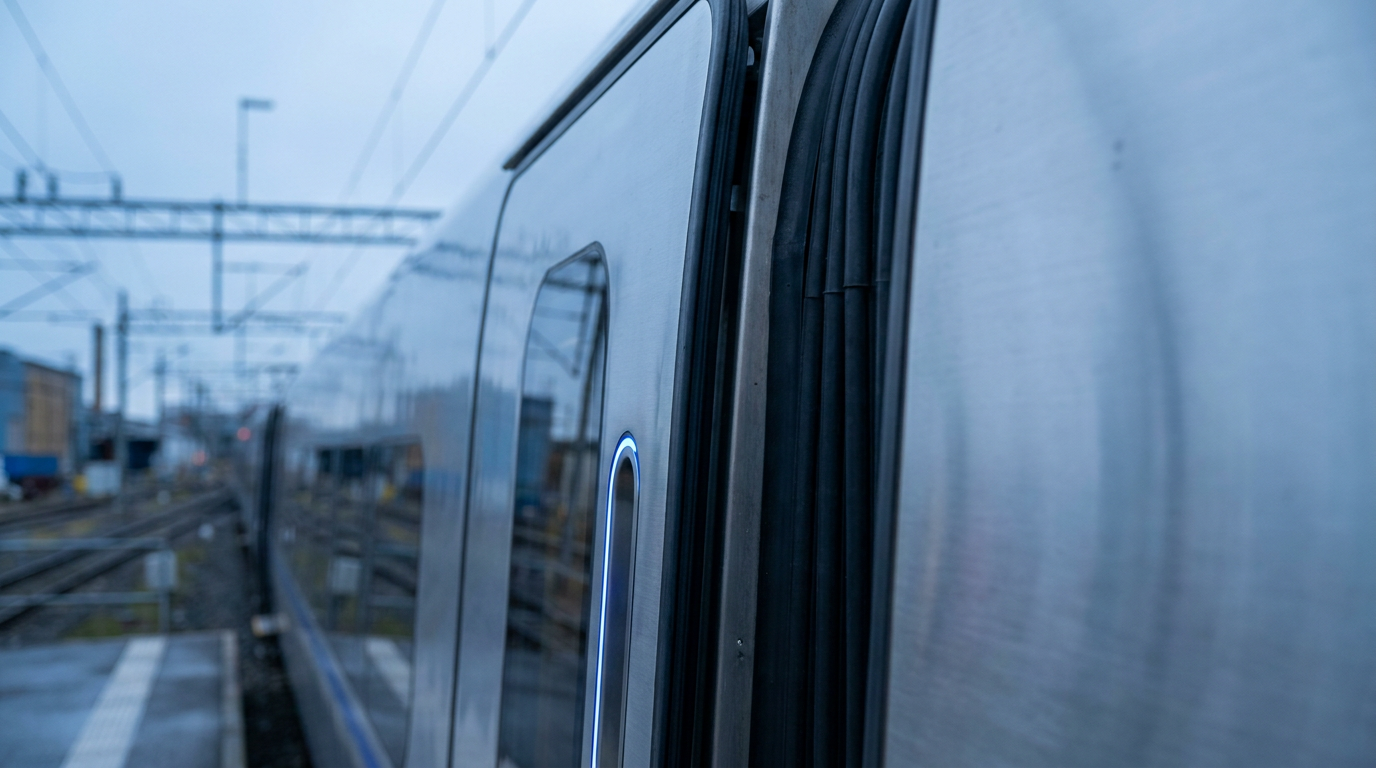
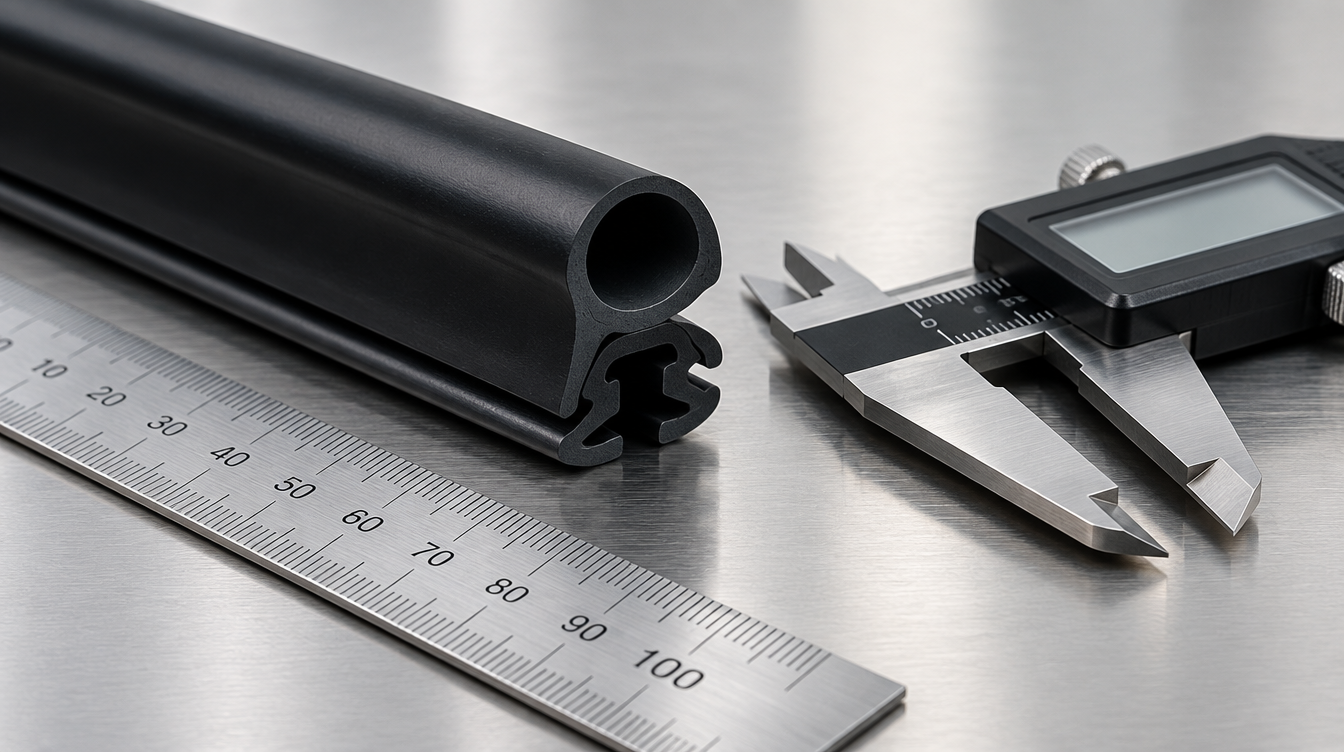
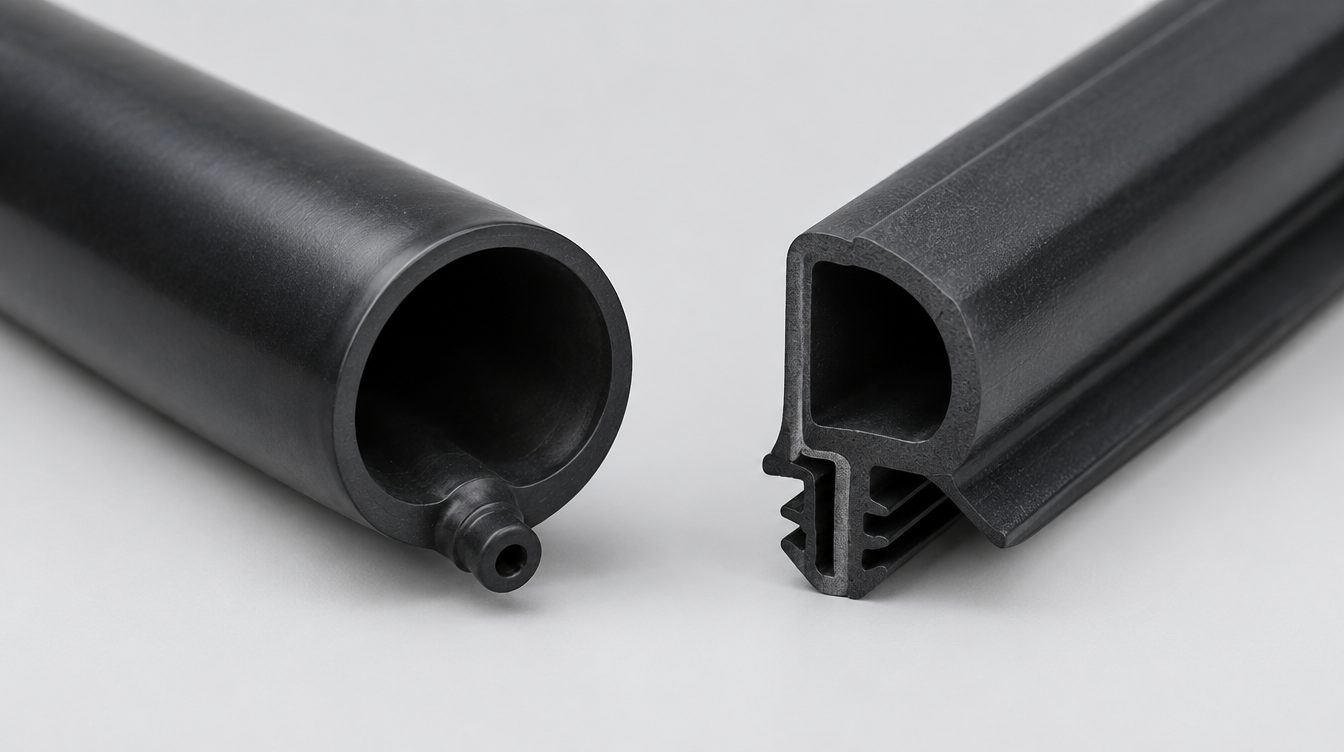
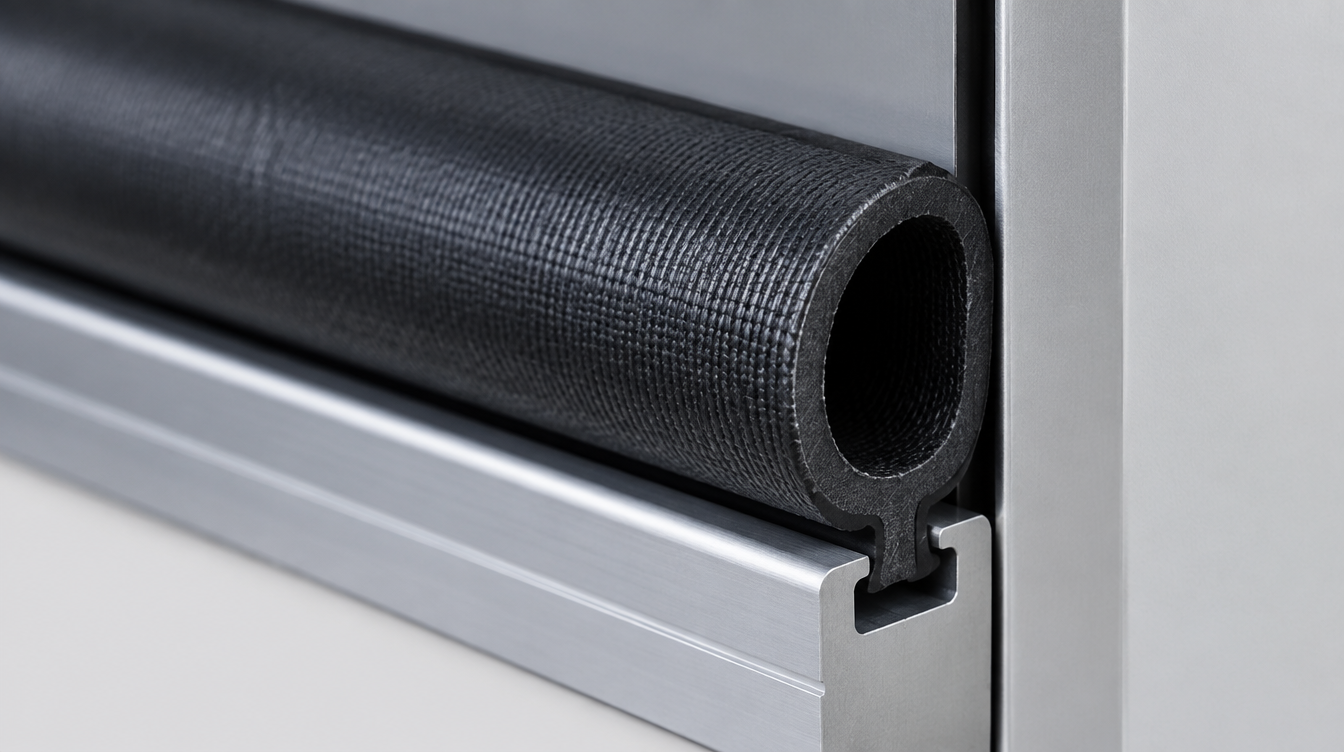
EN 45545-compliant sealing appears throughout the vehicle, each application with its own demands: passenger and sliding door seals that must seal reliably through high cycle counts, front windshield and window glazing gaskets that resist vibration and weather, HVAC sealing that supports cooling efficiency, and electrical enclosure gaskets that keep out moisture and dust. Many of these are framed seals, produced by extruding a tested profile and splicing and vulcanising it into seamless rings or frames — where the fire performance of the finished part, including the join, should be covered by the documentation you are given. Reverse-engineering of OEM profiles and custom colours to match coach interiors are common requirements alongside the core fire compliance.
Retrofit, refurbishment and colour matching
Not every rail sealing project is a new build. Refurbishment and retrofit programmes frequently need compliant replacements for seals originally fitted before current fire standards applied, or for profiles whose original supplier is no longer available. Here the ability to reverse-engineer an OEM profile from a sample, reproduce it in a tested fire-safe compound, and splice it into the required framed geometry is invaluable — it brings an ageing fleet up to modern fire performance without redesigning the door or window. Custom colour matching to existing coach interiors lets these replacements blend seamlessly with the refurbished vehicle.
Specifying compliant rail seals
Rail sealing is where fire science, material engineering and long-life durability meet. A compliant seal is one tested to the right requirement set and hazard level, formulated to survive years of vibration and weather, and documented well enough to pass vehicle approval. Specified that way, the humble rubber seal does its part to keep passengers safe.
Key takeaways
Specifying seals for rolling stock? Talk to us about EN 45545-2 tested Westorail™ compounds and fire-safe seals for doors, windows, HVAC and glazing — with the test documentation your approval process will require.
Need a custom sealing solution?
Talk to our engineers about inflatable seals, rubber diaphragms and custom extrusions built to your exact spec. We respond within one business day.
Frequently asked questions
Can a material be "EN 45545 certified"?
Not strictly. There is no EN 45545 certification scheme or certifying body. Conformity is demonstrated by test reports from an ISO/IEC 17025-accredited laboratory, supported by a manufacturer's declaration naming the requirement set and hazard level achieved. A compliance claim without an R-number and hazard level does not mean anything.
What is the difference between R22 and R23?
R22 covers sealing applications on the interior of the vehicle — interior window seals, door joints, panel connections. R23 covers exterior sealing. They are separate requirement sets with separate test evidence, so a supplier claiming both should be able to show data for both.
Do I need HL3?
Only if your vehicle's operation and design categories call for it. HL3 typically applies where evacuation risk is highest — underground operation, long tunnels, sleeping vehicles. Most vehicles fall under HL1 or HL2, and specifying HL3 unnecessarily narrows your material options and adds cost without adding safety.

Need a quote?
For custom rubber sealing solutions contact us. We will respond to you within 1 business day


.avif)