.png)


Posted on
September 27, 2026
Shore Hardness and Compression Set in Rail Sealing Applications
Why Shore hardness and compression set need to be specified together for rail seals, and how to write a compression set requirement that reflects real service conditions.
Two numbers on a rubber datasheet predict more about a rail seal's real-world service life than almost anything else: Shore hardness and compression set. Both are simple to measure and easy to misread, and a seal specified purely on hardness without a compression set requirement is a seal specified incompletely. At Western Sealtech, our custom moulded seals and extruded profiles for rolling stock are engineered around both properties together, because a door seal that feels right on day one but loses contact force after a few thousand duty cycles has still failed the rider, the passenger and the maintenance budget.
This guide walks through what each property actually measures, how the two interact, what hardness range is appropriate for different rail sealing roles, and how to write a specification that protects against the single most common failure mode in door, window and body seals: gradual loss of sealing force over time. It also connects directly to fire performance, since flame retardant compound formulation used to meet EN 45545 fire-safe sealing requirements can shift compression set behaviour in ways that are easy to miss if the two properties are tested and reported separately, or not tested at all.
Shore hardness and compression set: an overview
Shore A hardness, the scale used for most rubber seals, measures resistance to indentation on a scale that in rail sealing typically runs from around 40 Shore A, soft high-compliance seals, to 80 plus Shore A, firmer more structural profiles. Hardness affects how much force is needed to compress the seal, how well it conforms to surface irregularities and gap tolerance, and how it feels in a manual door-closing effort where that matters to passengers and crew. Hardness alone does not tell you how long the seal will hold its sealing force. Two compounds at the same Shore A hardness can have very different compression set behaviour, which is why hardness is a starting specification, not a complete one. The same logic applies to pneumatically actuated components: an inflatable seal tube relies on the elastomer's elastic recovery just as much as a static profile does, even though the loading mechanism is different.
Compression set measures how much a rubber sample fails to recover its original thickness after being held under compression for a set time and temperature, then released. It is expressed as a percentage: 0% would mean full recovery, 100% would mean no recovery at all, the material stayed fully compressed. A lower compression set number is better. Together, these two figures describe both the initial feel and the long-term reliability of a sealing profile, and specifying rail door, window or body seals without both numbers on the datasheet is one of the most common gaps we see in incoming rolling stock specifications.
How hardness and compression set are measured
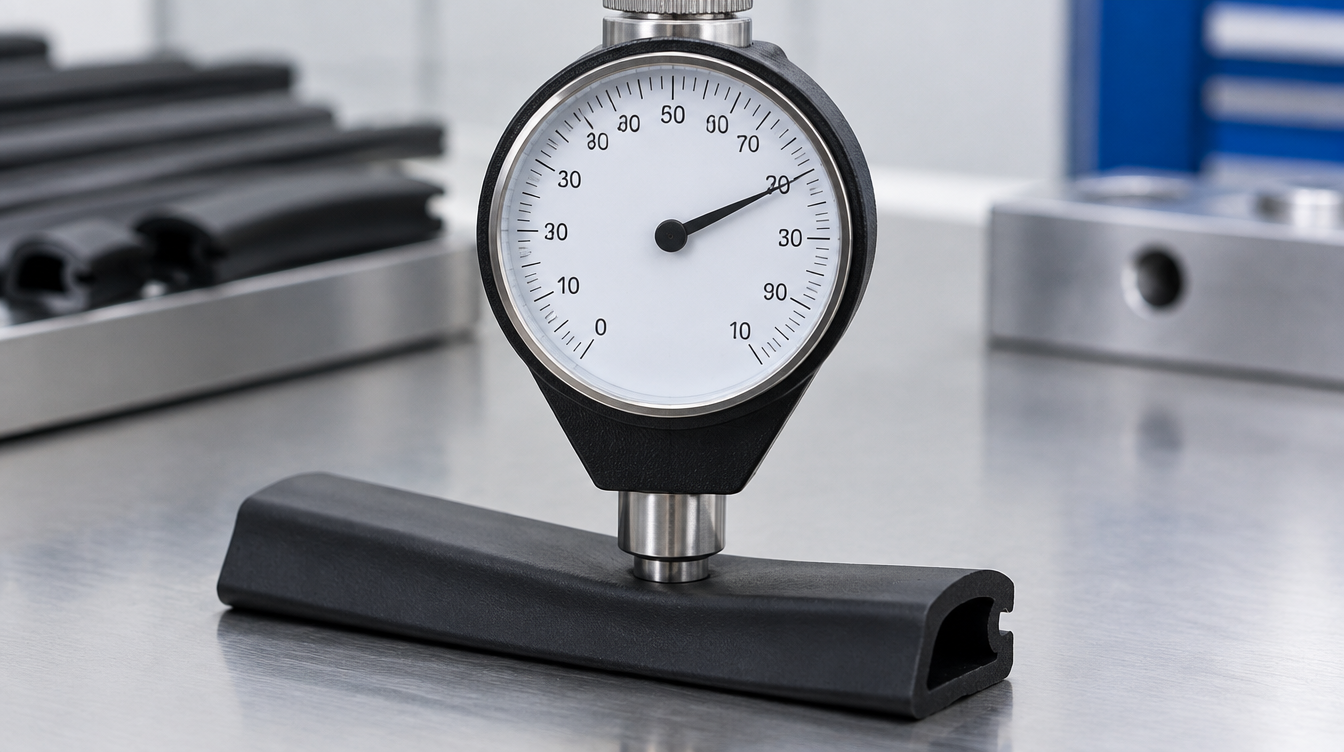
Shore A hardness testing uses a durometer, a spring-loaded indentor with a defined tip geometry pressed into the rubber surface under a specified load. The depth to which the indentor penetrates is converted into a hardness reading on a 0 to 100 scale, where a higher number means a harder, more indentation-resistant material. The test is fast, non-destructive on a thick enough sample, and widely standardised, which is why it appears on nearly every rubber datasheet. Compression set testing is a different kind of measurement entirely, and a slower one. A sample, typically a disc or button of defined dimensions cut from the compound in question, is compressed to a fixed percentage of its original thickness using a jig with calibrated spacers, held at a specified temperature for a specified duration, commonly ranging from 22 hours to 70 hours or longer depending on the standard and application, then the load is removed and the sample allowed to recover for a defined rest period before its thickness is remeasured.
Durometer hardness is essentially instantaneous elastic resistance. Compression set is a measure of how the rubber's cross-linked network behaves under sustained deformation and heat over time, which involves stress relaxation, potential oxidative or thermal degradation of the polymer backbone, and how well the cure system has locked the compound's elastic memory in place. A compound can be formulated to feel firm and indent-resistant on day one while still relaxing badly under sustained compression over months, because the two behaviours are governed by different aspects of polymer chemistry and cure chemistry.
Elastomer types and hardness ranges for rail seals
Rail sealing compounds are drawn from a fairly narrow band of elastomer families, each bringing a different balance of hardness range, compression set behaviour, weathering resistance and fire performance potential. EPDM is the workhorse elastomer for rail door seals, window gaskets and static body seals, thanks to strong ozone and UV resistance, good low-temperature flexibility, and a well-understood path to flame retardant formulation for EN 45545 compliance, commonly formulated across roughly 45 to 75 Shore A depending on the profile role, and used extensively in our dovetail seal and snap-in seal profile families for glazing and door frame applications. Silicone offers a wider usable temperature range and different compression set behaviour at temperature extremes compared with EPDM, and is often selected for rubber diaphragms and pneumatic components exposed to sustained thermal cycling, though it typically carries a cost premium. FKM and nitrile compounds are used in more specialised rail sealing roles, particularly where chemical or fuel resistance matters more than the weathering performance that EPDM excels at, such as certain underframe or fluid-handling gaskets on rolling stock. Whichever base polymer is chosen, the profile geometry and joining method also affects real-world sealing performance, and our spliced and vulcanised seals are used where a continuous loop profile needs a joint that performs identically to the extruded body rather than acting as a weak point.
Key properties, standards and performance data
Beyond hardness and compression set, a complete rail sealing datasheet should carry tensile strength, elongation at break, ozone and UV resistance data, and a stated temperature range, since these properties interact with how the seal ages in service. Testing methodology itself is standardised internationally: Shore A hardness testing generally follows ASTM D2240 or the equivalent ISO 48 series, while compression set testing follows ASTM D395, with Method B being the most common for O-ring and gasket-type geometries, or ISO 815. A 25% compression set result is only meaningful when read together with the test method, the test temperature, and the test duration. ASTM D395 and ISO 815 define comparable but not identical procedures, and a result generated under one standard's default conditions is not directly comparable to a result generated under a different temperature or duration, even nominally using the same test method. A single generic compression set line on a datasheet without stating the test temperature and duration is close to meaningless for comparison purposes.
Applications across rolling stock
Hardness and compression set requirements differ meaningfully across the different sealing roles found on a single vehicle. A plug door seal that must compress easily under a relatively light closing force, yet hold its contact pressure for years, sits toward the softer end of the hardness range with a tight compression set ceiling. A window gasket balances weather sealing with glazing retention and vibration damping. A static body panel seal, compressed once during assembly and rarely disturbed again, can tolerate a firmer compound but still needs low compression set to avoid gradually opening a gap that lets in water, dust or noise over the vehicle's multi-decade service life. Sealing solutions in this category also extend into aerospace, marine and building facade sectors, where similar compliance-under-load and long-term recovery requirements apply to very different structures.
Shore hardness vs typical rail sealing application
As a general engineering guide, 40 to 50 Shore A suits plug door edge and gangway interface seals, where high compliance gives low closing force and good conformity to frame irregularities. 50 to 60 Shore A suits window gaskets and glazing edge seals, balancing weather sealing with vibration damping and glazing retention. 55 to 65 Shore A suits HVAC ducting and equipment cabinet door seals, giving moderate compliance with resistance to repeated access-cycle wear. 60 to 70 Shore A suits underframe and equipment bay static seals, giving firmer support under sustained mechanical load with acceptable compression set. 65 to 80 plus Shore A suits structural static body and panel seals, where load-bearing dimensional stability is the priority and compliance is secondary. This is a starting point for a specification conversation, not a substitute for compound-specific test data on the part actually being qualified.
How to specify hardness and compression set correctly
Rather than specifying hardness alone, specify a maximum compression set percentage at a stated test temperature and duration relevant to the part's real service conditions. A robust rail sealing specification should state the target Shore A hardness with an acceptable tolerance band, typically plus or minus 5 points; the maximum compression set percentage; the exact test standard, ASTM D395 Method B or ISO 815 for example; the test temperature, matched to the part's real thermal environment rather than a generic default; the test duration; and whether the figure applies to the base compound or the flame retardant formulated variant actually used in production, since these are not always identical.
We do not currently publish a single generic compression set percentage across our rail compound range, since the meaningful figure always depends on the specific compound, test temperature and duration relevant to your application, and our internal recommended limits for door seals, window gaskets and static body seals are worked through case by case with our engineering team rather than quoted as a blanket datasheet number. Bring us your part's real service temperature and duty cycle and we will confirm a compression set target and test regime against it directly.
Manufacturing and compound customisation
Compression set behaviour is not fixed to a polymer family in the abstract, it is a property of the specific compound recipe, including filler type and loading, plasticiser content, and critically, the cure system. Peroxide-cured EPDM compounds generally offer different compression set characteristics compared with sulphur-cured equivalents, and the choice interacts directly with flame retardant filler loading used to meet fire, smoke and toxicity requirements. Our gasket, metal-bonded seal and sponge extruded seal manufacturing processes allow compound formulation, cure system and post-cure conditions to be adjusted specifically for a target compression set outcome rather than accepting a generic off-the-shelf polymer datasheet value. Because compression set is so sensitive to formulation and process control, the choice of manufacturing partner matters as much as the choice of base polymer, and a supplier that cannot show consistent batch-to-batch compression set data, or that changes filler suppliers without re-qualifying the compound, introduces variability that a hardness spec alone will never catch.
Quality, testing and compliance
Higher flame retardant filler loading can push compression set in the wrong direction if the cure system is not re-balanced to compensate, which makes compression set data especially important to request on fire-rated rail compounds specifically, rather than assuming the base polymer's generic compression set behaviour still applies once flame retardants are added. Fire safety compliance for European rail and mass transit rolling stock is governed by CEN-CENELEC's EN 45545 series, and international rail interoperability and technical standards more broadly sit under the International Union of Railways, while general material and mechanical test methodology continues to be governed by ASTM International and ISO. A test report worth relying on for a rail sealing qualification decision should state the compound identification and batch number, the exact standard and method variant used, the test temperature and duration, sample geometry, and the compression set result with an indication of whether the result is on the base compound or the production flame retardant formulation, since compression set can shift with raw material lot variation even under a nominally unchanged formulation.
Key takeaways
Hardness tells you how a seal feels on day one, compression set tells you whether it will still be sealing in year five. Specify both together, with the test temperature and duration stated, and request data on the actual production flame retardant formulation rather than the base polymer's generic literature values.
Share your rail seal drawing, gap tolerance and duty cycle requirements and our engineers will recommend a compound, hardness and compression set specification matched to your vehicle programme.
Need a custom sealing solution?
Talk to our engineers about inflatable seals, rubber diaphragms and custom extrusions built to your exact spec. We respond within one business day.
Frequently asked questions
What compression set percentage is considered good for a rail door seal?
This depends on the test temperature, duration and application, but lower is always better. Specific target values should be set against the actual service conditions, and our engineering team works through this case by case rather than quoting a single blanket figure.
Does higher Shore hardness mean lower compression set?
Not necessarily. The two properties are influenced by different aspects of the compound formulation and cure system, and a firmer compound is not automatically better at resisting compression set.
Should compression set testing be repeated after a compound's flame retardant loading changes?
Yes. Changes to filler loading or cure system made to meet fire requirements can materially affect compression set, so a compound should be re-tested rather than assuming prior results still apply after a formulation change.

Need a quote?
For custom rubber sealing solutions contact us. We will respond to you within 1 business day


.avif)