.png)


Posted on
August 14, 2026
Spliced & Vulcanised Window and Door Seals Explained
How spliced and vulcanised seals are made: joining extruded profiles into seamless closed rings and frames for doors, windows and hatches that seal reliably.
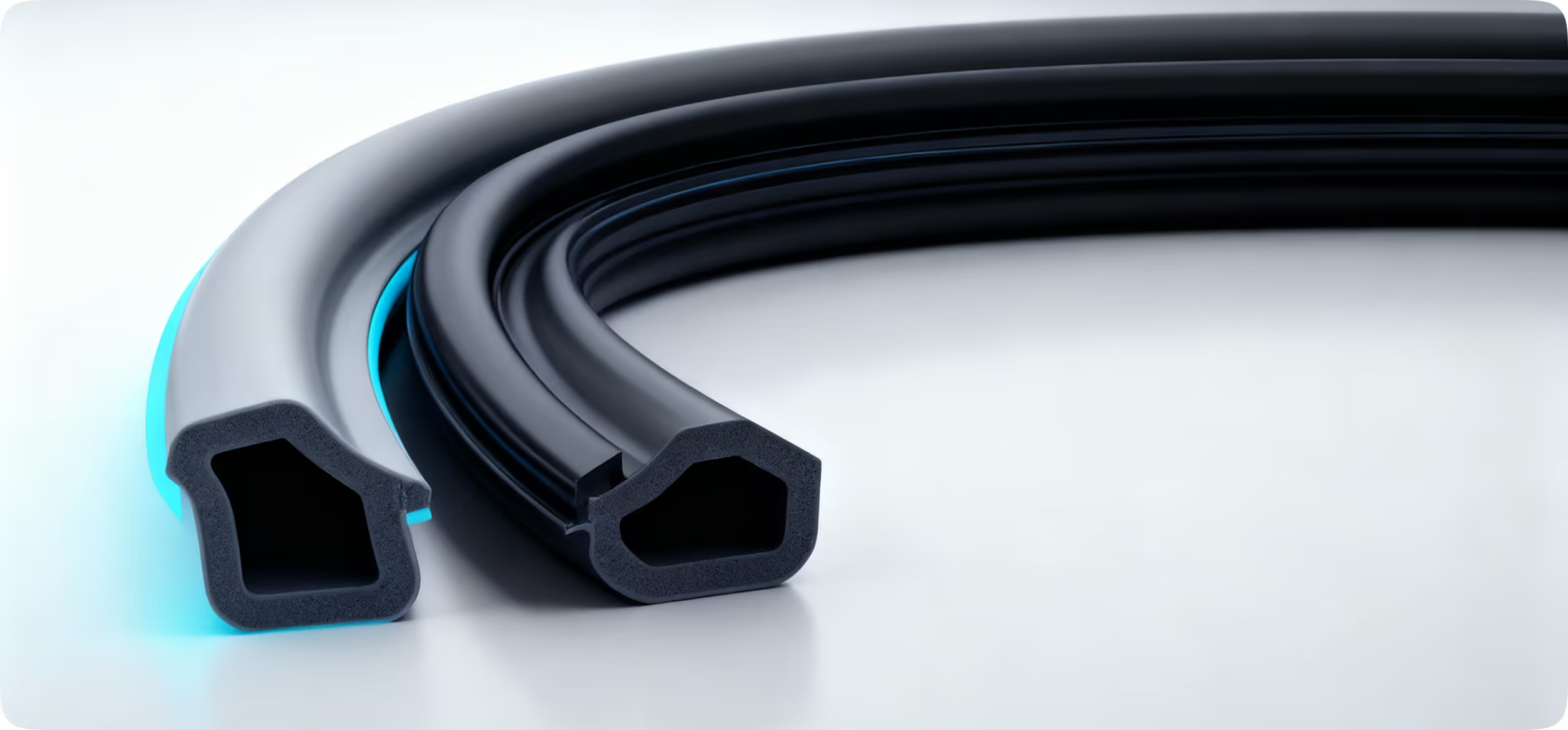
A door or window seal has to form a continuous, closed loop — but extruded rubber comes off the line as a straight length. Bridging that gap is the job of splicing and vulcanising: joining an extruded profile end-to-end into a seamless ring or frame that seals as if it were moulded in one piece. This article explains how the process works, why the join quality matters so much, and where spliced-and-vulcanised seals are the right answer.
The problem spliced seals solve
Static seals like O-rings can be moulded as closed loops, but they are limited in size and cross-section. Large frames — a railway door, a facade window, an access hatch, an electrical enclosure — need a seal that follows a rectangular or bespoke perimeter, often in a complex profile with lips and bulbs. Extrusion produces exactly the right cross-section economically, but only in straight lengths. Splicing and vulcanising marries the two: the extruded profile is cut, formed to the frame shape, and joined into a closed loop with a bond as strong and elastic as the parent material.
How splicing and vulcanising works
The process joins the profile ends by re-creating the cross-linking that gives cured rubber its strength, right across the join. In outline:
Done well, the splice is nearly invisible and does not become a weak point. Done poorly, the join is exactly where the seal will leak, tear or take a set — which is why splice quality is the true measure of a spliced-and-vulcanised supplier.
Splicing methods and corner joints
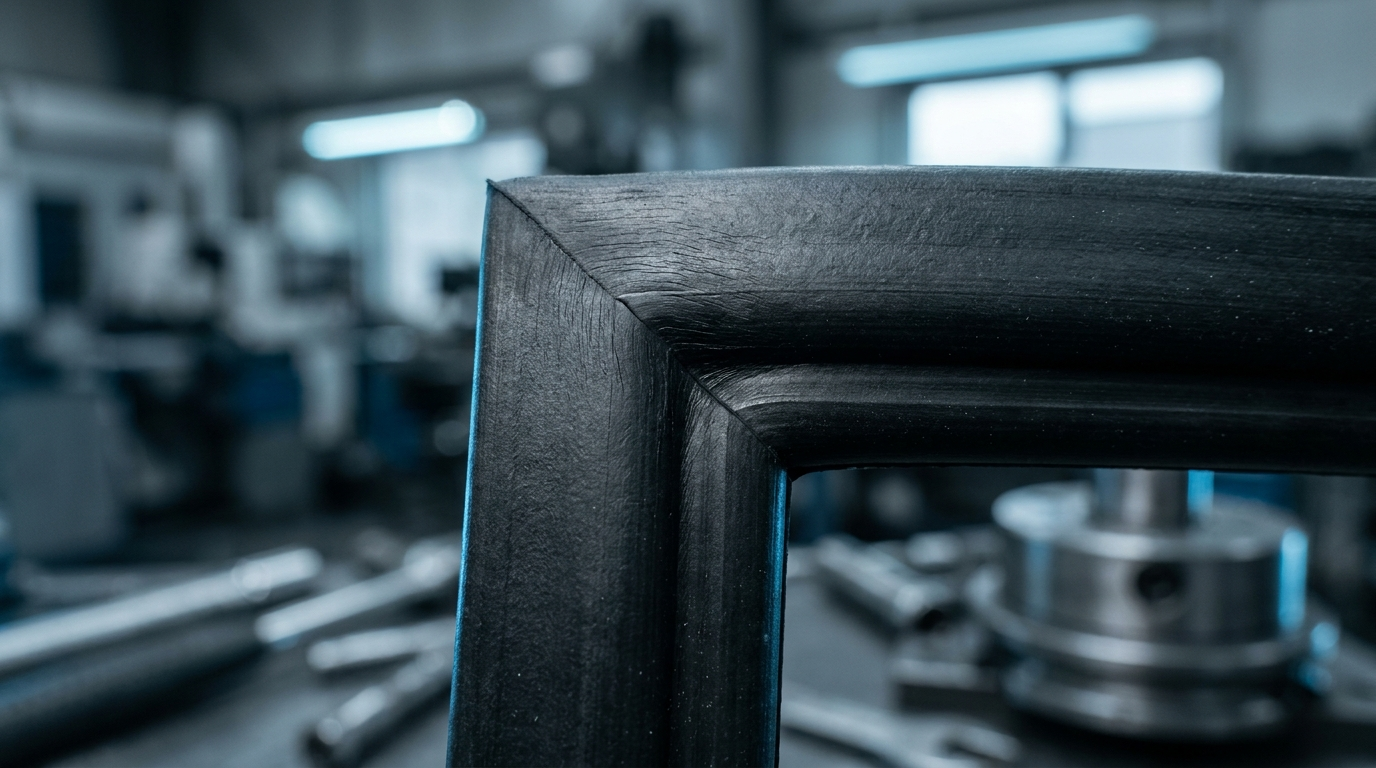
Not every join is made the same way. A straight butt splice joins two profile ends in line and is the simplest reliable join. A corner or moulded-corner splice forms the angled junctions of a rectangular door or window frame, where the profile must be both turned and bonded — the most demanding join to execute well, because the cross-section has to remain continuous around the bend. Ring closures join a single length into a continuous loop for round or oval frames. The right method depends on the frame geometry, and the quality of execution at each corner and closure is what determines whether the finished seal performs like a moulded part.
Why the join quality is everything
A framed seal fails at its weakest point, and for a spliced seal that point is the join. A good vulcanised splice maintains cross-section continuity so contact pressure is uniform all the way round, resists tearing under the repeated flexing of a door or window, and does not take a compression set at the join that would open a leak path. Achieving that consistently takes experience with the specific profile, correct joint preparation, and proper cure control. Corner joins in rectangular frames are especially demanding because the profile is both bent and bonded at the same location.
Inspecting splice quality
Because the join is the seal's critical point, it deserves inspection. A sound vulcanised splice shows continuous cross-section with no step or mismatch across the join, no visible voids or incomplete bond at the interface, and mechanical strength and elasticity close to the parent profile when flexed. Reputable suppliers inspect joins and can demonstrate their integrity. When evaluating a spliced-seal supplier, ask how they control and verify join quality — a manufacturer confident in their splicing will welcome the question.
Materials and compliance
Spliced-and-vulcanised seals are produced in the same elastomers as the parent extrusion — EPDM for weather and water, silicone for temperature and purity, and specialist compounds where the environment demands them.
Where the parent compound carries fire or contact compliance, the objective is that the finished framed seal remains compliant across the join as well as along the profile. Because splicing introduces additional compound at the interface and a further cure cycle, this is something to confirm against your supplier's test evidence rather than assume as an automatic property of the process — particularly for rail applications, where approval bodies will expect the documentation to cover the part as supplied. Ask the question early; a supplier who has been through rolling-stock approval will have the answer ready.
Vulcanised seamless rings and reverse engineering
Beyond rectangular frames, the same capability produces vulcanised seamless rings — large-diameter O-ring-style seals joined from extruded cord or profile where a moulded ring would be impractical or uneconomic. And because the input is an extruded profile, a spliced-and-vulcanised supplier can reverse-engineer an OEM or obsolete framed seal from a sample: match the profile, cut the die, splice it to the original perimeter, and reproduce a part no longer available from its original maker. For maintenance and legacy equipment, this is often the only route to a like-for-like replacement.
Where spliced-and-vulcanised seals are used
These seals are the standard solution for railway and mass-transit doors and windows, building facade and glazing systems, industrial access doors and hatches, electrical and equipment enclosures, and any large framed opening that must keep out air, water, dust or noise. Wherever a seal must follow a large or bespoke perimeter and still perform like a moulded part, splicing and vulcanising is the process that makes it possible — and the difference between a supplier who can do it and one who can do it consistently shows up at the corners, years into service, long after the purchase order is forgotten.
Key takeaways
Need a seamless framed seal or a like-for-like replacement for an obsolete one? Send us the profile or a sample and we will splice and vulcanise a continuous seal to your exact perimeter — with the compliance documentation to match.
Need a custom sealing solution?
Talk to our engineers about inflatable seals, rubber diaphragms and custom extrusions built to your exact spec. We respond within one business day.
Frequently asked questions
Is a spliced seal as strong as a moulded one?
A well-executed vulcanised splice has mechanical and elastic properties close to the parent profile, and for large or bespoke perimeters it is the only practical route — a moulded seal at that size would be impractical or uneconomic. The variable is execution quality, not the process itself.
Can you splice a seal for which I only have a sample?
Yes. We can reverse-engineer the profile from a physical sample, cut a compensated die, and splice the reproduction to your original perimeter. This is the standard route for obsolete framed seals on legacy equipment.
What is the most common failure point on a framed seal?
The corners. A rectangular frame requires the profile to be both turned and bonded at the same location, which is the most demanding join to execute cleanly. When a spliced seal fails, that is usually where it starts.

Need a quote?
For custom rubber sealing solutions contact us. We will respond to you within 1 business day


.avif)