.png)


Posted on
August 14, 2026
Silicone vs EPDM Inflatable Seals: Which Elastomer Should You Specify?
Silicone or EPDM for your inflatable seal? Compare temperature range, chemical and steam resistance, purity and cost to specify the right elastomer.
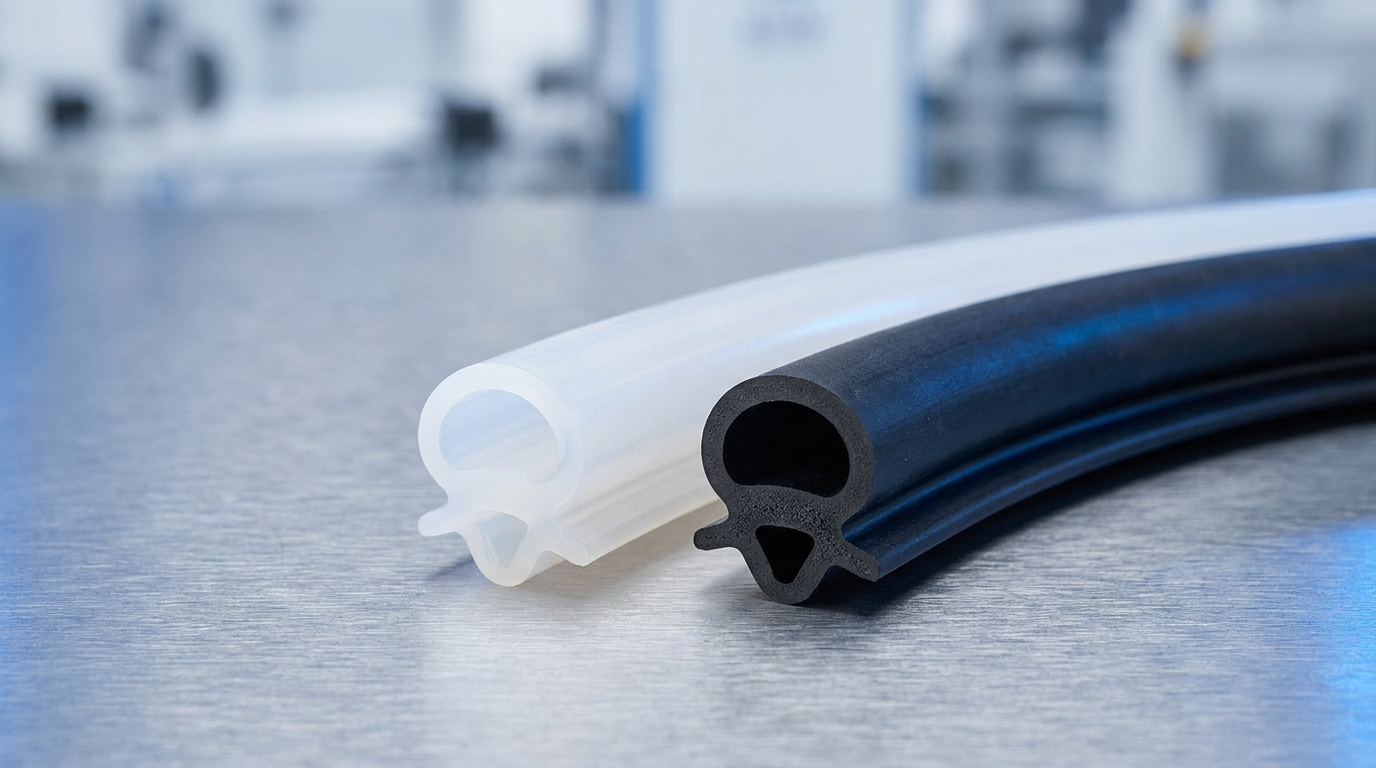
Silicone and EPDM are the two elastomers most often specified for inflatable seals, and for good reason — both are versatile, both seal reliably across a wide range of conditions, and both are stocked as standard by most serious seal manufacturers. But they are not interchangeable. Choosing the wrong one can mean a seal that swells in service, hardens in the cold, or fails a purity requirement. This guide compares them across the properties that decide real applications.
The short version
EPDM is the tougher, more chemically resilient general-purpose choice for water, steam, weather and many polar chemicals. Silicone (VMQ) is the high-purity, wide-temperature specialist for cleanrooms, food and pharmaceutical contact, and extreme heat or cold. Where an application is dominated by steam and dynamic abrasion, EPDM usually wins; where it is dominated by purity, temperature extremes or flexibility, silicone usually wins.
Temperature range
Silicone has the wider thermal window by a clear margin. In continuous service it covers roughly −60°C to +200°C, and specialist phenyl-silicone (PVMQ) grades stay flexible below −90°C. EPDM is narrower: about −50°C to +120°C when sulphur-cured, extending to around +150°C when peroxide-cured, which is why the cure system matters as much as the polymer when hot water or steam is involved. EPDM therefore matches silicone comfortably through the middle of the range but reaches neither extreme. If your seal will see genuine temperature extremes or rapid thermal cycling — furnace-adjacent equipment, autoclaves, cold chain — silicone is the safer specification.
Chemical and steam resistance
This is where EPDM earns its reputation. It resists water, steam, ozone, UV, weathering and a broad range of polar chemicals, dilute acids and alkalis, which is why it dominates outdoor, rail and water-handling applications. Silicone is excellent against oxidising environments and offers good resistance to many chemicals, but it is attacked by concentrated acids and alkalis, by aromatic and chlorinated solvents, and by hot water and superheated steam, which hydrolyse the siloxane backbone. Silicone is also markedly more permeable to gases than most elastomers — a real consideration in vacuum service and gas containment.
Neither material is suitable where mineral oils, greases or fuels are present: both swell and lose properties in hydrocarbon media. NBR (nitrile) is the usual base for general mineral oil and fuel service, and FKM for higher temperatures and more aggressive chemistry — though FKM type must be chosen with care, since standard grades are attacked by alcohol-blended fuels, ketones and glycol-ether brake fluids. Where fuel resistance and low-temperature flexibility are both required, fluorosilicone (FVMQ) bridges the gap. All are available on request.
Purity, food and pharmaceutical contact
Silicone is the natural choice wherever cleanliness and biocompatibility matter. It is physiologically inert, does not readily support microbial growth, and can be supplied in colours and in platinum-cured grades for cleanroom and process work. For pharmaceutical isolators, food and beverage equipment and semiconductor tools, silicone inflatable seals are usually specified for exactly these reasons. EPDM can be produced in compliant grades too, but silicone is the more common answer where purity is the driving requirement.
The certification that sits behind those grades — the relevant FDA provisions for food contact, and the biocompatibility framework for pharmaceutical use — is a specification decision in its own right, and it is changing in 2026. Our compliance guide to pharmaceutical and food-grade sealing covers it in detail.
Mechanical behaviour and cycle life
EPDM generally offers better abrasion resistance, tear strength and low compression set under mechanical load, which supports long cycle life in doors, hatches and equipment that see repeated mechanical contact. Silicone trades some mechanical toughness for its temperature and purity advantages; it has excellent compression set at high temperature but is softer and more prone to abrasion at ambient conditions. In a high-cycle, mechanically demanding door seal at moderate temperature, EPDM is often the more durable choice; in a high-temperature or high-purity duty, silicone's other properties outweigh the mechanical gap.
Compression set and long-term recovery
One property that often decides silicone-versus-EPDM in practice is compression set — the tendency of an elastomer to stay deformed after being held under load. A seal that takes a permanent set loses contact force and eventually leaks, regardless of how well it sealed when new. Silicone excels at retaining its recovery at high temperature, which is a major reason it is chosen for hot, static sealing duty. EPDM offers strong compression-set performance across the general industrial band and under dynamic mechanical loading. For a seal that sits compressed for long periods at elevated temperature, silicone's recovery is usually decisive; for a seal cycled mechanically at moderate temperature, EPDM often holds up better.
Cost and availability
EPDM is typically the more economical of the two and is widely available, which reinforces its position as the general-purpose default. Silicone commands a premium justified by its temperature range and purity credentials. For budget-sensitive projects where neither purity nor temperature extremes are decisive, EPDM often delivers the better value; where the application genuinely needs what silicone offers, the premium is money well spent because the alternative is early failure.
Common specification mistakes
When a custom compound is the answer
Real applications sometimes impose requirements that pull silicone and EPDM in opposite directions — high purity alongside hydrocarbon exposure, or extreme temperature alongside aggressive chemistry. In those cases a standard grade of either material will disappoint, and the right route is a custom-engineered compound formulated to balance the competing demands. Our in-house compounding capability lets the seal be tuned to the exact combination of temperature, chemistry, purity and mechanical duty the application presents, rather than forcing the design to accept the nearest catalogue material.
A quick selection guide
In practice, the right elastomer is decided by whichever requirement is non-negotiable: temperature, chemistry, purity or cost. Once that is fixed, the reinforcement, profile and inflation pressure follow. If two requirements pull in opposite directions, a custom-engineered compound is usually the resolution — and it is worth having that conversation before the gland is machined rather than after.
Key takeaways
Tell us your temperature, media and compliance targets and we will match your inflatable seal to the right elastomer — EPDM, silicone or a custom formulation — and validate it before it ships.
Need a custom sealing solution?
Talk to our engineers about inflatable seals, rubber diaphragms and custom extrusions built to your exact spec. We respond within one business day.
Frequently asked questions
Can EPDM handle steam better than silicone?
Yes. Peroxide-cured EPDM is the standard choice for steam and hot water, whereas superheated steam hydrolyses silicone's siloxane backbone and causes reversion. This is one of the few areas where EPDM clearly outperforms silicone.
Is silicone always the right choice for pharmaceutical equipment?
Usually, but not automatically. Silicone leads on purity and biocompatibility, but where the duty is dominated by repeated SIP steam cycles or heavy mechanical wear, a certified EPDM grade can be the more durable answer. Specify against the cleaning regime, not just the process fluid.
What if my application needs both purity and oil resistance?
Neither standard silicone nor EPDM will serve. That is a case for a custom-engineered compound or, depending on the chemistry, a compliant FKM grade — send us the full duty profile and we will formulate against it.

Need a quote?
For custom rubber sealing solutions contact us. We will respond to you within 1 business day


.avif)