
Posted on
October 29, 2026
Requirement Sets Decoded: How to Find the Right R-Number for a Rail Rubber Part
How EN 45545-2 requirement sets work, which tests each one calls for, and how to confirm which requirement set applies to a rail rubber seal, gasket or hose.
A supplier who says a compound meets "EN 45545-2 HL3" has told you very little. HL3 is a hazard level. The actual pass and fail limits sit inside a requirement set, and different parts on the same vehicle are assigned different requirement sets. A seal tested against the wrong set produces a report that answers a question nobody asked.
This guide explains what a requirement set is, how it connects to the hazard level of the vehicle, how to work out which one applies to a rubber part and what to look for on a certificate. It also sets out the HL3 limits for R22 and R23 and the report that covers Western Sealtech's EPDM compound.
What a Requirement Set Is
EN 45545-2 contains a table of requirement sets numbered R1 to R26. Each one is tied to a product category, such as interior surfaces, seating, electrical equipment, cables or other items. For every requirement set the standard lists which tests apply and the limit values for each hazard level. The chain therefore runs in three steps:
- The vehicle is assigned a hazard level (HL1, HL2 or HL3)
- The part is assigned a requirement set (R-number) based on what it is and where it is fitted
- The requirement set and the hazard level together define the tests and the limits the material must meet
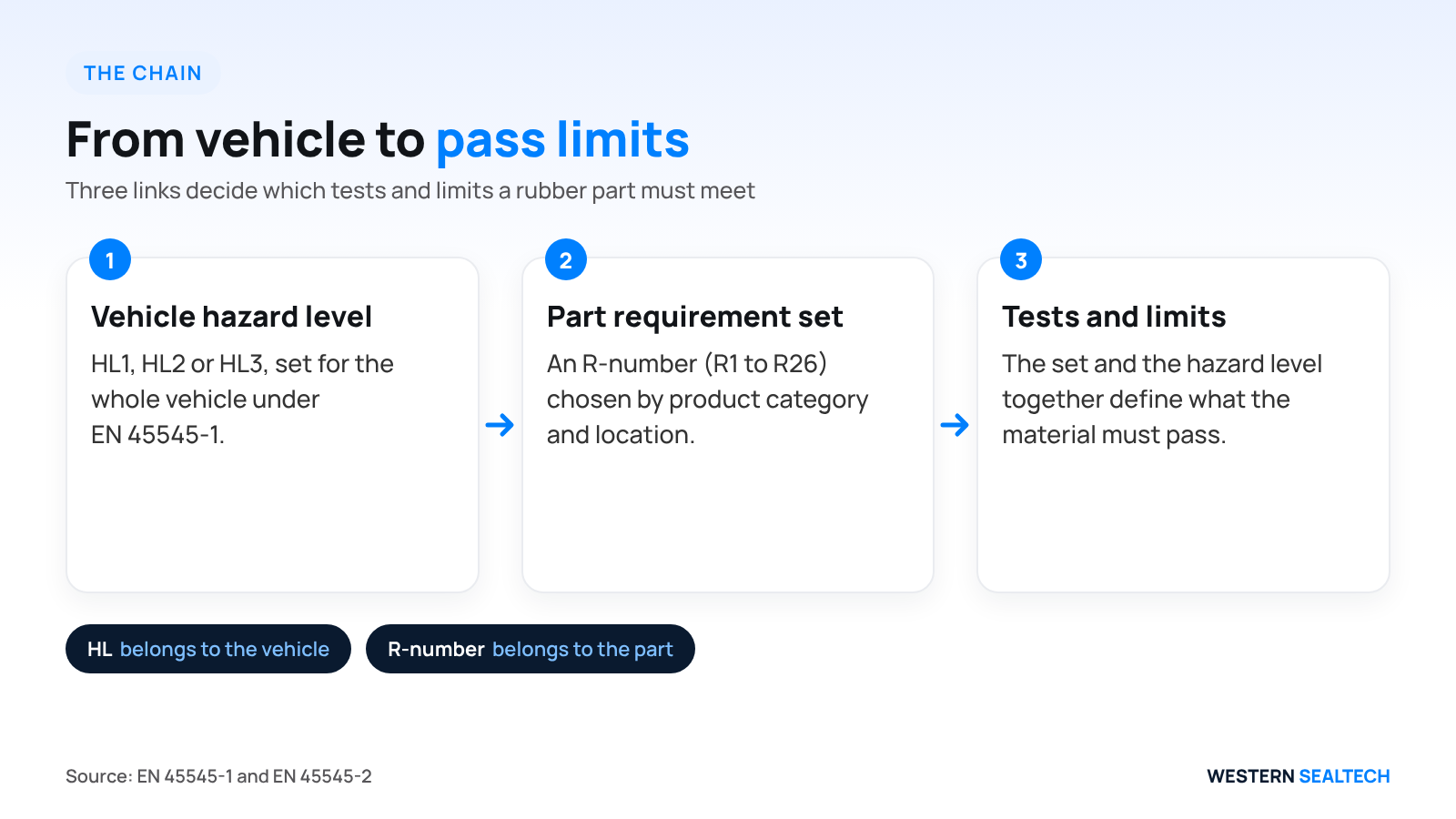
The first link belongs to the vehicle and the second belongs to the part. That is why a hazard level on its own tells a buyer very little. Our guide to HL1, HL2 and HL3 explains how the vehicle side is decided, and this article covers the part side.
The Tests Behind the Numbers
Requirement sets draw on a common group of laboratory tests. Not every set calls for every test, and the limit values tighten as the hazard level rises.
| Test Parameter | What It Measures | Reference Method |
|---|---|---|
| Oxygen index (OI) | Lowest oxygen concentration that sustains burning | EN ISO 4589-2 |
| Critical flux at extinguishment (CFE) | Lateral flame spread | EN ISO 5658-2 |
| Maximum average rate of heat emission (MARHE) | Heat release under a cone heater | EN ISO 5660-1 |
| Ds max, Ds(4) and VOF4 | Smoke density in a closed chamber | EN ISO 5659-2 |
| CITG | Toxicity of the combustion gases | EN 17084 |
💡 Tip: Request the requirement set from the vehicle manufacturer in writing before you commission test work. It avoids repeating tests later.
Smoke density and toxicity are often the hardest results for rubber to meet, and they are explained in detail in our article on smoke density and toxicity testing. If a term on a certificate is unfamiliar, our terminology reference gives plain-language definitions of the abbreviations used.
Where Rubber Parts Usually Fall
Door seals, window gaskets, hoses, diaphragms and bellows are not assigned a requirement set by their material. They are assigned one by their product category and location. The requirement sets most often seen on elastomer certificates are in the R22 to R24 range, but the correct one for a specific part depends on its function, where it sits on the vehicle and how large it is. The standard also contains provisions for small items and for items not otherwise listed, which is a frequent source of confusion on rubber parts.
| Test Method | Parameter | Requirement as per R23: HL3 of EN 45545-2 | Requirement as per R22: HL3 of EN 45545-2 |
|---|---|---|---|
| Smoke Density as per ISO 5659-2:2017 and Toxicity as per EN 17084:2018, Method 1 | Dₛ Max | Maximum 300 | Maximum 150 |
| Smoke Density as per ISO 5659-2:2017 and Toxicity as per EN 17084:2018, Method 1 | CIT₍G₎ | Maximum 1.5 | Maximum 0.75 |
| Limited Oxygen Index (as per ISO 4589-2:2017) | Oxygen content (%) | Minimum 32 | Minimum 32 |
Western Sealtech's certified EPDM compound is covered by test report DO-25-7151/A-R1, classified HL3 against requirement sets R22 and R23 of EN 45545-2.
📊 Reading the table: R22 carries the tighter smoke and toxicity limits (Ds max 150, CITG 0.75), while R23 allows Ds max 300 and CITG 1.5. The oxygen index minimum is 32 for both.

The practical consequence is that the two sets are not interchangeable. A compound that meets the R23 limits can still fail R22, because the R22 limits for smoke density and toxicity are half as high. A compound qualified against both sets, as our EPDM compound is under report DO-25-7151/A-R1, can be offered for parts under either set, provided each part really falls under one of them.
Three Questions to Find the Right Requirement Set
- Where is the part fitted? Interior or exterior, visible to passengers or hidden behind panels or inside underframe equipment
- What does the part do? A surface, a seal, a hose, a component inside an electrical or mechanical assembly
- How large is it? Size can move a part into a different treatment under the standard, so confirm the dimensions that matter with the vehicle manufacturer
The vehicle manufacturer's fire safety documentation normally states the requirement set for each part. Ask for it in writing before ordering test work.
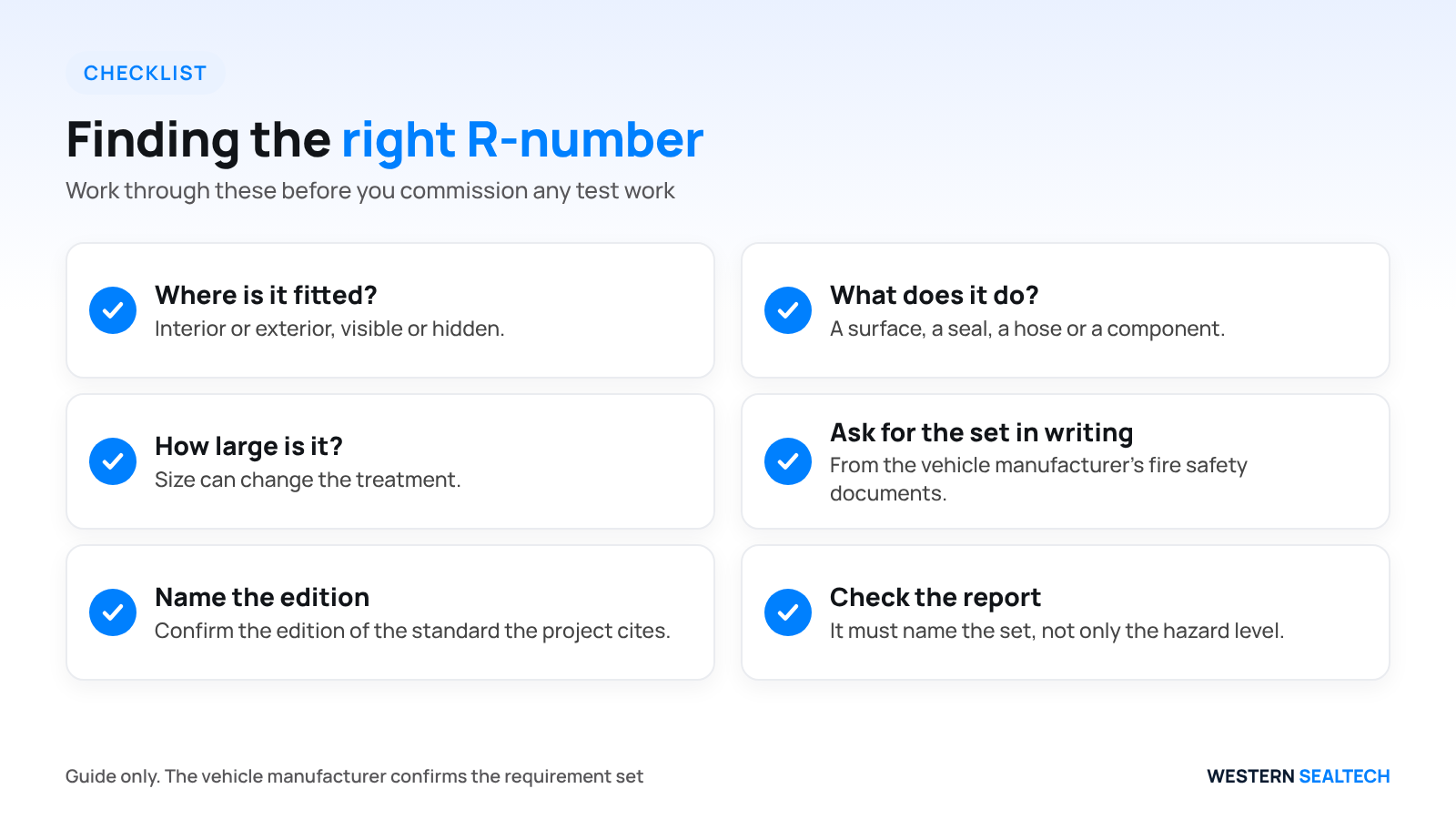
Two points are worth adding to the list. First, name the edition of the standard the project cites, because limits and methods have been revised between editions. Second, check that every report you receive names the requirement set explicitly. A certificate that shows a hazard level and a list of results, but no R-number, cannot be matched to a part.
Reading a Report Against the Set
Once the set is known, a report becomes much easier to judge. A useful certificate shows the hazard level, the requirement set or sets, the edition of EN 45545-2, the test methods with their dates, the results line by line and the exact compound code that was tested. Our guide on how to read an EN 45545-2 test report walks through a full report step by step.
Also check who carried out the work. The laboratory should be competent for the test methods named on the report, and the report should identify the laboratory, the date of testing and the report number so that it can be traced. Where a report carries a revision suffix, such as the A-R1 in DO-25-7151/A-R1, make sure you are looking at the current revision.
✅ Report check: Compare each result with the limit for your set and hazard level, and check that the compound code on the report matches what is being delivered.
If the project also references other fire standards, our comparison of EN 45545-2, DIN 5510-2, NFPA 130 and BS 6853 explains how they differ, so you can see which results carry across and which need separate testing.
Common Mistakes With Requirement Sets
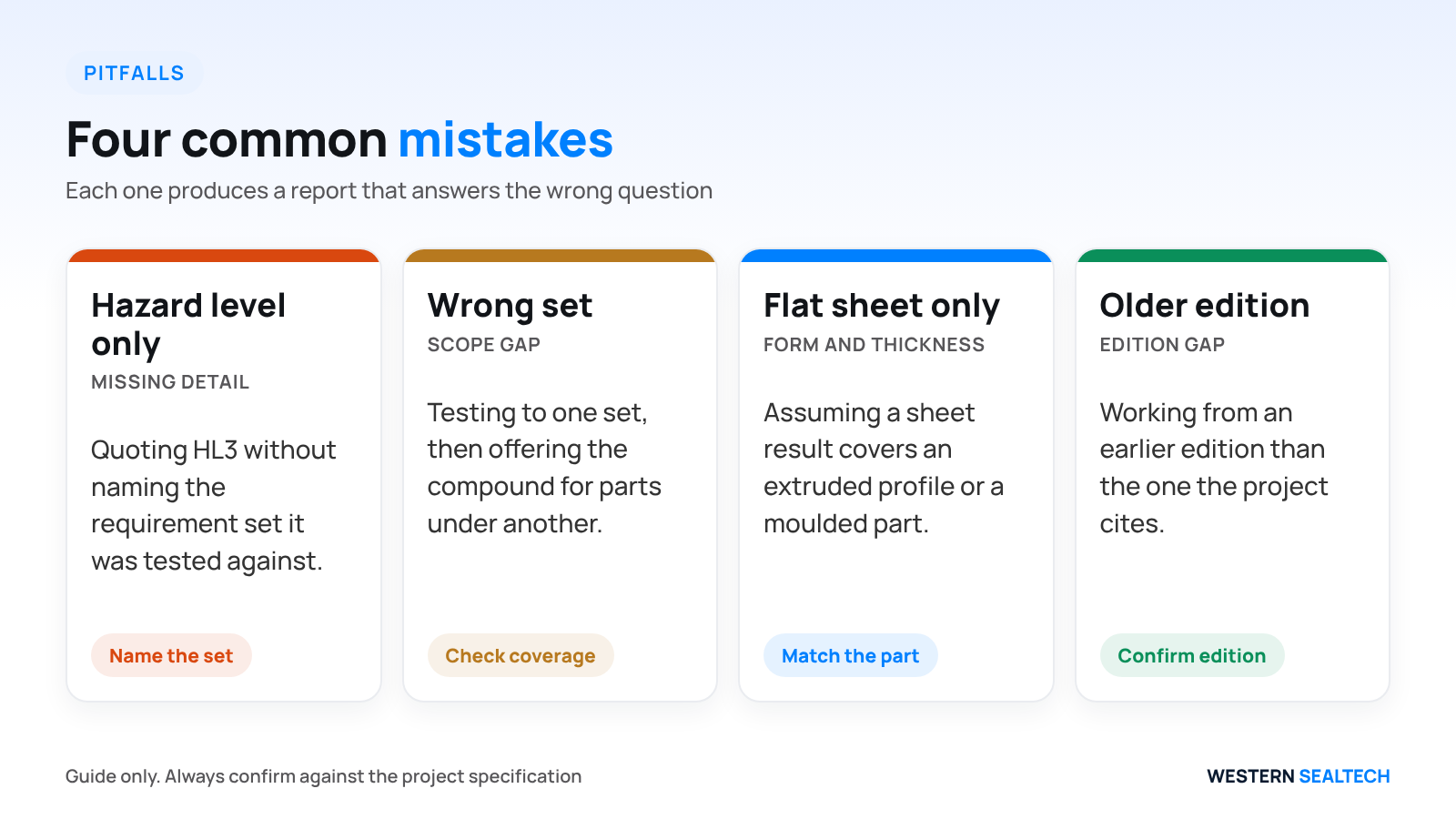
- Quoting a hazard level without naming the requirement set it was tested against
- Testing a compound to one requirement set and then offering it for parts that fall under another
- Assuming a flat sheet result also covers an extruded profile or a moulded part of different thickness
- Working from an older edition of the standard than the one the project cites
Our EPDM compound is classified as HL3 and tested against the applicable requirements of EN 45545-2. The number of requirement sets covered in a single test programme depends on the intended application and agreed testing scope.
⚠️ Watch out: A compound is not covered for a requirement set just because it passed a similar one. Every test and limit the set calls for must be met.
How Requirement Sets Apply to Different Rubber Parts
Rail vehicles use many types of rubber part, and each type raises its own questions about which set applies and which form was tested:
- Inflatable door seals are large, visible parts. Our comparison of inflatable and static door seals explains how the two seal types differ, and the construction of the finished seal should match what was tested
- Window and body gaskets are normally made from rubber extrusions, so a report on a flat sheet may not cover the profile you are buying
- Spliced and vulcanised seals include joints and corners, which are part of the finished construction
- Silicone tubing and hoses are covered by their own product category and location, so check the set for each hose application separately
For a wider view of how fire-safe sealing is specified across vehicles, see our rail and mass transit sealing page and our article on EN 45545 fire-safe sealing for rail and mass transit.
Working With Compounds Across Several Requirement Sets
Many projects involve several parts under different sets, which tempts buyers to qualify a single compound for everything. That can work, but it is a decision with trade-offs. A compound developed for the tighter limits typically needs more flame retardant and smoke suppression, which can affect hardness, compression set and cost, as covered in our article on how EN 45545 compliant compounds are formulated.
The right balance depends on the application, so we recommend that you list the parts, their sets and their mechanical needs first, then choose compounds. Our guide to elastomer selection for rail helps with the base polymer choice, and the REACH and RoHS article covers the substance restrictions that also apply.
📌 Note: Fire results belong to one compound in one tested form. If the formulation changes, check whether the existing report still covers it before supplying it against the same requirement set.
Key Takeaways
A hazard level belongs to the vehicle and a requirement set belongs to the part. To find the right R-number, check where the part is fitted, what it does and how large it is, then get the requirement set confirmed in writing in the vehicle manufacturer's fire safety documentation. For HL3, R22 carries tighter smoke and toxicity limits than R23, so the two are not interchangeable. Never accept a report that quotes HL3 without naming the requirement set and the edition of EN 45545-2 it was tested to.
Need an EN 45545-2 compliant rail seal, gasket or hose? Send us your requirement set and hazard level and our engineers will confirm what we can supply.
Need a custom sealing solution?
Talk to our engineers about inflatable seals, rubber diaphragms and custom extrusions built to your exact spec. We respond within one business day.
Frequently asked questions
Can one compound be certified to more than one requirement set?
Yes, provided it has been tested to every test and limit that each requirement set calls for. A compound is not covered for a set simply because it passed a similar one.
Who decides which requirement set applies to a part?
The requirement set follows from the part's product category and location under the standard, and is normally confirmed in the vehicle manufacturer's fire safety documentation rather than chosen by the component supplier.
Do I need a new report if a part moves from the interior to the exterior of a vehicle?
Possibly. Interior and exterior parts can fall under different requirement sets with different tests or limits, so the existing report should be checked against the new set before it is reused.
Do requirement set limits change between editions of the standard?
They can. Amendments and new editions have revised test methods and limits in places, so always confirm the edition cited in the project specification.
Is a requirement set the same thing as a hazard level?
No. The hazard level belongs to the vehicle. The requirement set belongs to the part. The two combine to define the limits the material must meet.
Why are R22 and R23 not interchangeable at HL3?
Their limits differ. At HL3, R22 allows a maximum Ds max of 150 and a maximum CITG of 0.75, while R23 allows 300 and 1.5. A compound that passes R23 can still fail R22.
Does a report on a flat sheet cover an extruded or moulded part?
Not automatically. Smoke results depend on specimen thickness and form, so the report should be checked against the part you are buying, and the vehicle manufacturer should confirm what is acceptable.

Need a quote?
For custom rubber sealing solutions contact us. We will respond to you within 1 business day