
Posted on
October 29, 2026
EN 45545 Terminology Reference: Terms Every Rail Rubber Buyer Should Know
A plain-language reference to the key terms, abbreviations and test parameters used in EN 45545, for engineers and buyers reading fire test reports for rail rubber.
EN 45545 reports are dense with abbreviations. Reading a supplier's test report, or writing a specification, is much easier once the vocabulary is clear. A buyer who does not know the difference between a hazard level and a requirement set, or between Ds max and VOF4, can easily accept a report that does not answer the question that was asked.
This reference collects the terms used most often when buying rail rubber, in plain language, with pointers to the articles that explain each one in more depth. It is organised the way a buyer meets the standard: first the structure of EN 45545, then how a vehicle and a part are classified, then the test parameters, and finally the report and supply chain terms that decide whether a certificate still applies to what arrives on site. For the wider picture of fire-safe sealing on rolling stock, see our overview of EN 45545 fire-safe sealing for rail and mass transit.
The Standard and Its Parts
EN 45545 is a series, not a single document. Each part covers a different aspect of fire protection on railway vehicles, and for rubber seals, gaskets and hoses the part that matters most is EN 45545-2.
| Term | Plain-Language Meaning |
|---|---|
| EN 45545 | The European series of standards on fire protection on railway vehicles |
| EN 45545-1 | General part, including the classification of vehicles into operation and design categories and hazard levels |
| EN 45545-2 | Requirements for the fire behaviour of materials and components |
| EN 45545-3 | Fire resistance requirements for fire barriers |
| EN 45545-4 | Fire safety requirements for rolling stock design |
| EN 45545-5 | Fire safety requirements for electrical equipment |
| EN 45545-6 | Fire control and management systems |
| EN 45545-7 | Fire safety requirements for flammable liquid and flammable gas installations |
When a supplier says a product is "EN 45545 compliant", ask which part and which requirement set they mean. For most rubber components the answer should be EN 45545-2, and the report should name the requirement set and hazard level that were tested. Our article on EN 45545 compliant compounds explains how formulation and performance fit together once the target is clear.
The standard is also only one of several in use around the world. If your project crosses borders, our comparison of EN 45545-2, DIN 5510-2, NFPA 130 and BS 6853 shows how the terms and test methods differ between them.
Classification Terms
These terms describe the vehicle and the part, not the material. They decide which tests a compound has to pass in the first place.
| Term | Plain-Language Meaning |
|---|---|
| Operation category | Classification of the line the vehicle runs on and how easily passengers can be evacuated, from category 1 to category 4 |
| Design category | Classification of the vehicle type: N for standard, A for automatic (driverless), D for double-deck, S for sleeping or couchette |
| Hazard level (HL) | The fire requirement level assigned to a vehicle, HL1 to HL3, found by combining operation category and design category |
| Requirement set (R-number) | The group of tests and limits assigned to a product category, numbered R1 to R26 |
| Product category | The type and location of a part, which decides its requirement set |
📌 Remember: The hazard level belongs to the vehicle and the requirement set belongs to the part. Together they define the tests and limits a material must meet.
How the Terms Fit Together
The easiest way to keep the terms straight is to follow the chain from the vehicle to the part. The operation category and design category are properties of the vehicle and the line it runs on. Combined, they give the hazard level. Separately, the part is assigned a product category based on what it is and where it is fitted, and that category points to a requirement set. The hazard level and the requirement set are then read together to find the tests and limits.

This is why two parts on the same vehicle can face very different tests. A seal around a passenger door, a gasket inside an electrical cabinet and a hose under the floor can sit in different product categories, even though the vehicle has a single hazard level. The way the hazard level is found is explained at the end of this article, and our comparison of HL1, HL2 and HL3 shows what changes for a rubber part as the level rises. The step that assigns a part to a set is covered in how to find the right R-number.
Test Parameters
The parameters below are the values you will see in a test report. Each one is the result of a laboratory test, and each has a direction in which a better material scores.
| Term | Plain-Language Meaning |
|---|---|
| OI (oxygen index) | Lowest oxygen concentration at which a material keeps burning. Higher means harder to burn |
| CFE (critical flux at extinguishment) | The heat flux at which a spreading flame stops. Higher means better resistance to flame spread |
| MARHE | Maximum average rate of heat emission. Lower means less heat released in a fire |
| Ds(4) | Specific optical density of smoke at four minutes |
| Ds max | Maximum specific optical density of smoke reached in the test |
| VOF4 | Cumulative smoke density over the first four minutes |
| CIT, CITG (also ITC in older documents) | Conventional index of toxicity calculated from measured combustion gas concentrations. Lower is better |
📊 Quick rule: Higher is better for OI and CFE. Lower is better for MARHE, Ds, VOF4 and CITG.

The table in the figure also shows the test method behind each parameter. Knowing the method matters, because limits are defined for a specific test condition, specimen thickness and irradiance. A value from a different method or a different thickness cannot be compared directly with the limit in the standard.
Smoke and Toxicity
For rubber, smoke density and toxicity are often the parameters that decide whether a compound passes. Ds(4), Ds max and VOF4 all describe how dense the smoke becomes, which matters for visibility during evacuation. CITG describes how toxic the combustion gases are. Our article on smoke density and toxicity testing for rail elastomers explains how these tests are run and why the base polymer has such a strong influence on the result.
The choice of polymer matters here. Halogenated rubbers tend to weigh heavily on toxicity, while silicone usually performs well on smoke and toxicity. If you are comparing materials for a specific part, our guide to elastomer selection for rail: EPDM, silicone and FKM sets out how each one behaves.
Test Methods Referenced
| Method | Used For |
|---|---|
| EN ISO 4589-2 | Oxygen index |
| EN ISO 5658-2 | Lateral flame spread |
| EN ISO 5660-1 | Heat release by cone calorimeter |
| EN ISO 5659-2 | Smoke density in a closed chamber |
| EN 17084 | Toxic gas emission analysis |
A good report quotes the method for each result. If a report lists a value without naming the method, ask the test house to confirm it. The same discipline applies to the standard edition and the date, because the requirements and methods have been revised over the years.
Fire behaviour is only one part of a rail rubber specification. Mechanical properties such as hardness and compression set are tested separately, and our guide to Shore hardness and compression set in rail sealing explains how to read those results alongside the fire data. Material restrictions are a third strand, covered in REACH and RoHS substance restrictions for rail rubber.
💡 Tip: Keep one sheet per part that lists the hazard level, the requirement set, the methods and the limits. It makes every supplier report faster to check.
Report and Supply Chain Terms
The terms below are not in the standard itself. They describe what happens between the laboratory and your production line, and they are where many problems begin.
- Test house - the accredited laboratory that performed the tests and issued the report
- Notified body - an organisation designated to carry out conformity assessment tasks under European rules
- Compound reference - the supplier's internal code for the exact formulation tested
- Compound drift - a change in the production compound after the report was issued, which can make the report no longer valid
- Requalification - repeating testing after a formulation or construction change
- Dual certification - a compound tested against more than one standard, for example EN 45545-2 and NFPA 130
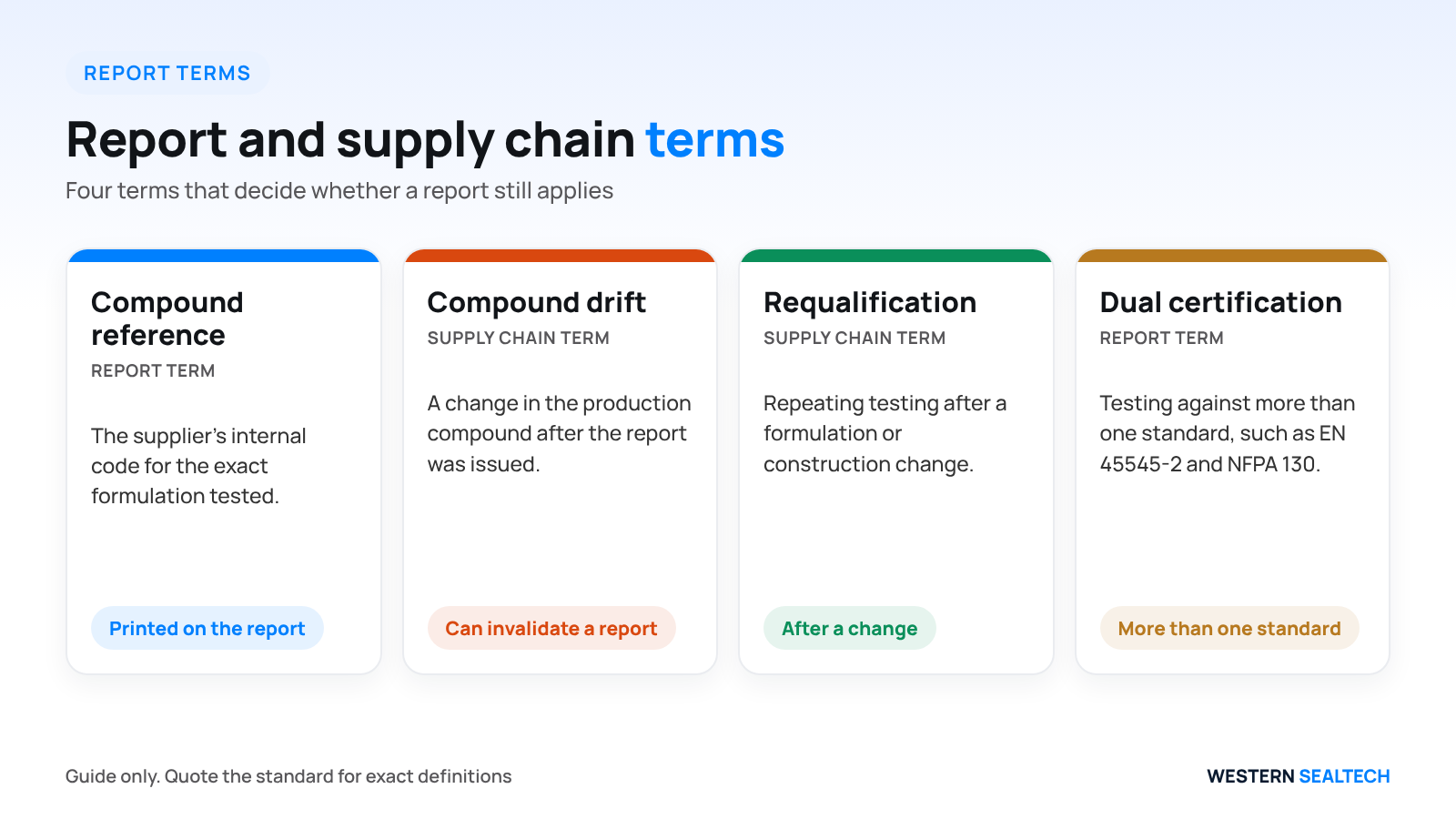
💡 Tip: Compound drift, a change in the production compound after the report was issued, can make a report no longer valid. Check that the compound code on the report matches what you receive.
Tracing a Report to the Part You Receive
A test report proves something about the specimen that was tested. It says nothing about a part unless you can show that the part is made from the same compound. Three identifiers do that job: the compound code, the batch or lot number and the internal report reference. When all three agree, the chain from report to delivered part is unbroken.
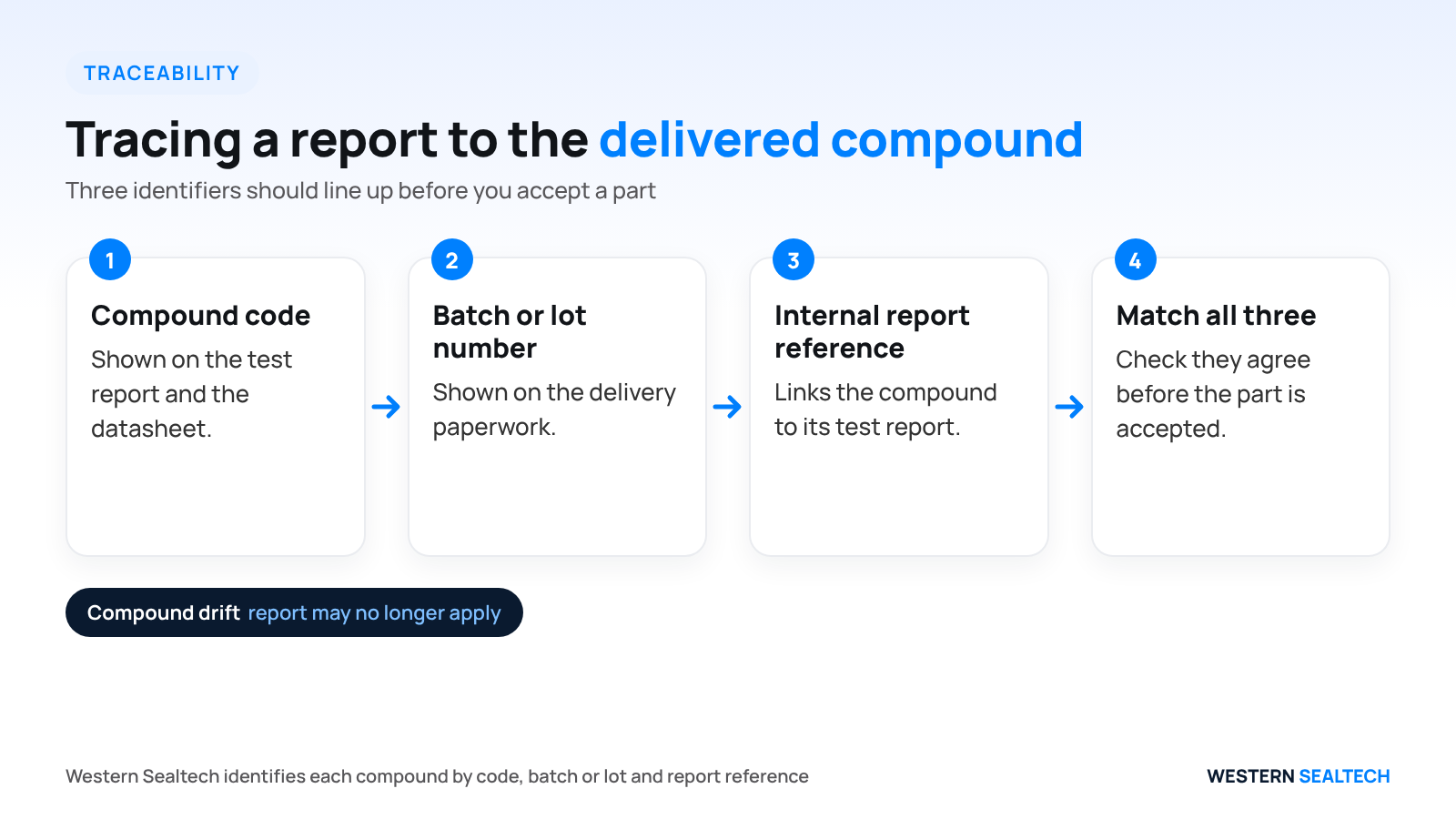
Western Sealtech test reports and datasheets identify each compound by its compound code, batch or lot number and internal report reference, so a report can always be traced to the compound delivered.
The same check applies to the construction. A report on a flat sheet of cover compound does not automatically cover a laminated or reinforced part, so confirm what was tested. Our overview of rubber extrusions and our range of inflatable seals each describe the constructions we supply, and our silicone tubing and hoses cover the fluid and air line side.
Common Misreadings to Avoid
- Treating a hazard level as a pass mark. HL3 tells you the vehicle's level, not what the part was tested against. Look for the requirement set.
- Comparing values across methods. A smoke or toxicity value only means something under the test condition it was measured in.
- Accepting a report for a different compound. A similar compound is not the same compound. Match the code.
- Forgetting the construction. A test on the rubber alone may not cover a part built from several layers.
- Ignoring the date. A report written under an earlier edition may not satisfy a project that cites the current one.
Silicone and EPDM behave differently in these tests, and the right choice depends on the part and its duty. Our comparison of silicone and EPDM inflatable seals is a good starting point, and our inflatable seals design guide covers the mechanical side of the decision.
Where to Read More
Each of these terms is explained in more depth in the articles in this series, including how hazard levels are set, how requirement sets are assigned, how to read a test report and what smoke and toxicity results mean. For the sector as a whole, our page on fire-safe sealing solutions for rail and mass transit brings the products and standards together.
Key Takeaways
EN 45545-2 sets the fire behaviour requirements for rail materials. The hazard level belongs to the vehicle, the requirement set belongs to the part, and test parameters such as OI, CFE, MARHE, Ds, VOF4 and CITG show how a compound behaves in a fire. Knowing the report and supply chain terms, from test house to compound drift, makes supplier reports far easier to read critically.
Have a rail rubber test report you want to check against your specification? Our team can walk through it with you.
Need a custom sealing solution?
Talk to our engineers about inflatable seals, rubber diaphragms and custom extrusions built to your exact spec. We respond within one business day.
Frequently asked questions
What does HL stand for in EN 45545?
HL stands for hazard level. It is the requirement level assigned to a rail vehicle, from HL1 to HL3.
What is the difference between a hazard level and a requirement set?
The hazard level belongs to the vehicle. The requirement set belongs to the part. Together they define the tests and limits a material must meet.
Is ITC the same as CIT?
They refer to the same concept, a conventional index of toxicity. ITC is the older abbreviation and CIT or CITG is the form used with the current method.
Which part of EN 45545 applies to rubber seals and hoses?
EN 45545-2, which sets the fire behaviour requirements for materials and components.
What does a lower Ds value mean?
Lower specific optical density means less dense smoke, which is better for visibility during evacuation.
What is compound drift and why does it matter?
Compound drift is a change in the production compound after the test report was issued. If the formulation has changed, the report may no longer describe what you are buying, so check the compound code and ask the supplier about requalification.
How can I check that a test report applies to the parts delivered?
Match the compound code on the report and datasheet, the batch or lot number on the delivery paperwork and the supplier's internal report reference. If all three agree, the report can be traced to the delivered compound.

Need a quote?
For custom rubber sealing solutions contact us. We will respond to you within 1 business day