
Posted on
October 29, 2026
HL1 vs HL2 vs HL3: How Vehicle Type Determines Your Fire Class
How operation category and design category combine to set the EN 45545 hazard level for a rail vehicle, and what that means for rubber component sourcing.
Hazard level is a property of the vehicle, not the component. A rubber seal does not choose to be HL3. The vehicle it is fitted to is classified under EN 45545-1, and that classification sets how demanding the fire requirements are for every material and part on board. For a supplier, the practical question is always "which hazard level is this project, and who confirmed it in writing".
This article explains how the hazard level is decided, what it changes for a rubber compound and what buyers should confirm before they request a quotation. It stays at the vehicle level. Part-level rules are covered in our guide to EN 45545-2 requirement sets.
Hazard Level Belongs to the Vehicle
The same door seal compound can be perfectly adequate on one project and non-compliant on another, purely because the two vehicles carry different hazard levels. This is why a datasheet that says "EN 45545-2 compliant" without naming a hazard level is incomplete.
It also explains why a supplier cannot decide the hazard level on the buyer's behalf. The vehicle manufacturer or operator makes the classification, and everything downstream, from compound choice to test programme, follows from it. Our deeper article on how hazard levels are set from operation and design categories covers the classification in more detail.
Two Inputs: Operation Category and Design Category
The hazard level comes from combining two classifications:
- Operation category (1 to 4) describes the line the vehicle runs on and how easily passengers can be evacuated to a safe place. Category 1 covers surface lines with easy side evacuation. Higher categories cover tunnel, underground or elevated running where evacuation is harder and takes longer.
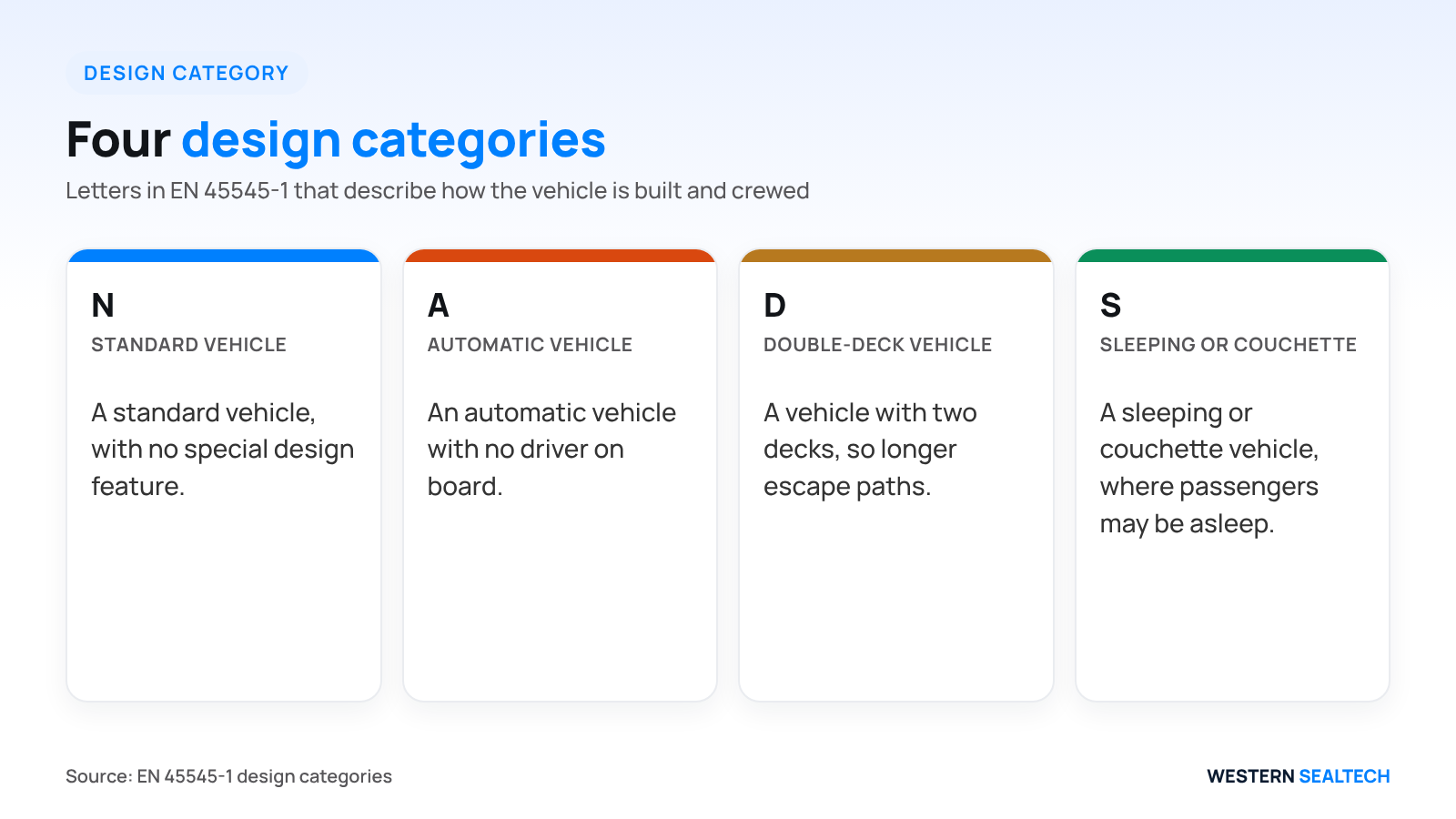
- Design category describes how the vehicle is built and crewed. Category N is a standard vehicle, A is an automatic vehicle with no driver on board, D is a double-deck vehicle, and S is a sleeping or couchette vehicle.
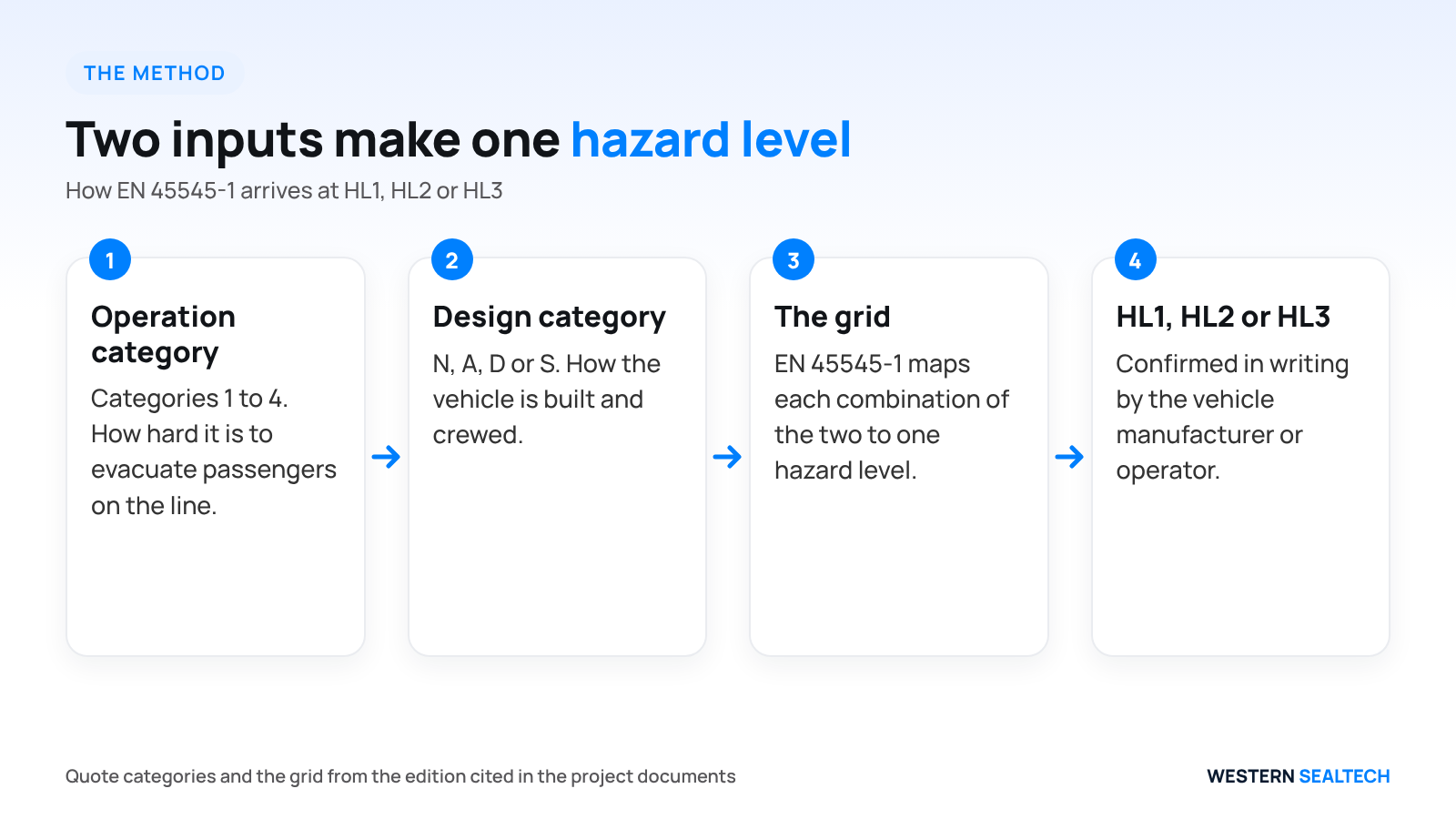
The precise definitions, including the time limits that separate the operation categories, are written in EN 45545-1 and should be quoted from the edition cited in the project documents.
📌 Note: Hazard level is set by the vehicle manufacturer or operator, not by the component supplier. Ask for it in the project specification instead of assuming it from the vehicle type.
How the Two Combine
EN 45545-1 contains a grid that maps each combination of operation category and design category to HL1, HL2 or HL3. The direction of travel is easy to remember even when the grid is not in front of you:
| Vehicle Scenario | Direction of Hazard Level | Why |
|---|---|---|
| Standard vehicle on surface lines with side evacuation | Lower, typically HL1 | Passengers can leave quickly and safely |
| Standard vehicle with tunnel or elevated sections | Intermediate | Evacuation takes longer |
| Double-deck or sleeping vehicle | Raised for the same route | Longer escape paths, or passengers who may be asleep |
| Driverless vehicle running in tunnels | Highest, typically HL3 | No crew on board and difficult evacuation |
This table is directional only. The actual hazard level for a project must be read from the grid in EN 45545-1 and confirmed by the vehicle manufacturer or operator.
The logic behind the direction is consistent. The harder it is to get people out, and the longer they may be exposed to smoke and heat, the more the standard asks of the materials around them. A metro in a long tunnel, with no driver on board, is a very different fire problem from a surface regional train with doors at every carriage.
💡 Tip: If a project description only says "metro" or "regional train", ask which operation and design category apply. The vehicle type alone does not fix the hazard level.
What the Hazard Level Changes for a Rubber Compound
Moving from HL1 to HL3 does not change which tests are run. It changes the limits those tests must meet. Smoke density and toxicity limits tighten, flame spread and heat release limits tighten, and the compound needs more flame retardant and smoke suppression to pass. That in turn affects cost, hardness and compression set, as covered in our article on how EN 45545 compliant compounds are formulated.
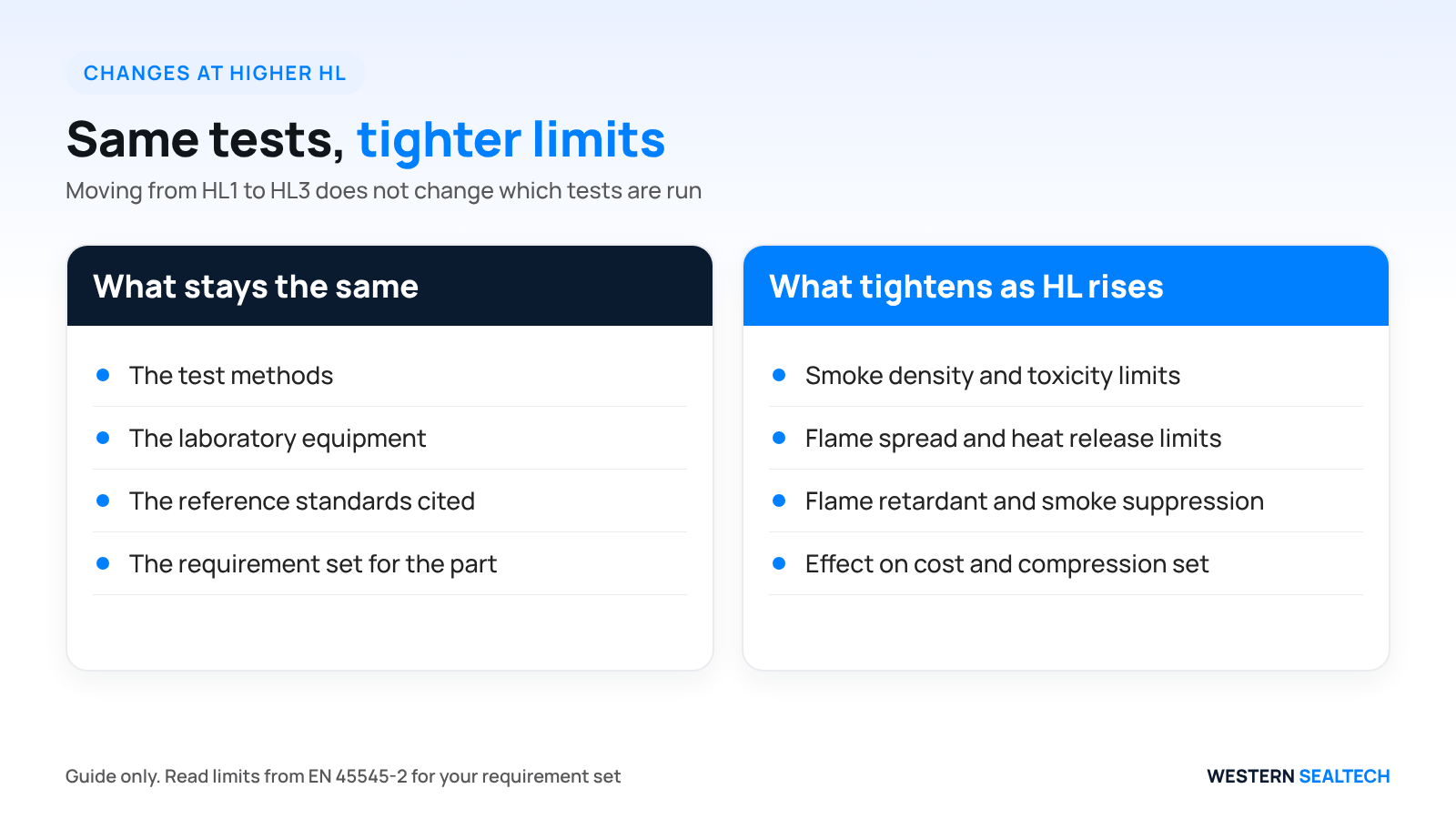
📊 Rule of thumb: Hazard level changes the pass limits, not the test methods. When you compare supplier reports, compare the limits each result was held to, not just the list of tests.
The mechanical side matters as much as the fire side. Flame retardant fillers can stiffen a compound and raise compression set, which shows up as lost sealing force over time. Our article on Shore hardness and compression set explains why those two properties matter so much for a seal, and our guide to elastomer selection for rail shows how the base polymer choice affects the trade-off.
For smoke and toxicity in particular, see our article on smoke density and toxicity testing, which explains what the results mean and how base polymer changes them.
Practical Implications for Sourcing
- Ask for the hazard level in the project specification rather than assuming it from the vehicle type
- Ask which requirement set applies to each rubber part as well, since the hazard level alone does not define the tests
- Decide whether to qualify one high-level compound for several projects or to match compounds to hazard levels. A single HL3 compound simplifies inventory but may carry cost and property trade-offs on projects that only need HL1
Our current EPDM compound range is qualified for HL3 according to EN 45545-2 requirements R22/R23, as confirmed by the test report. We recommend selecting compounds based on the required hazard level and application, rather than assuming one compound is suitable for all hazard levels. Separate qualification should be confirmed for each applicable requirement set and hazard level.

✅ Sourcing checklist: Get the hazard level, the requirement set for each rubber part and the edition of the standard in writing before you request a quotation.
Applying the Hazard Level to Different Rubber Parts
The hazard level applies to every rubber part on the vehicle, but each type of part raises its own practical questions:
- Inflatable door seals are large and visible, so fire performance has to be confirmed on a construction that represents the finished seal. Our comparison of inflatable and static door seals explains how the two types differ
- Gaskets and profiles are usually rubber extrusions, where thickness and cross-section can influence test results
- Spliced and vulcanised seals add joints and corners that belong to the tested construction
- Silicone tubing and hoses serve air, water and drainage circuits and need the requirement set confirmed for each application
For an overview of how these products come together on a vehicle, see our rail and mass transit sealing page and our article on fire-safe sealing for rail and mass transit. If your project references standards other than EN 45545-2, our standards comparison explains how they relate.
Illustrative Projects and What They Mean for a Buyer
A few simple cases show how the same compound can sit differently from project to project. These are illustrations only, and the real hazard level for any vehicle must come from the grid in EN 45545-1 and the vehicle manufacturer's confirmation.
- A standard vehicle on a surface line with side evacuation. Passengers can usually leave quickly, so the hazard level tends to be at the lower end. A compound built for the tightest limits may be more than the project needs, and cost and mechanical properties then become the deciding factors
- A standard vehicle that runs partly in tunnels or on elevated sections. Evacuation takes longer, so the level typically rises. The buyer should confirm early which sections of the route drive the classification
- A driverless vehicle running in tunnels. There is no crew on board to assist and evacuation is difficult, which is why this kind of combination typically reaches the highest level
In all three cases the right first step is the same: obtain the hazard level in writing, then work out the requirement set for each rubber part. Only then does it make sense to compare compounds and test reports.
Documents Worth Requesting at the Start of a Project
Most confusion about hazard level can be avoided by asking for the same few documents at the outset. The project technical specification normally states the hazard level and the edition of the standard. The vehicle manufacturer's fire safety documentation normally lists the requirement set for each part category. A list of approved materials, where one exists, shows what has already been accepted on similar projects.
📌 Note: Fire qualification of a compound takes time to plan and carry out, so confirming the hazard level early helps avoid late changes to the compound or to the test programme.
Reading Supplier Claims About Hazard Level
Because hazard level is easy to quote and easy to misread, claims about it need a second look. A statement that a compound is "HL3 compliant" should always be followed by three questions: which requirement set or sets, which edition of the standard, and which test report covers the exact compound being supplied. Our guide on how to read an EN 45545-2 test report shows where to find each answer, and our terminology reference explains the abbreviations used on certificates.
⚠️ Watch out: An HL3 result does not automatically cover an HL3 project. The report must be for the requirement set that applies to the part, and for the compound as delivered.
Key Takeaways
Hazard level is a property of the vehicle, set by combining its operation category and design category under EN 45545-1. Higher hazard levels keep the same test methods but tighten the limits, which affects compound cost, hardness and compression set. Confirm the hazard level and the requirement set for each part in the project specification, and qualify compounds for each combination you intend to supply.
Not sure which hazard level your project needs to meet? Share your specification and our team will help you match the right rail-qualified compound.
Need a custom sealing solution?
Talk to our engineers about inflatable seals, rubber diaphragms and custom extrusions built to your exact spec. We respond within one business day.
Frequently asked questions
Is HL3 always required for metro vehicles?
Not automatically. The hazard level follows from the operation and design category of the specific vehicle, and a metro on a different route or design can land on a different level. Driverless vehicles in tunnels are among the combinations that typically reach HL3.
Can a compound qualified at HL3 be used on an HL1 project?
Technically yes, because it meets the stricter limits. Whether it is the right commercial choice depends on cost and on the mechanical properties of the compound.
Who confirms the hazard level for a project?
The vehicle manufacturer or operator, based on the classification under EN 45545-1, normally recorded in the technical specification or fire safety documentation.
Does the hazard level change the test methods?
No. The test methods stay the same. The pass limits become stricter as the hazard level rises.
Where can I find the grid that maps categories to hazard levels?
In EN 45545-1. Quote it from the edition cited in your project documents rather than from a summary.
What do the design categories N, A, D and S mean?
N is a standard vehicle, A is an automatic vehicle with no driver on board, D is a double-deck vehicle and S is a sleeping or couchette vehicle. They combine with the operation category to set the hazard level.
Does a hazard level on its own define which tests a rubber part needs?
No. The hazard level belongs to the vehicle. The part also needs a requirement set, which defines the tests and limits that apply to it.

Need a quote?
For custom rubber sealing solutions contact us. We will respond to you within 1 business day