Posted on
October 29, 2026
Smoke Density and Toxicity Testing for Rail Elastomers: What CIT Means
How smoke density and toxic gas testing works under EN 45545-2, what Ds, VOF4 and CITG mean, and why elastomer chemistry changes the result.
Flame spread is the test most people picture when they hear "fire test". For rail rubber, smoke density and toxicity are usually harder to pass, and they are the results most likely to be glossed over in a supplier summary. Understanding what these two tests actually measure makes it much easier to read a report critically, and to judge whether a compound will meet the limits set for your vehicle.
This guide explains how the tests are run, what the numbers mean, how base polymer changes the result and what to look for on a certificate. It also shows real results from a Western Sealtech EPDM compound, set against the limits it was tested to.
Why Smoke and Toxicity Matter More Than Flame Spread
In a vehicle fire, passengers are more often endangered by smoke that blocks visibility and by toxic gases than by the flame itself. Dense smoke slows evacuation because people cannot see exits, and toxic gases can incapacitate people before the fire reaches them. EN 45545-2 reflects that by setting limits on how much smoke a material produces and how toxic its combustion gases are, at levels that tighten as the hazard level rises.
The hazard level belongs to the vehicle and is set from its operation and design category, as described in our guide to how EN 45545-2 hazard levels are set. A part on an HL3 vehicle, such as an underground train, faces the tightest limits. Our overview of HL1, HL2 and HL3 shows what that means in practice for the parts you buy.
Where These Tests Sit in EN 45545-2
Smoke and toxicity are two of several fire tests in the standard. Which of them a given rubber part has to pass depends on its requirement set, the R-number assigned to its product category and location. Our guide to EN 45545-2 requirement sets explains how to find the right one for a seal, gasket or hose.
| Property | Reference Method | What It Tells You |
|---|---|---|
| Oxygen index (OI) | EN ISO 4589-2 | How easily the material keeps burning |
| Flame spread (CFE) | EN ISO 5658-2 | How far a flame travels along a surface |
| Heat release (MARHE) | EN ISO 5660-1 | How much heat the material gives off in a fire |
| Smoke density (Ds, VOF4) | EN ISO 5659-2 | How fast and how dense smoke becomes |
| Toxicity (CITG) | EN 17084 | How toxic the combustion gases are |
📌 Note: Not every requirement set calls for every test. Always read the set that applies to your part, and see our terminology reference if an abbreviation on a report is unfamiliar.
How a Smoke and Toxicity Test Runs
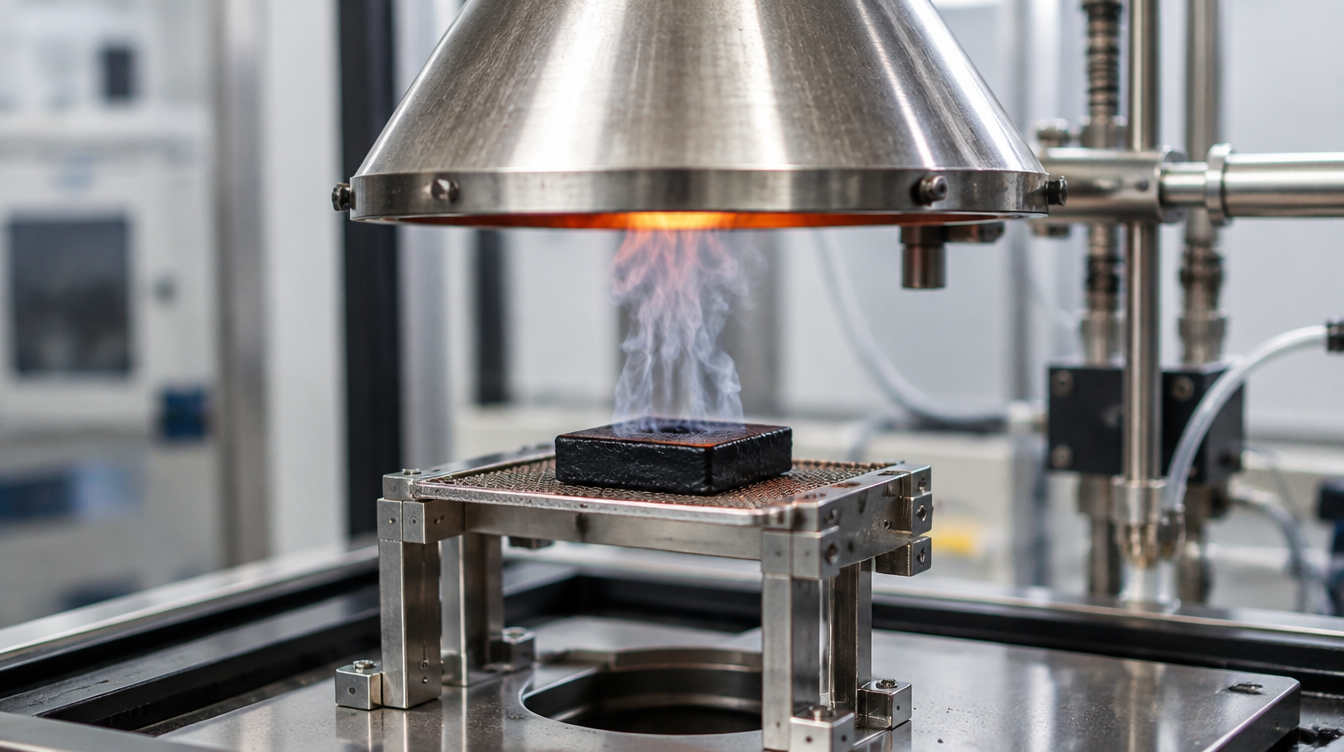
Both results come from the same piece of equipment. A small flat specimen is mounted in a closed chamber and exposed to a radiant heater, smoke builds up inside the sealed space and the gases are sampled and analysed at the same time. The figure below shows the sequence.
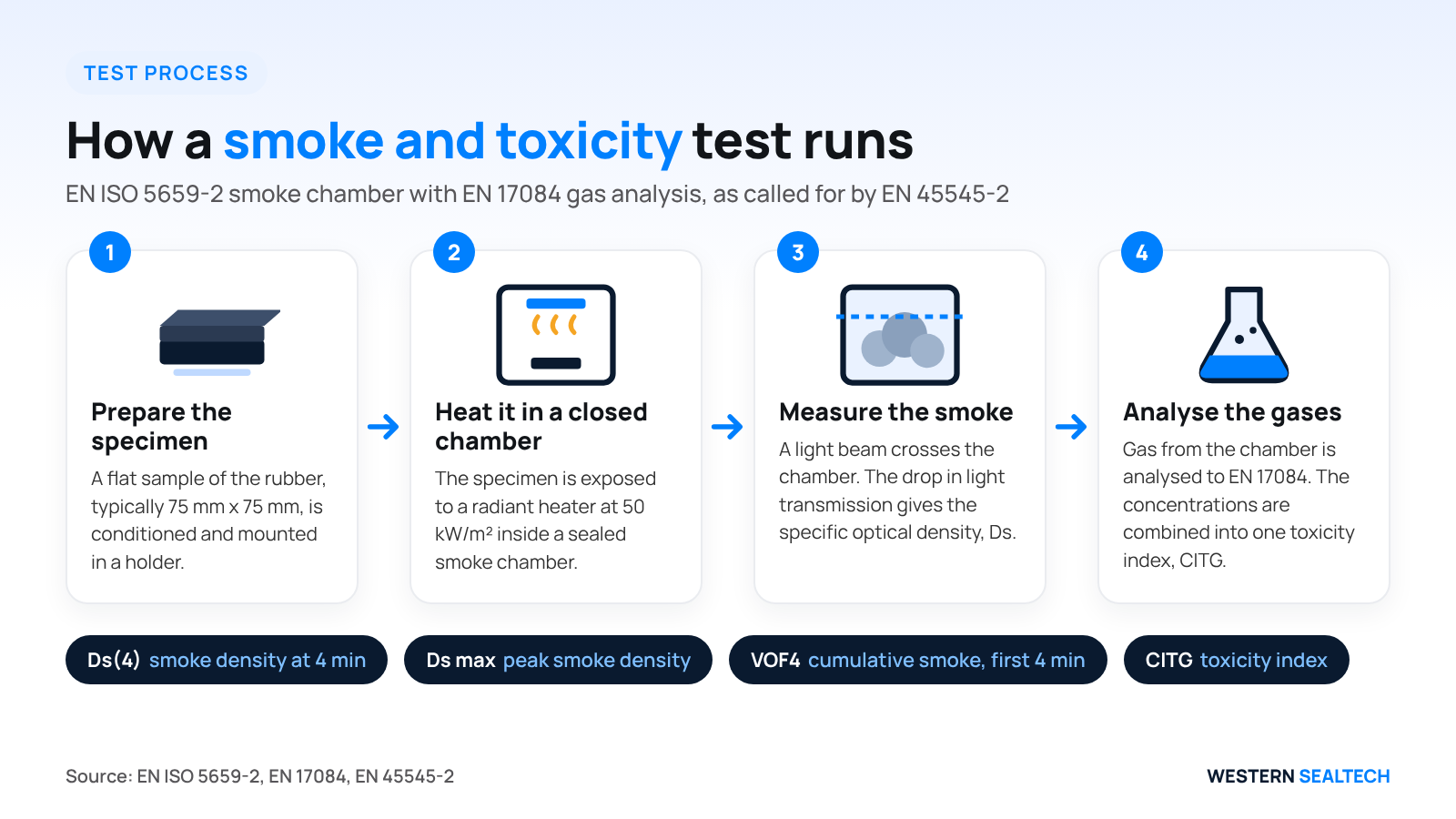
Because the chamber is closed, the test captures all the smoke the specimen produces, and the gas analysis captures what was released while it burned. That is why a single run delivers both the smoke density and the toxicity result.
The Smoke Density Test
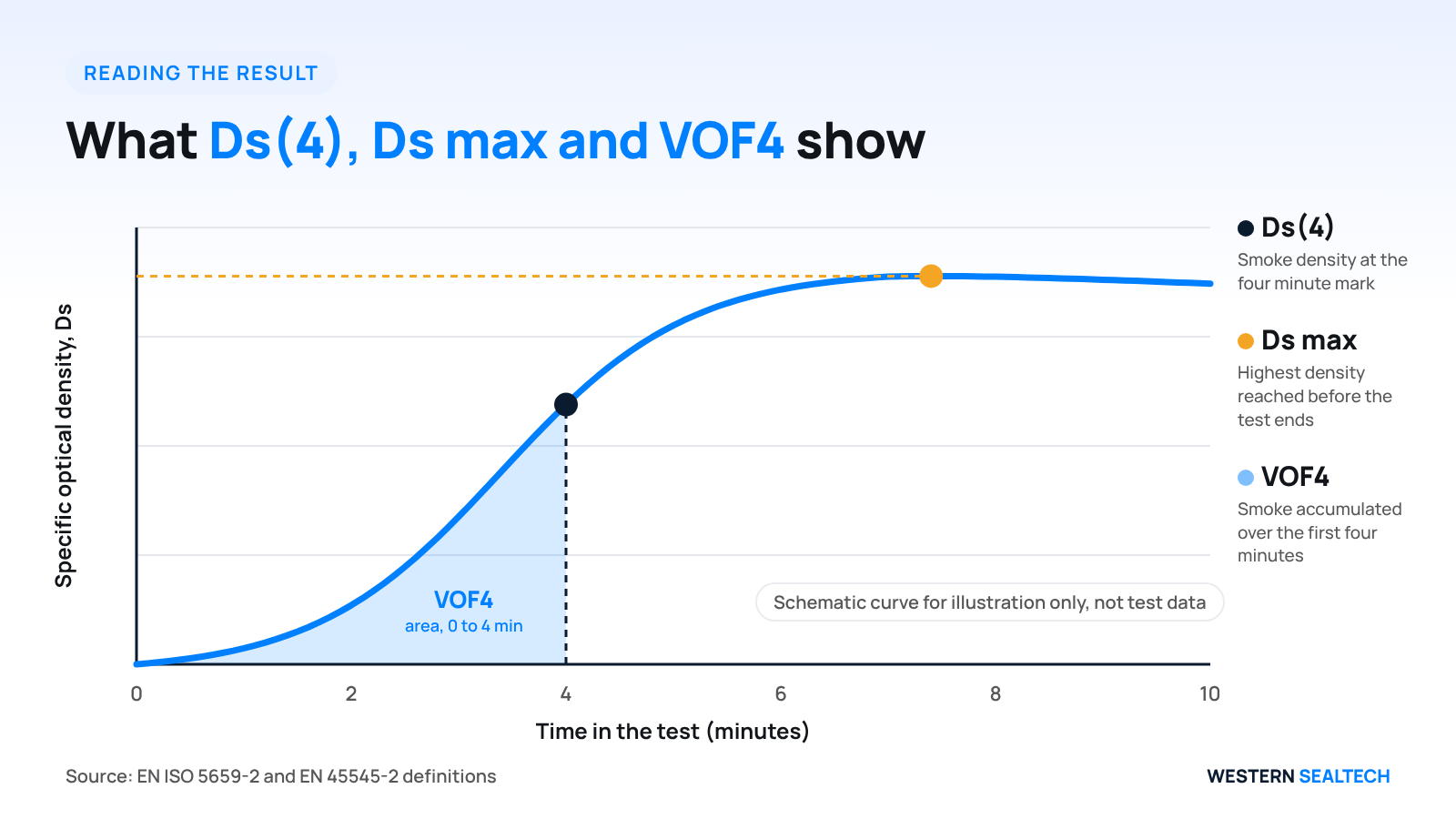
Smoke density is measured in a closed chamber under EN ISO 5659-2. A small flat specimen, typically 75 mm by 75 mm, is exposed to a defined radiant heat flux, and the loss of light transmission through the smoke that builds up in the chamber is recorded over time. EN 45545-2 uses a heat flux of 50 kW/m2 for this test. The results are reported as:
- Ds(4) - the specific optical density at four minutes
- Ds max - the maximum specific optical density reached during the test
- VOF4 - the cumulative value of specific optical density over the first four minutes
Together these show both how quickly smoke builds up and how dense it becomes. A material can show a low peak but build smoke quickly, which is why both the four minute value and the maximum are limited.
💡 Tip: Smoke results depend on specimen thickness, so check the thickness on the report before you compare two compounds.
The Toxicity Test and What CIT Means
Toxicity is assessed by analysing the gases produced during the smoke chamber test, using gas analysis to measure the concentration of a defined group of gases. EN 45545-2 refers to EN 17084 for this. Typical gases in the calculation include carbon dioxide, carbon monoxide, hydrogen fluoride, hydrogen chloride, hydrogen bromide, hydrogen cyanide, sulphur dioxide and nitrogen oxides.
Each measured concentration is divided by a reference concentration for that gas, and the results are combined into a single number called the conventional index of toxicity (CIT). In older documents it may appear as ITC, and in current practice you will see it reported as CITG. A lower index means less toxic combustion gases. Because several gases feed into one number, a compound that releases a lot of a single highly toxic gas can fail even when its smoke density is acceptable.
| Result | What It Tells You | Where Elastomers Struggle |
|---|---|---|
| Ds(4) and Ds max | How fast and how dense smoke becomes | Carbon-rich polymers with limited smoke suppression |
| VOF4 | Cumulative smoke in the first four minutes | Compounds with high organic plasticiser content |
| CITG | Combined toxicity of the combustion gases | Compounds containing halogens or nitrogen-bearing additives |
⚠️ Watch out: Ask for the individual Ds, VOF4 and CITG values, not just a pass statement, so you can see how close each result is to its limit.
Western Sealtech EPDM Results Against the HL3 Limits
Numbers mean more when they sit next to the limits. The limits that matter depend on the requirement set. For HL3, requirement set R22 allows a maximum Ds max of 150 and a maximum CITG of 0.75, while R23 allows a maximum Ds max of 300 and a maximum CITG of 1.5. Our certified EPDM compound was tested to EN 45545-2:2020 and classified HL3 for both sets.
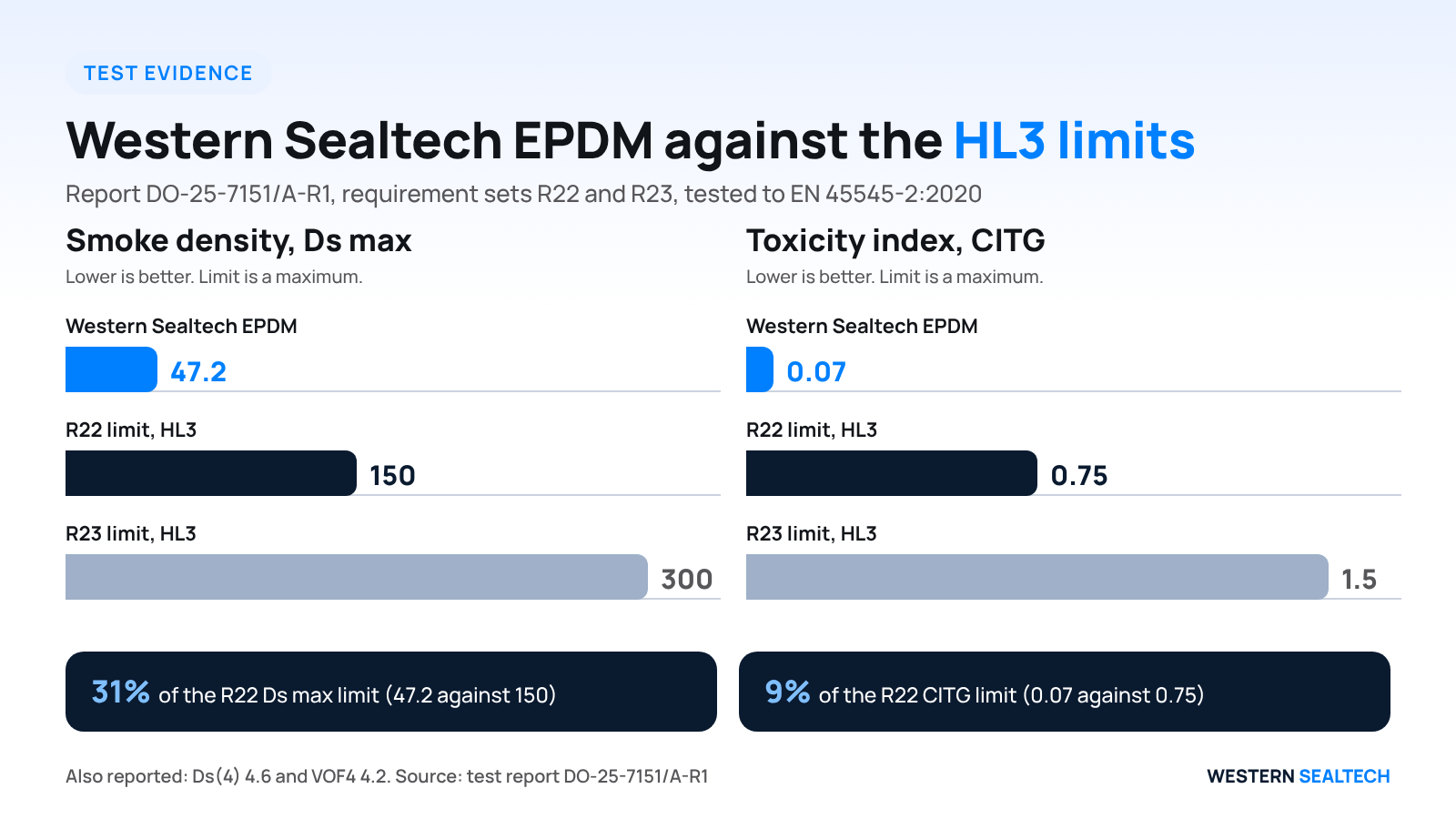
The report records a Ds(4) of 4.6, a Ds max of 47.2, a VOF4 of 4.2 and a CITG of 0.07. Both Ds max and CITG sit well inside the tighter R22 limits, so the compound is not just passing, it has margin.
📊 Test report: The results above come from report DO-25-7151/A-R1 for Western Sealtech's EPDM compound, classified HL3 for requirement sets R22 and R23 of EN 45545-2. The same compound family is discussed in our article on how EN 45545 compliant compounds are formulated.
How Elastomer Chemistry Changes the Result
The base polymer and the additive package decide how a rubber behaves in these two tests. The figure below summarises the pattern, and the points that follow explain the reasoning.
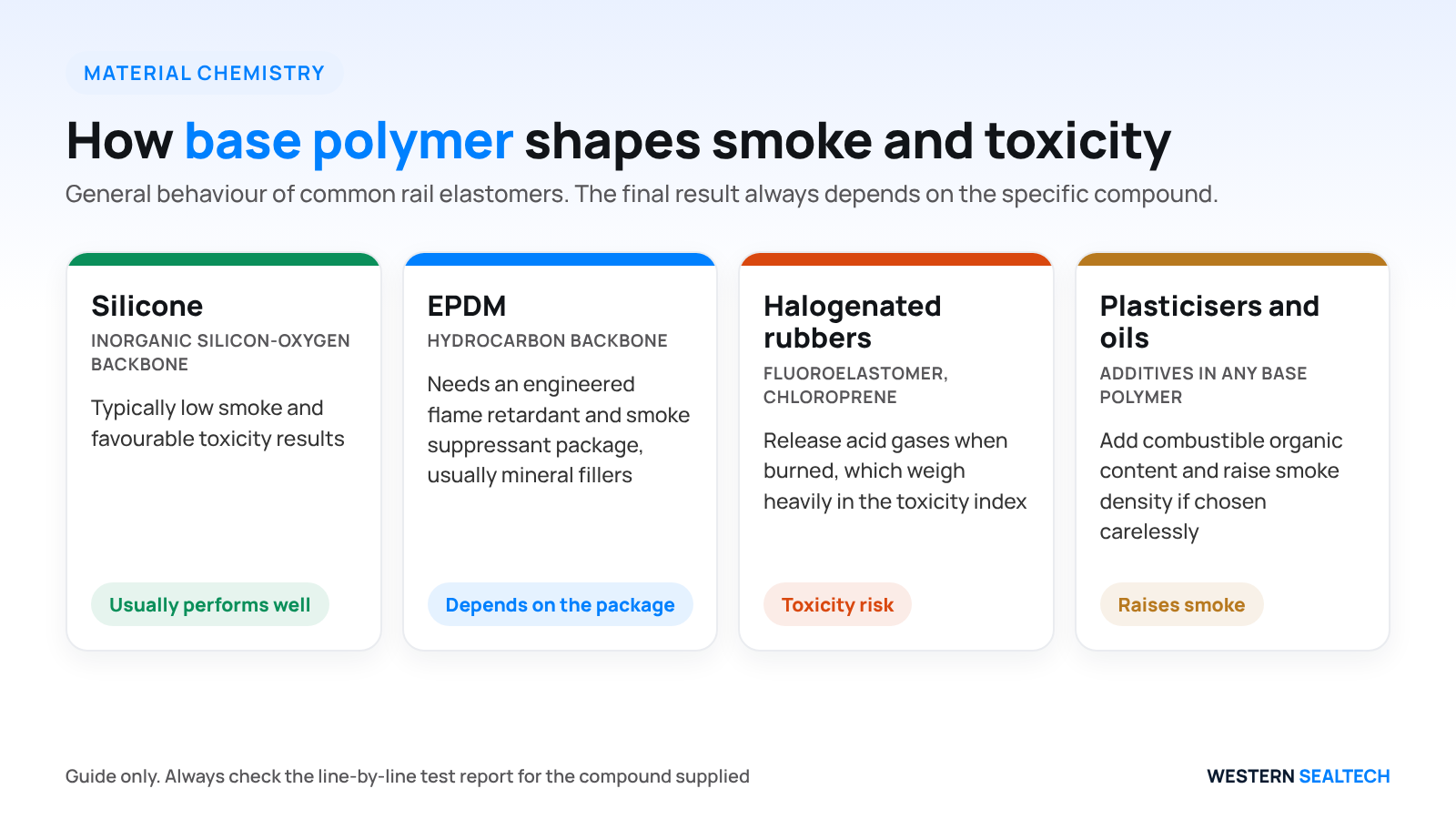
- Halogen-containing polymers such as fluoroelastomers and chloroprene release acid gases (hydrogen fluoride or hydrogen chloride) when they burn, which weigh heavily in the toxicity calculation
- Silicone has an inorganic backbone and typically produces low smoke and favourable toxicity results
- EPDM needs an engineered flame retardant and smoke suppressant package, usually based on mineral fillers, to reach the same level
- Plasticisers and process oils add combustible organic content and raise smoke density if they are not chosen carefully
The trade-offs go beyond fire results. Flame retardant fillers stiffen a compound and can affect compression set and flex life, which is why fire performance and mechanical performance have to be developed together. Our comparison of silicone and EPDM inflatable seals and our guide to elastomer selection for rail look at those trade-offs in detail, and the REACH and RoHS article covers the substance restrictions that also shape which additives can be used.
✅ Rule of thumb: Choose the base polymer for the whole service life, including temperature, fluids and ageing, then confirm the fire results on that exact compound. Our article on ozone, ageing and UV testing covers the durability side of that decision.
Why the Same Compound Can Give Different Results
A fire report is a statement about one specific compound, tested in one specific form. Several things can move the result without anyone changing the base polymer:
- Specimen thickness. A thicker specimen has more material to burn, which can change how much smoke builds up
- Additive changes. Swapping a filler, plasticiser or cure system can move smoke and toxicity results in either direction
- Test condition. The heat flux and flame condition used must match what the requirement set calls for
- Compound drift. If the production compound changes after the report was issued, the report may no longer describe what you receive
📌 Note: This is why we recommend matching the compound code on the report to the compound code on the delivery paperwork. It is a simple check that catches most traceability problems.
Which Rail Parts Are Most Affected
Smoke and toxicity limits apply to every rubber part in the vehicle that falls under a requirement set, so the tests matter across the whole range of sealing products. The most common cases are:
- Inflatable door seals and fixed door seals, which are large, visible and present in every passenger area. Our comparison of inflatable and static door seals shows how the two types differ
- Window and body gaskets made from rubber extrusions
- Spliced and vulcanised seals for frames and corners, where the joint area is part of the tested construction
- Silicone tubing and hoses used in air, water and drainage circuits
For a wider look at how fire-safe sealing is applied across vehicles, see our rail and mass transit sealing page.
What to Check on a Supplier Report
- That the smoke density and toxicity results are shown line by line, not folded into a single pass statement
- That the specimen thickness on the report matches the part you are buying, since smoke results depend on thickness
- That the test condition used is the one the requirement set calls for
- That the compound code on the report matches the compound being delivered
- That the edition of EN 45545-2 stated on the report is the one your specification calls for
✅ Report check: Look for line-by-line smoke and toxicity results, a specimen thickness that matches your part, and a compound code that matches what is being delivered. Our guide on how to read an EN 45545-2 test report walks through a full report, and our comparison of EN 45545-2, DIN 5510-2, NFPA 130 and BS 6853 helps if your project references more than one standard.
Key Takeaways
Smoke density (Ds(4), Ds max and VOF4) and toxicity (CITG) are often harder for rubber to pass than flame spread, especially at higher hazard levels. Both come from the same closed chamber test, and both are judged against limits that depend on the requirement set. Base polymer and additive package decide the result: halogenated rubbers weigh heavily on toxicity, silicone usually performs well, and EPDM needs an engineered flame retardant and smoke suppressant package. Read supplier reports line by line and check thickness, test condition, edition and compound code.
Want to see smoke and toxicity results on a real rail compound? Talk to our engineers about EN 45545-2 tested EPDM and silicone options.
Need a custom sealing solution?
Talk to our engineers about inflatable seals, rubber diaphragms and custom extrusions built to your exact spec. We respond within one business day.
Frequently asked questions
What is the difference between CIT, CITG and ITC?
They refer to the same idea, a conventional index of toxicity calculated from measured combustion gas concentrations. ITC is the older term, and CITG is the form commonly used with the current method.
Which test is harder to pass for rubber, flame spread or smoke and toxicity?
For many elastomers, smoke density and toxicity are the harder criteria, particularly at the higher hazard levels.
Does silicone always pass smoke and toxicity limits?
Silicone usually performs well because of its inorganic backbone, but the final result depends on the specific compound, including fillers and any additives.
Why does specimen thickness matter in the smoke test?
A thicker specimen gives more material to burn and can change smoke build-up, so a result on one thickness does not automatically apply to a much thicker or thinner part.
Can a compound fail on toxicity even if it passes on smoke density?
Yes. The two are assessed separately, and a compound that releases a high concentration of a single toxic gas can fail the toxicity limit while producing acceptable smoke density.
Do the smoke and toxicity limits change between requirement sets?
Yes. For HL3, requirement set R22 has a lower maximum Ds max and CITG than R23, so a result that passes R23 may not pass R22. Always check the limits for the set that applies to your part.
Are smoke and toxicity results from one test run enough?
The two results come from the same test run, but the report should be for the exact compound, thickness and standard edition that your specification calls for. A report for a different compound or a changed formulation may not cover what you are buying.

Need a quote?
For custom rubber sealing solutions contact us. We will respond to you within 1 business day