Posted on
October 29, 2026
Ozone, Ageing and UV Testing Requirements for Rolling Stock Rubber
Which ozone, heat ageing and UV weathering tests matter for rail rubber, how they are run, and how to read the results against a service life requirement.
Fire compliance decides whether a rail rubber part can be fitted to a vehicle. Ageing performance decides whether it is still doing its job ten years later. A compound can pass every fire test and still crack at the door frame in year five if its ozone, heat and weathering resistance were never properly checked, and datasheets that only show new-condition values hide exactly that risk.
This guide explains which ageing tests matter for rolling stock rubber, how each one works, how to match a test to a part and how to write a requirement that a laboratory can actually test. It sits alongside our articles on fire testing, such as smoke density and toxicity testing, because a good rail compound has to do both jobs.
Why Ageing Tests Predict Field Failure
Rail vehicles run for thirty years or more, in sunlight, heat, rain, wash plants and electrical environments. A seal that is held under strain at a door frame for most of its life is under constant attack from ozone, oxygen, heat and ultraviolet light. Ageing tests compress that exposure into days or weeks in the laboratory so that a compound can be judged before it is fitted.
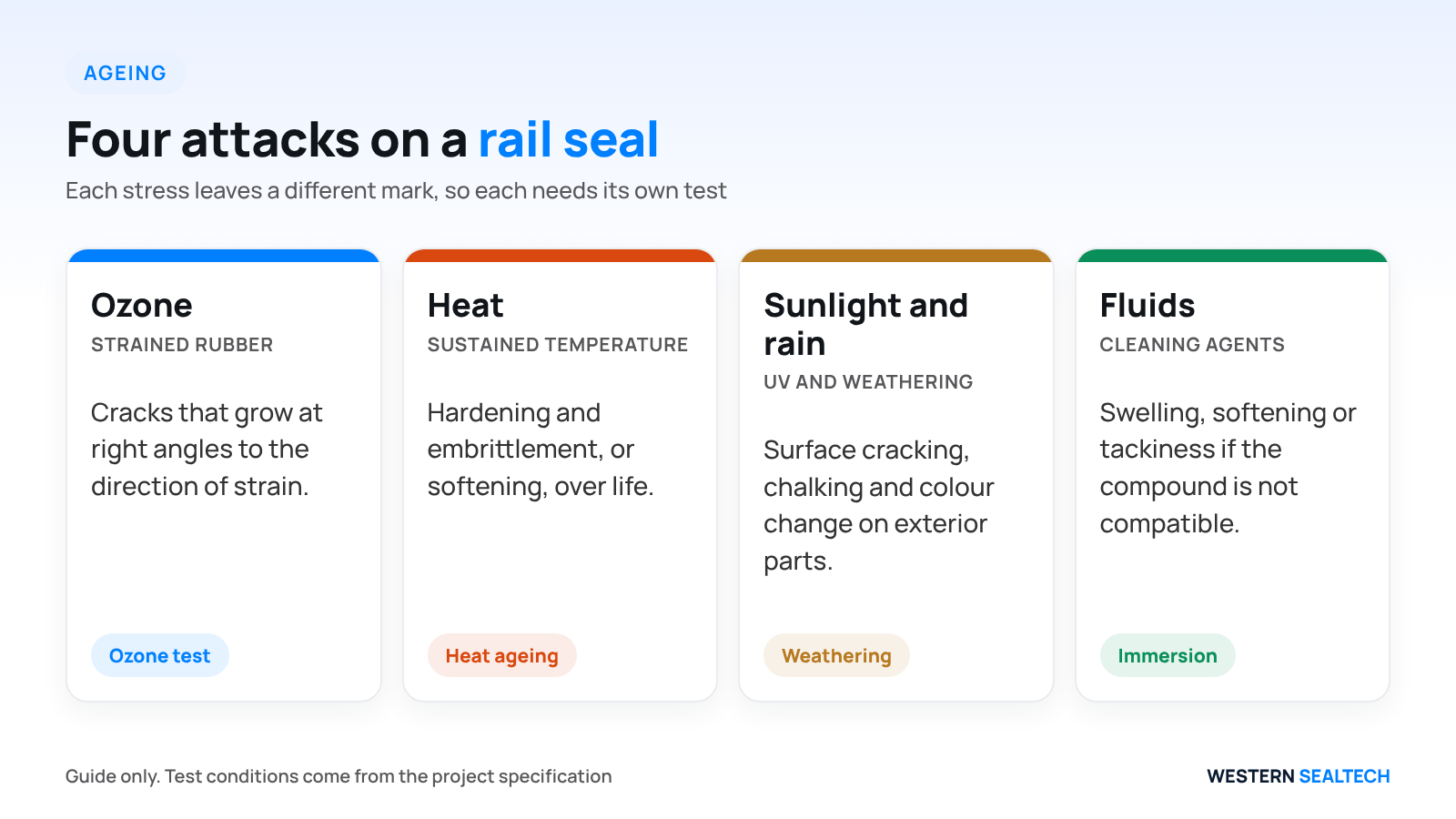
Each stress leaves a different mark, which is why one test cannot stand in for the others. A compound that resists ozone well can still soften under cleaning agents, and one that survives heat can still crack in sunlight. The sections below take each stress in turn.
Ozone Resistance
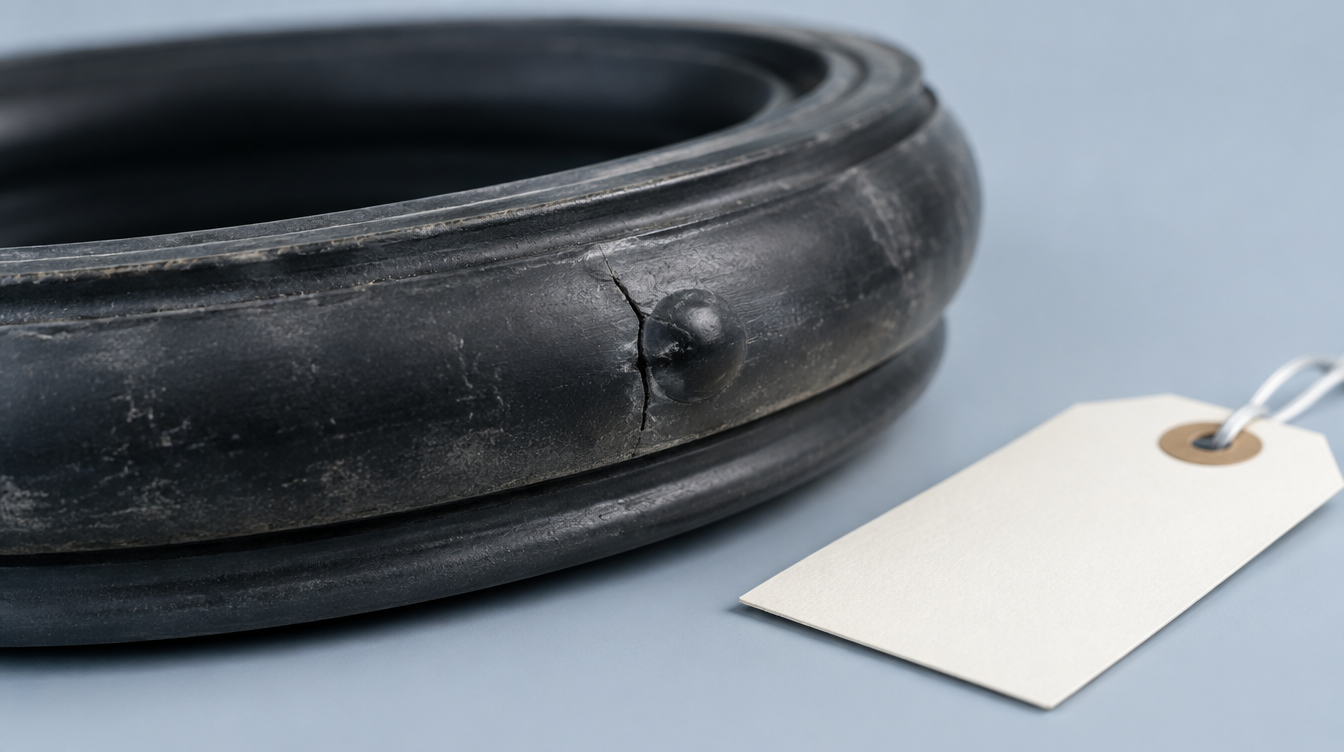
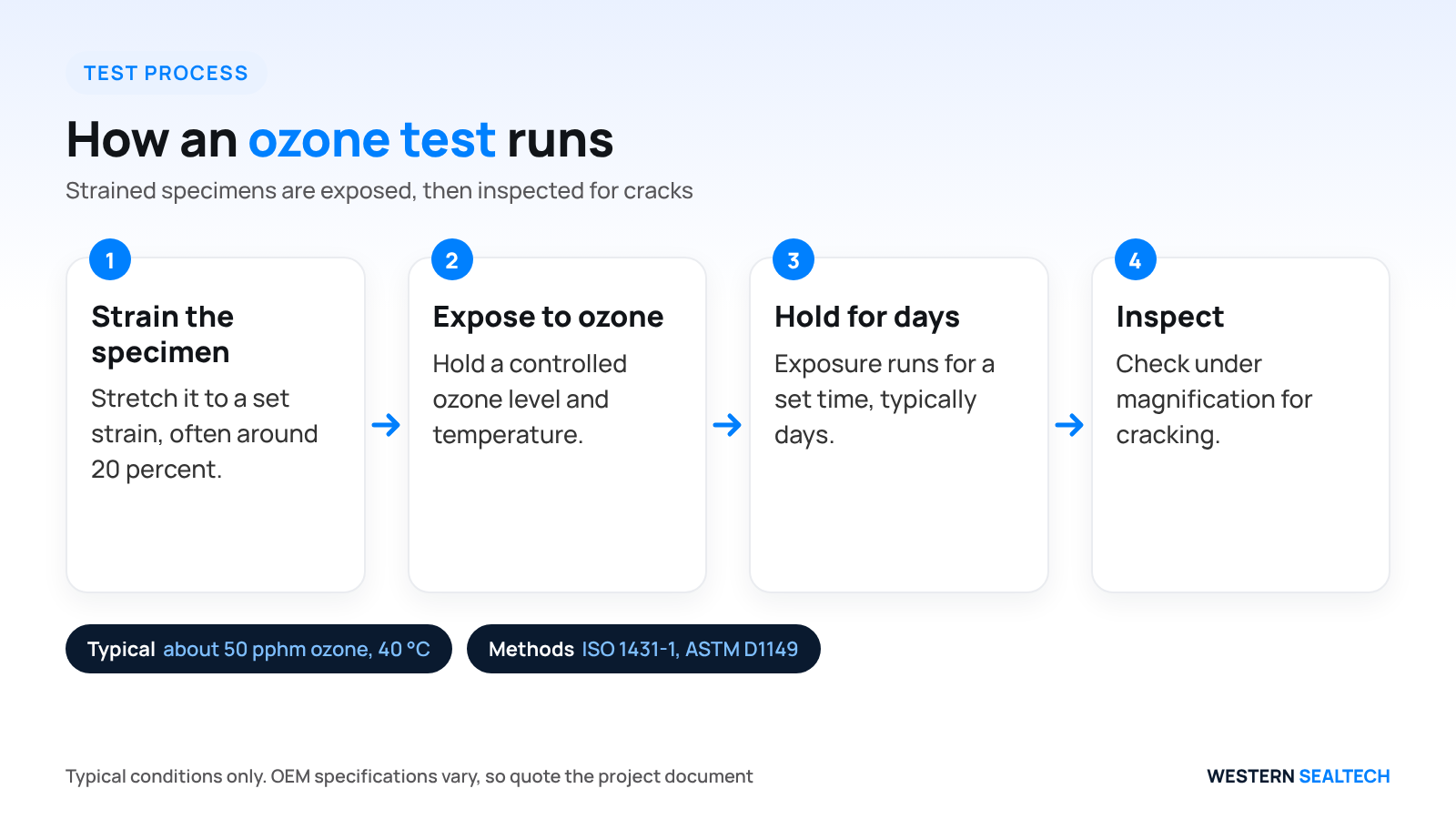
Ozone attacks stretched rubber, producing cracks that grow at right angles to the direction of strain. Seals under compression or stretched around a frame are especially exposed. The test exposes strained specimens to a controlled ozone concentration and temperature for a set time, then inspects for cracking under magnification. Common references are ISO 1431-1 and ASTM D1149. Typical conditions use an ozone concentration in the order of 50 parts per hundred million at 40 degrees C and around 20 percent strain for a period of days, although OEM specifications vary and should always be quoted from the project document.
EPDM has a saturated polymer backbone and is naturally strong in ozone resistance, which is one reason it dominates rail sealing. Diene-based rubbers need protective additives to approach the same performance. Our comparison of silicone and EPDM shows how the two materials compare on ozone and other properties.
📌 Note: Ozone cracks grow at right angles to the direction of strain, which is why seals that stay compressed or stretched without movement are among the most exposed.
Heat Ageing
Heat ageing tests expose specimens to elevated temperature in an oven for a set time, then measure how far hardness, tensile strength and elongation have moved from their initial values. Common references are ISO 188 and ASTM D573. The result shows whether the compound hardens and embrittles, or softens, under sustained heat. Roof-mounted equipment seals and underframe parts near heat sources are the usual high-demand cases.
Heat ageing matters because it changes how a seal behaves, not only how it looks. A seal that has hardened is less able to follow the movement of a door or panel, and one that has softened may lose shape. Both changes can open a leak path long before a crack is visible.
Compression Set After Ageing
Compression set, covered in our article on Shore hardness and compression set, is also tested as an ageing property under ISO 815-1 or ASTM D395. For a sealing compound this is often the most important ageing result, because it shows how much sealing force remains after long compression at temperature.
A compound with poor compression set resistance takes a permanent set in the groove or under the door, so the seal presses less firmly each year. The same effect is one of the causes covered in our guide to why inflatable seals fail early.
💡 Tip: Ask for compression set results at the temperature the seal will actually see in service, not only at a standard laboratory condition.
UV and Weathering
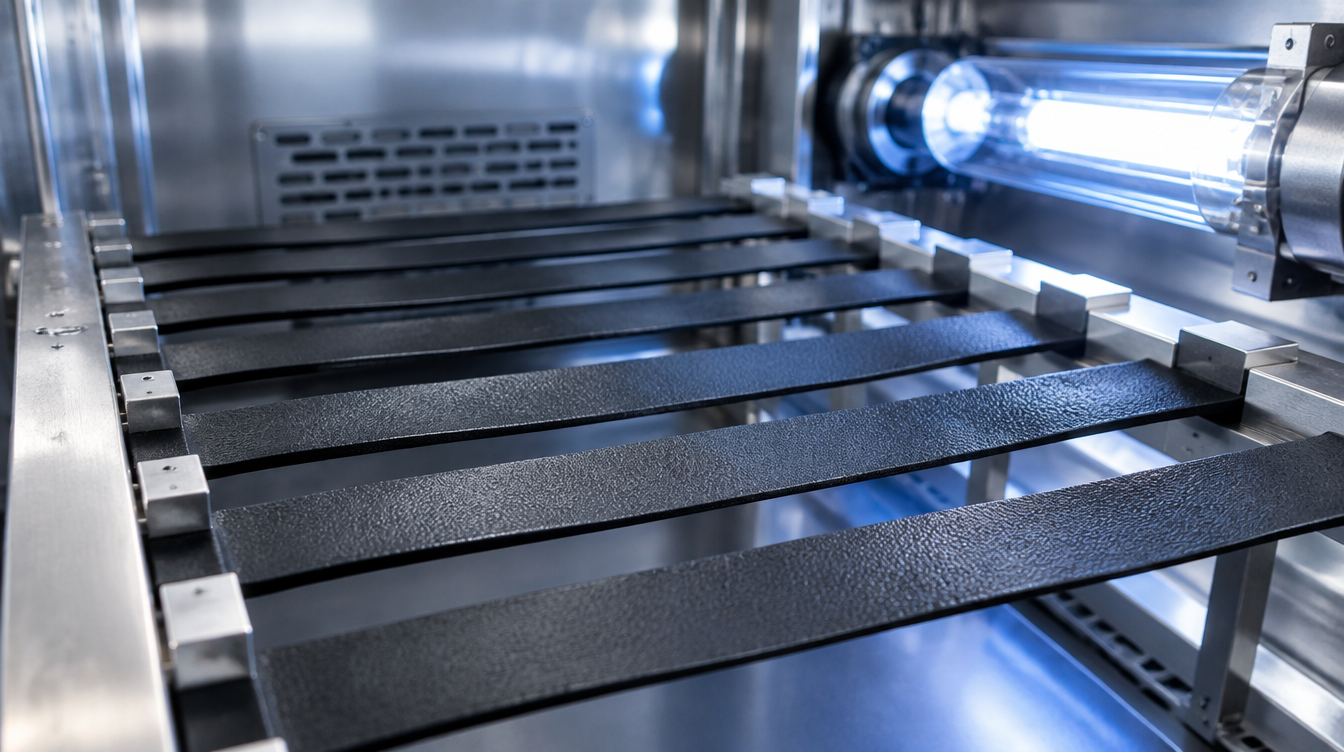
Exterior parts such as window gaskets and external door seals see direct sunlight. Weathering tests use a xenon arc lamp and moisture cycles to simulate sunlight and rain, under references such as ISO 4892-2 or ASTM G155. After exposure, specimens are checked for surface cracking, chalking, colour change and loss of properties.
Weathering results are most relevant for parts that face the outside of the vehicle. Interior seals and parts behind panels see far less ultraviolet light, so the weathering test matters less for them than ozone, heat and compression set.
Fluid and Cleaning Agent Resistance
Immersion tests under ISO 1817 or ASTM D471 expose rubber to defined fluids and measure swelling and property change. For rail, the fluids that matter most are cleaning agents, graffiti removers and, near the underframe, lubricants and hydraulic fluids.
Depot cleaning practice varies, so the fluids named in a test should reflect what the part will really meet. A compound that is stable in water can swell or soften in a solvent-based cleaner, and the damage often shows up only after repeated washing.
| Property | Typical Reference Methods | What the Result Predicts |
|---|---|---|
| Ozone resistance | ISO 1431-1, ASTM D1149 | Cracking on strained seals |
| Heat ageing | ISO 188, ASTM D573 | Hardening and embrittlement over life |
| Compression set | ISO 815-1, ASTM D395 | Loss of sealing force |
| UV and weathering | ISO 4892-2, ASTM G155 | Surface cracking on exterior parts |
| Fluid immersion | ISO 1817, ASTM D471 | Swelling and degradation from cleaning agents and fluids |
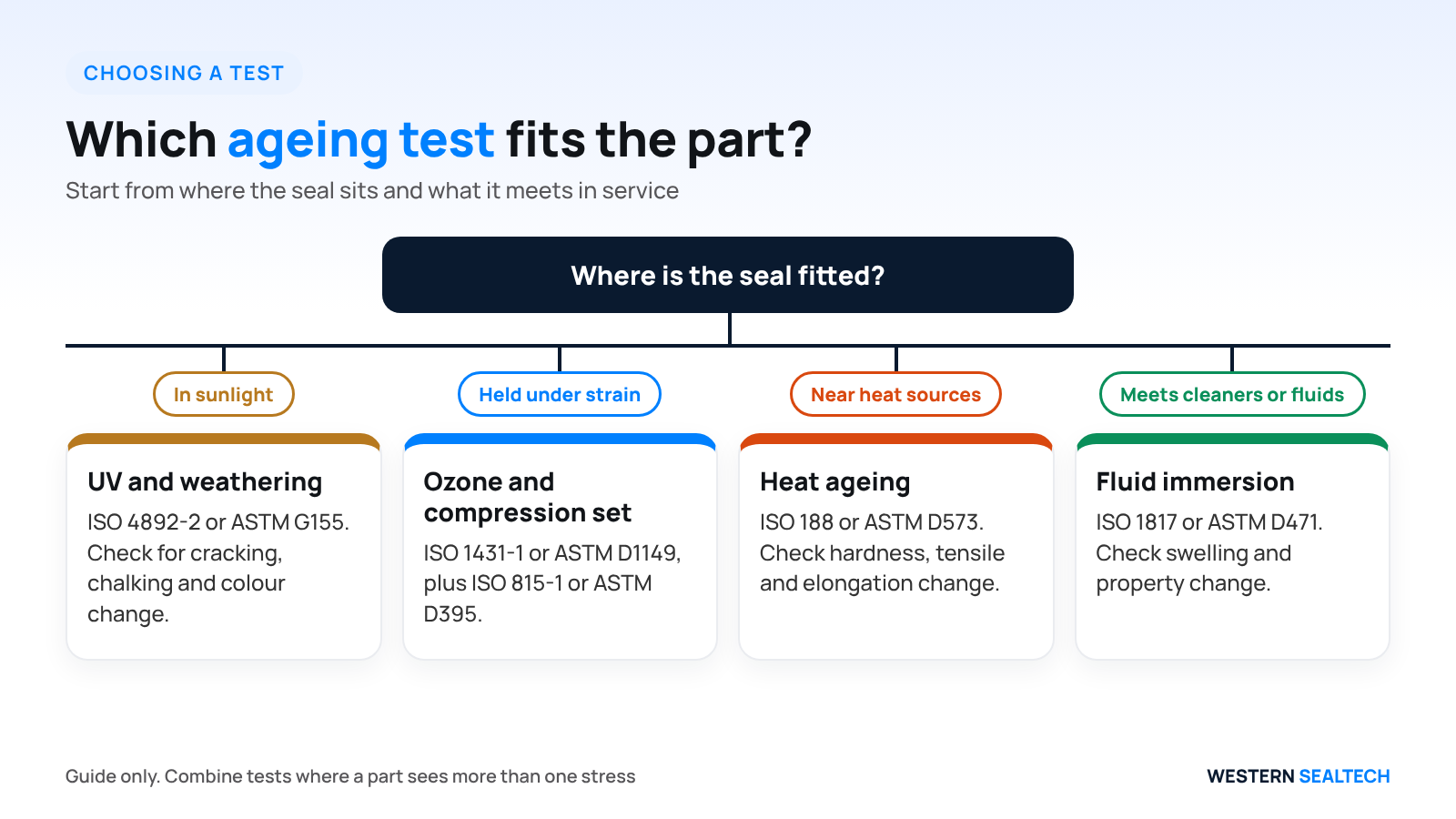
Not every part needs every test. The figure below shows a simple way to choose, starting from where the seal is fitted and what it meets in service.
Ageing and Fire Performance Together
Ageing and fire results are linked, because the same compound has to deliver both. Adding the flame retardant and smoke suppressant package needed for EN 45545-2 can stiffen a compound and change its ageing behaviour, as explained in our article on how EN 45545 compliant compounds are formulated. A compound should therefore be developed against both sets of requirements, and the ageing tests should be run on the same compound that carries the fire certificate.
The same principle applies to the finished seal. For laminated constructions such as inflatable seals, our article on inflatable seal materials and compound selection explains how each layer has to satisfy mechanical, ageing and fire needs together. If the formulation changes, check whether the existing fire report and ageing results still apply, and repeat the relevant tests where they do not. Our guide on how to read an EN 45545-2 test report helps with the fire side of that check.
Ageing Across Different Rail Sealing Products
Different products meet ageing stresses in different ways, so it helps to think product by product:
- Inflatable seals flex at every inflation, so ozone resistance has to be combined with flex fatigue life. Our articles on fabric-reinforced inflatable seals and pressure mistakes that cause seal bursts cover the mechanical side, and our guide to inflatable seal failure modes on rolling stock shows how ageing damage appears in service
- Door and window gaskets made from rubber extrusions are usually held under steady compression, which makes compression set and ozone the key ageing properties
- Silicone tubing and hoses are exposed to heat and fluids in service, so heat ageing and immersion tests carry more weight
For an overview of how these products are specified for vehicles, see our rail and mass transit sealing page, and our guide to inflatable seal design for the design side of seal life.
How to Specify Ageing Requirements
State the method, the exposure condition and the pass criterion together, for example the test standard, the temperature, the duration and the maximum allowed change in each property. A requirement such as "good ageing resistance" cannot be tested, quoted against or enforced.
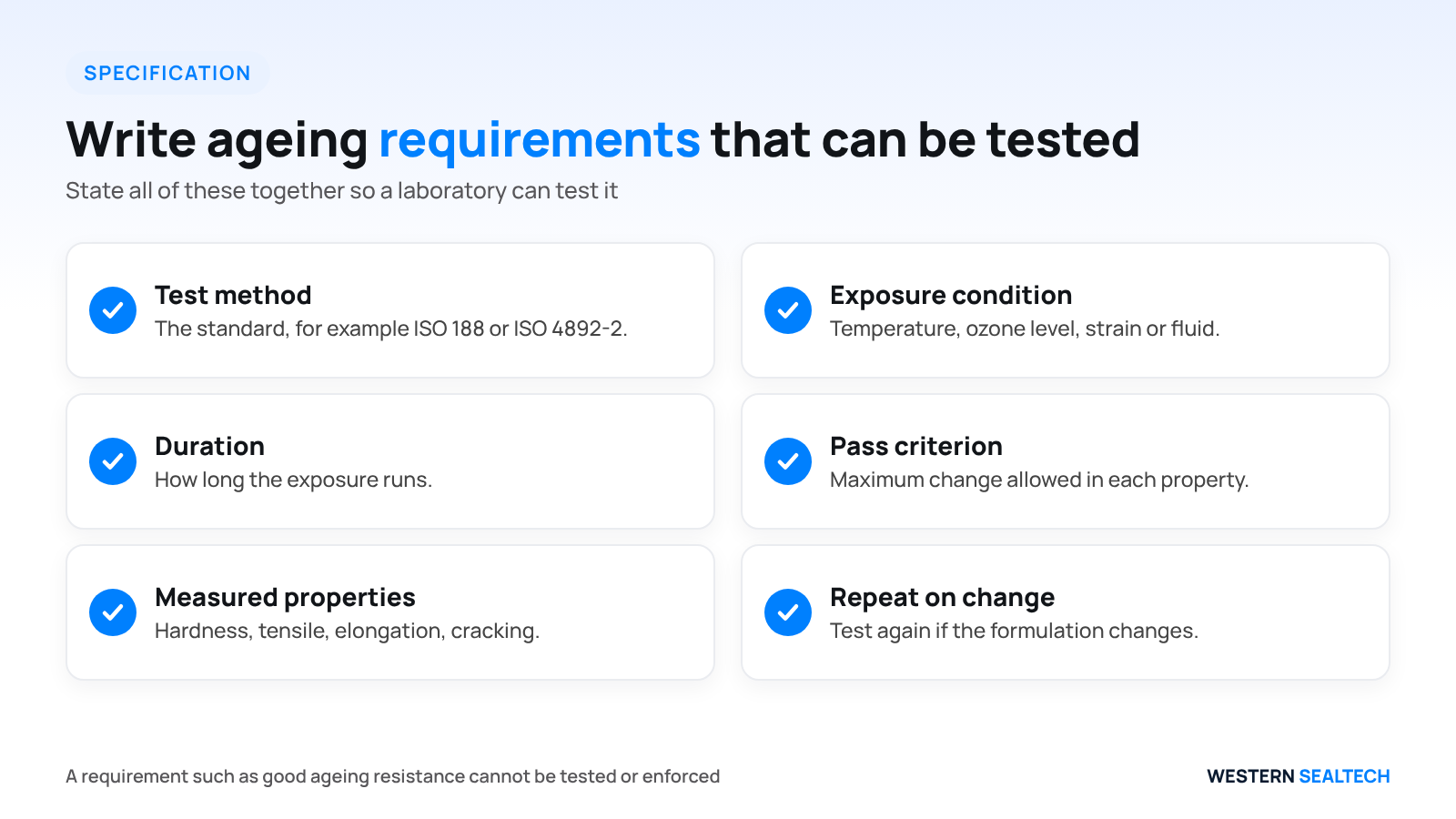
✅ Specification rule: Write every ageing requirement so that a laboratory could test it and a supplier could be held to it.
Reading Ageing Results
An ageing report is only useful if it can be compared with something. The most informative reports show the initial value of each property, the value after ageing and the percentage change, alongside the limit in the specification. A single "passed" statement hides how close the compound came to the limit.
- Compare aged values with initial values, not with a different compound's datasheet
- Check that the exposure condition matches your specification and not only a standard laboratory condition
- Confirm that the compound code on the report matches the compound being supplied
- Treat accelerated results as a way of ranking and screening compounds, and read them alongside field experience
⚠️ Watch out: Converting laboratory hours into years of service involves assumptions. Use accelerated ageing to compare and screen compounds, and do not treat it as an exact life prediction.
If the compound is also used under the requirements of a fire standard, see our article on EN 45545-2 requirement sets for how to confirm which tests apply, and keep in mind that substance restrictions can limit which additives a compound may use.
Key Takeaways
Fire compliance decides whether a rail rubber part can be fitted, and ageing performance decides whether it still works years later. Ozone, heat ageing, compression set, UV weathering and fluid immersion tests each predict a different failure. Specify the method, exposure condition and pass criterion together, and repeat the relevant tests whenever the formulation changes.
Specifying rubber for a thirty-year rolling stock life? Our team can help you define the right ageing and compound requirements.
Need a custom sealing solution?
Talk to our engineers about inflatable seals, rubber diaphragms and custom extrusions built to your exact spec. We respond within one business day.
Frequently asked questions
Does EN 45545-2 test ageing performance?
No. EN 45545-2 addresses fire behaviour. Ageing, ozone and weathering requirements normally come from the vehicle manufacturer's own material specification.
Why do parked vehicles sometimes show more ozone cracking?
Seals that remain compressed or stretched for long periods without movement are under constant strain, which is exactly the condition in which ozone cracking develops fastest.
Is accelerated ageing a reliable prediction of real life?
It is a comparison tool. It ranks compounds and screens out weak ones reliably, but converting laboratory hours to years in service involves assumptions, so results should be read alongside field experience.
Which elastomer is most resistant to ozone and UV?
EPDM and silicone are both strong in ozone and weathering resistance. The final choice depends on the other constraints in the application, such as temperature, fluid exposure and fire requirements.
Should ageing tests be repeated if the compound formulation changes?
Yes. Changes to fillers, plasticisers or the cure system can change ageing behaviour, so the relevant tests should be repeated on the new formulation.
Which ageing test matters most for a door seal?
It depends on where the seal sits. Seals held under strain are most exposed to ozone and compression set, exterior parts also need weathering, and parts near heat sources need heat ageing. Choose tests from the conditions the seal will actually meet.
What should an ageing requirement include?
The test method, the exposure condition, the duration and a pass criterion, for example a maximum change in each property. A requirement that only says good ageing resistance cannot be tested or enforced.

Need a quote?
For custom rubber sealing solutions contact us. We will respond to you within 1 business day