Posted on
October 29, 2026
Inflatable Seal Materials for Rail: Compound Selection Under EN 45545
How the layers of a rail inflatable seal are built, which compounds suit each layer, and how fire requirements shape the selection.
An inflatable seal is not made from one rubber. It is a laminated structure in which each layer has a different job, and the compound chosen for each has to satisfy mechanical, ageing and fire requirements together. Selecting materials for one layer without thinking about the others is a common reason an otherwise sound design fails early.
This guide explains how the layers of a rail inflatable seal are built, which base polymers suit which job, how the fire requirements of EN 45545-2 change the choices and what to check before a compound is specified. If you are new to the product, start with our explainer on what an inflatable seal is and how it works, then return here for the materials detail.
The Layers of an Inflatable Seal
Each layer in the wall of an inflatable seal has a distinct function. The air has to be contained, the pressure load has to be carried, the surface has to survive the outdoors and the contact face has to meet the door or frame without sticking.
| Layer | Function | Material Consideration |
|---|---|---|
| Inner liner | Contains the air and limits permeation | Low gas permeability, good adhesion to fabric |
| Fabric reinforcement | Controls expansion and carries the pressure load | Fibre type, weave and ply count, bond to rubber |
| Outer cover | Resists ozone, weather, abrasion and cleaning agents | Ageing resistance, tear and abrasion resistance, fire performance |
| Base or retention foot | Holds the seal in the groove | Firmer compound, good fit and pull-out resistance |
| Contact face or coating | Reduces friction and sticking | Low friction, wear resistance, adhesion to the cover |
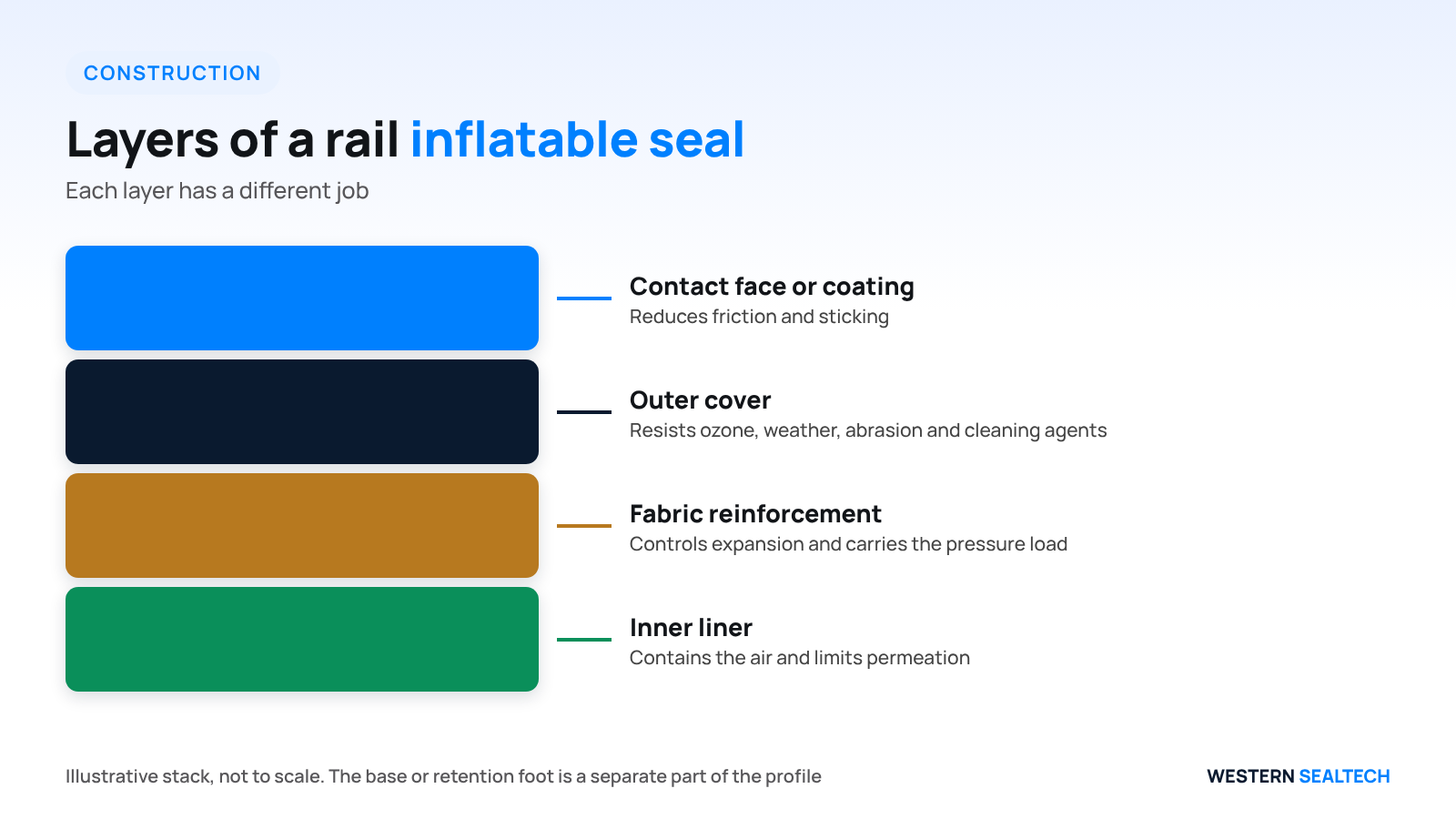
The figure shows the layers of the tube wall as a simple stack. It is an illustration of the idea and not a drawing of a specific product, so the number of layers, their thickness and the order can differ between constructions. What does not change is the principle: every layer must work with the ones beside it. Our inflatable seals design guide shows how these layers fit into the wider design of a door seal system.
💡 Tip: Choose the compound for each layer with the whole laminate in mind. Optimising one layer in isolation is a common reason a sound design fails early.
Why the Layers Must Be Chosen Together
The liner and the cover do not have to be the same polymer, but they do have to be able to bond to the fabric and to flex together. A stiff cover over a flexible liner puts extra strain on the bond line every time the seal inflates. A cover with excellent ageing resistance but poor adhesion is no use if it peels away from the fabric. These interactions are why the same cover compound can perform well in one construction and poorly in another.
The shape of the profile matters as well. The section of the tube, the position of the foot and the way the seal is retained all affect which compound is practical. Our guide to inflatable seal profiles and sections for rail doors explains how those choices are made.
Base Polymer Options
EPDM is the usual base for rail inflatable seals. It offers strong ozone and weathering resistance, good flexibility over a wide temperature range and can be engineered to meet EN 45545-2 requirements with a suitable flame retardant package.
Silicone offers a very wide temperature range and favourable smoke and toxicity behaviour, but lower tear and fatigue resistance, which matters in a part that flexes at every cycle. It is used where temperature or fire performance dominates and cycle demands are moderate.
Chloroprene has inherent flame resistance, but as a halogenated polymer it releases acid gases when burned, which weighs on the toxicity result under EN 45545-2. It is less commonly specified for new rail work for that reason.
Fluoroelastomer is reserved for locations with fuel or aggressive chemical exposure, because of its cost and its halogen content.
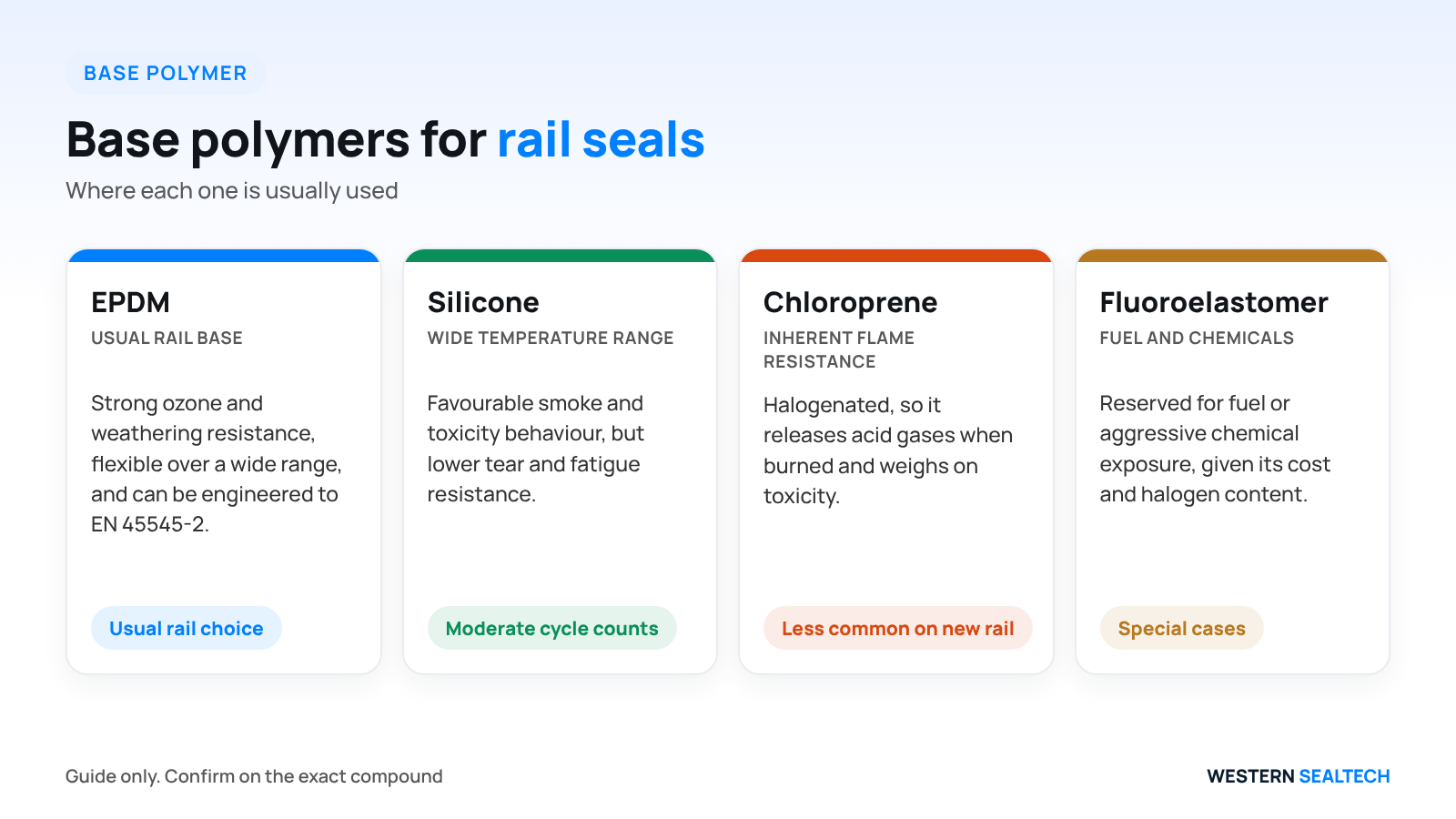
The figure summarises the same guidance in one place. It is a starting point and not a substitute for checking the exact compound, because two compounds based on the same polymer can behave very differently once fillers, plasticisers and flame retardants are added. For a deeper comparison of the two most common choices, see the silicone and EPDM article linked above.
⚠️ Watch out: The polymer name alone does not tell you whether a compound will pass EN 45545-2. Two EPDM compounds can give very different smoke and toxicity results. Always check the test report for the exact compound.
Fabric Reinforcement
Polyester and polyamide fabrics are the common reinforcement for rail inflatable seals, with aramid used where very high strength is needed. The fabric must be treated or coated so that it bonds to the rubber, because delamination between fabric and rubber is a leading cause of blistering and burst failures.
The reinforcement also decides how the seal behaves under pressure. A fabric that controls expansion keeps the seal within its intended shape, while an unreinforced wall can balloon. Our comparison of fabric-reinforced and non-reinforced inflatable seals explains when each is the right choice, and our guide to inflatable seal failure modes shows what delamination and blistering look like in service.
How Fire Requirements Shape the Selection
Adding the flame retardant package needed for EN 45545-2 stiffens the compound, can raise compression set and can reduce flex fatigue life. For an inflatable seal, flex fatigue is the property most at risk, because the tube wall bends at every inflation. Fire compliance and fatigue life should be developed together, and verified with cycle testing on the finished construction rather than on a flat sample.
It also matters which layers are covered by the fire test. A report on a flat sheet of the cover compound does not automatically cover a laminated tube with fabric, so confirm what construction was tested. The requirement set that applies to the part decides which tests are run, and our guide to requirement sets and R-numbers explains how to find it.
Reading the Fire Evidence
Smoke and toxicity are frequently the deciding results for rubber, so it is worth knowing how they are measured. Our article on smoke density and toxicity testing for rail elastomers covers the methods, and our guide on how to read an EN 45545-2 test report shows how to check the thickness, test condition and compound code on the page. For a broader view of how formulation influences the result, see EN 45545 compliant compounds.
Our silicone inflatable seal compound (SILICONE FR SL-40) was tested to EN 45545-2:2020+A1:2023 at hazard level HL3 for requirement sets R22 and R23. The test report number is M260918006/M260918006-11, issued by Spectro Analytical Labs Pvt. Ltd. on 30 September 2026.
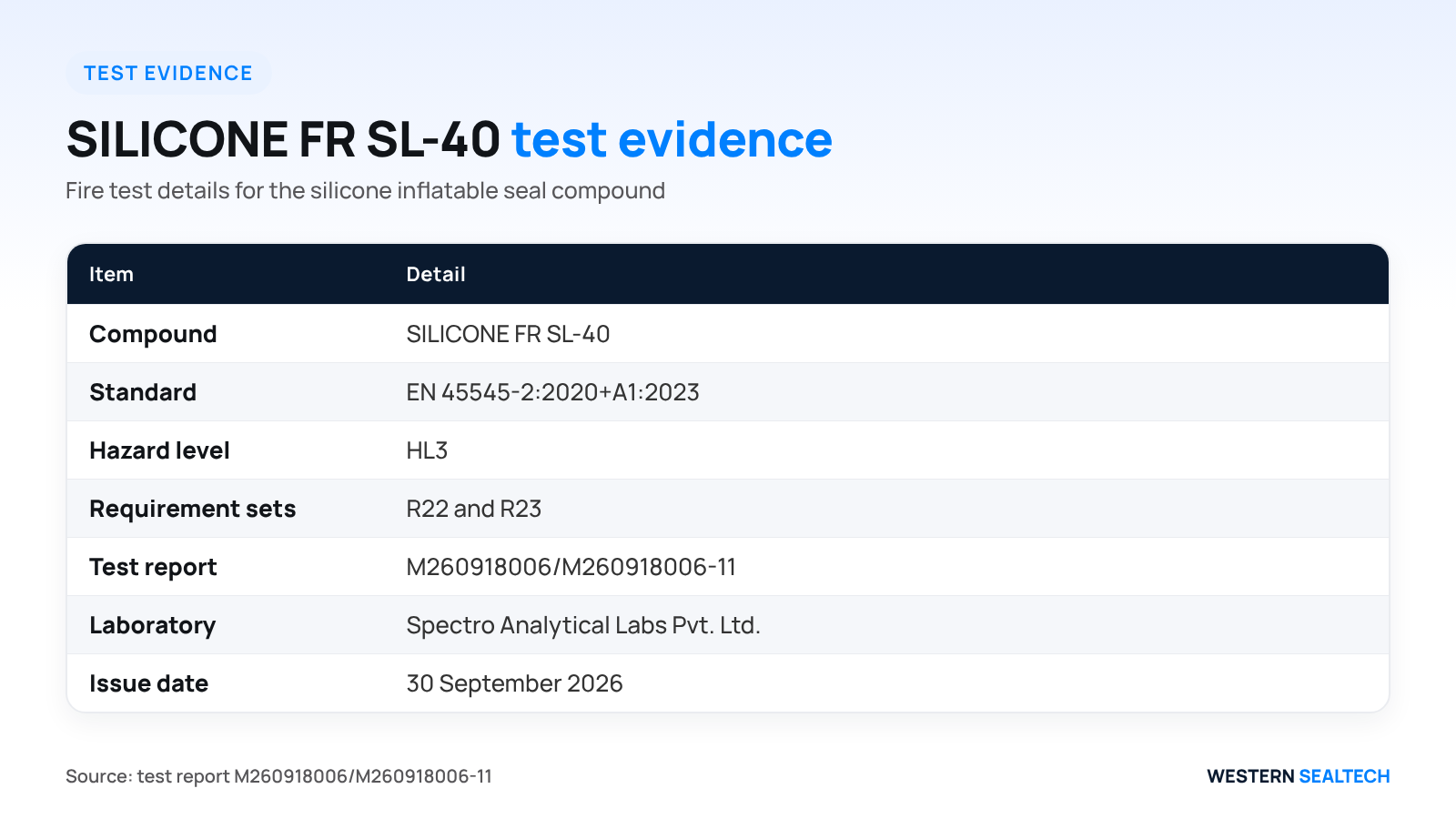
⚠️ Watch out: A fire test report on a flat sheet of the cover compound does not automatically cover a laminated tube with fabric. Confirm exactly what construction was tested.
Mechanical and Ageing Properties
Fire performance is only one side of the specification. The compound also has to hold its shape, recover after being compressed and resist the outdoor environment for the life of the vehicle. Hardness and compression set are the first properties to check, and our guide to Shore hardness and compression set in rail sealing explains how to read them.
Ageing is the second. Ozone, heat and ultraviolet light attack the outer cover over years, and the test methods used to measure that resistance are explained in our article on ozone, ageing and UV testing for rolling stock rubber. A cover that passes the fire test but cracks after a few seasons is not a good result, which is why the early failures described in why inflatable seals fail early so often trace back to material choices.
Selection Checklist
- Define the hazard level and requirement set from the vehicle specification
- Define the temperature range, ozone exposure and cleaning agents
- Define cycle count, inflation pressure and stroke
- Select the cover, liner and base compounds for these conditions
- Select the fabric reinforcement and confirm bonding
- Confirm fire compliance on a representative construction
- Confirm cycle life and ageing performance on the finished seal
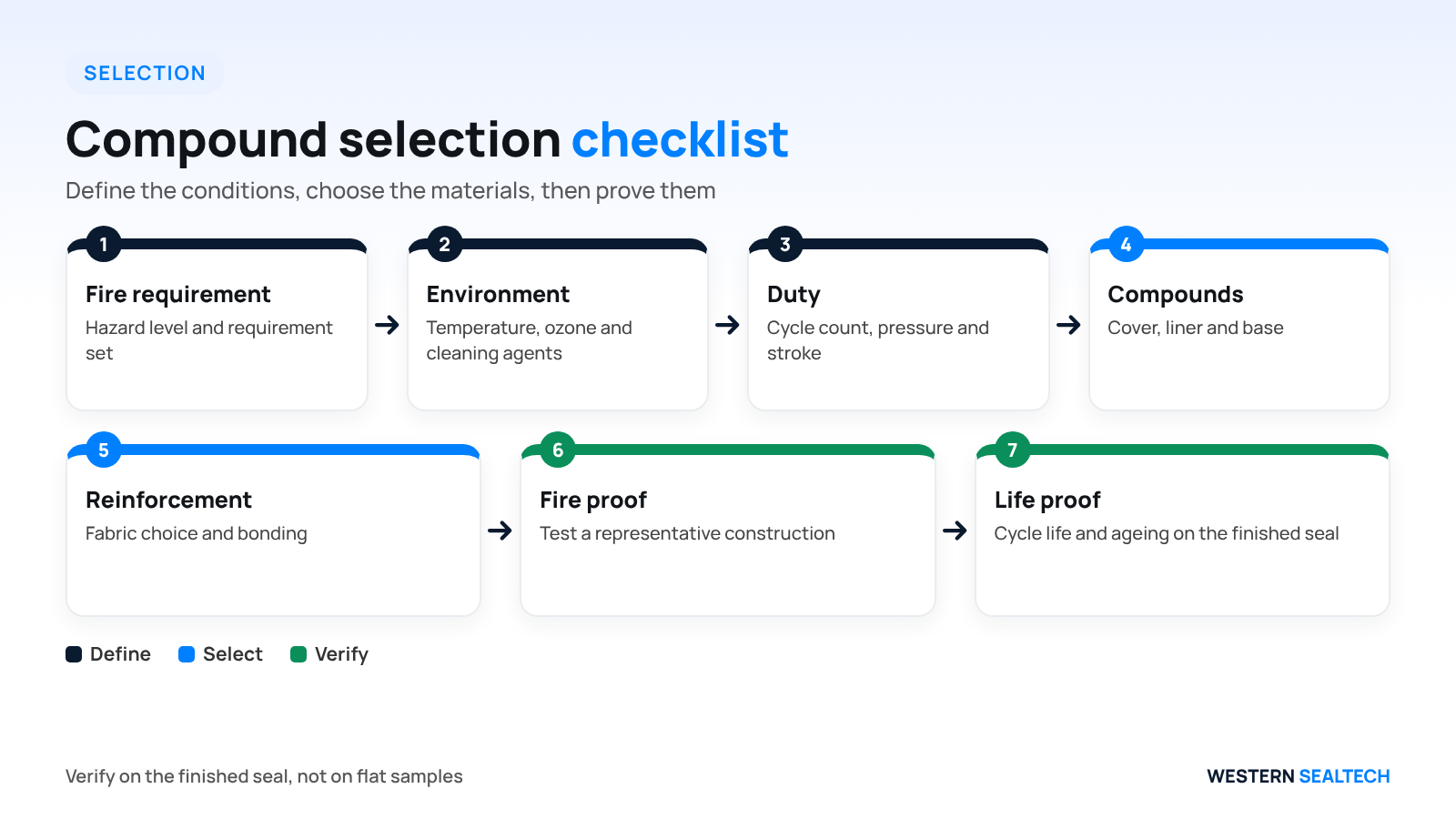
The first three steps define the problem and the next two choose the materials. The last two prove the choice, and they are the steps most often skipped. Cycle count, pressure and stroke come from the door and the gap it has to close, which is covered in our guide to sizing an inflatable seal for gap, tolerance, stroke and pressure.
✅ Remember: Verify cycle life and ageing on the finished seal construction, not only on flat samples.
Joints, Corners and Other Constructions
The compound has to work not only in the straight run of the seal but also at the joints. Corners and splices put extra strain on the wall, and the joint method has to be compatible with the chosen material. Our page on spliced and vulcanised seals describes how formed corners are produced, and our range of inflatable seals shows the constructions we supply.
Questions to Ask a Supplier
A supplier who understands the construction will be able to answer a short set of questions without hesitation. Which compound is used in each layer, and which polymer is it based on? Which standard edition, hazard level and requirement set was the fire test run to, and on what construction? Is there cycle test data on the finished seal at the pressure and stroke you need? What bonding system joins the fabric to the rubber, and how has it been proved? And how is the compound identified on the report so that it can be traced to the batch you receive?
Vague answers to any of these are a signal to dig further. Clear answers, backed by a report that names the compound and the construction, are what a good selection looks like in practice.
Key Takeaways
An inflatable seal is a laminate of liner, fabric reinforcement, cover, base and contact face, and each layer needs a compound that meets mechanical, ageing and fire requirements together. EPDM is the usual base for rail, silicone suits temperature- and fire-driven cases at moderate cycle counts, and chloroprene and fluoroelastomer are uncommon on new rail work. Verify fire compliance and fatigue life on a representative finished construction.
Selecting compounds for a rail inflatable seal? Tell us your hazard level, cycle count and operating conditions and we will recommend a construction.
Need a custom sealing solution?
Talk to our engineers about inflatable seals, rubber diaphragms and custom extrusions built to your exact spec. We respond within one business day.
Frequently asked questions
Why is EPDM the standard choice for rail inflatable seals?
It combines strong ozone and weathering resistance with good flexibility and can be engineered to meet EN 45545-2, at a lower cost than silicone or fluoroelastomer.
Can silicone be used for an inflatable seal on a high-cycle door?
It can, but its lower tear and fatigue resistance must be checked against the cycle count. Test data on the finished seal is the best guide.
Does the fabric reinforcement affect fire compliance?
It can. The fire test should be carried out on a construction representative of the finished seal, not only on the rubber compound alone.
Why avoid chloroprene on new rail projects?
Because it contains chlorine, it releases hydrogen chloride when burned, which can make the toxicity limits of EN 45545-2 harder to meet.
Are different compounds used for the tube and the retention foot?
Commonly yes. The tube needs flexibility and fatigue resistance while the foot needs firmness and pull-out resistance, so they can be different compounds bonded or co-extruded together.
Why does adding flame retardants affect the life of an inflatable seal?
The additives needed for EN 45545-2 can stiffen the compound and reduce flex fatigue life. Because the tube wall bends at every inflation, fire performance and fatigue life should be developed together and tested on the finished seal.
What should I check on a fire test report for an inflatable seal?
Check the standard edition, the hazard level and requirement set, the compound code and whether the tested construction is representative of the finished seal, including the fabric reinforcement if it is part of the design.

Need a quote?
For custom rubber sealing solutions contact us. We will respond to you within 1 business day