
Posted on
October 29, 2026
Inflatable Seal Profiles and Sections for Rail Doors
The main inflatable seal profile families used on rail doors, how retention and cross-section choices affect performance, and what to specify in an RFQ.
Most RFQs for an inflatable seal start with a door gap and a length, and skip the part that decides how the seal will actually behave: the profile. Cross-section, wall construction and retention method determine how far the seal strokes, how well it retracts, how it sits in the groove and how it fails. Choosing the profile is a design decision, not a catalogue pick.
This guide walks through the main profile families, the retention methods, the wall construction and the information that helps a supplier propose the right section. If you are new to the product, start with our explanation of what an inflatable seal is and how it works.
What a Profile Has to Do
An inflatable seal profile has to do four jobs at once. It has to hold itself in position when deflated, retract far enough to clear the door path, expand enough to bridge the real gap, and survive thousands of inflation cycles at the bend points of its wall. Different profile families trade these jobs against each other.
The trade-offs are real. A section that retracts very small may give less stroke for its width. A section with a strong retention foot may need a larger groove. A section that copes with a wide gap range may inflate in a more complex way. Because of this, no single profile is best for every door, and the right choice follows from the door rather than from the catalogue. Our guide to sizing an inflatable seal for gap, tolerance, stroke and pressure covers the numbers behind that decision.
💡 Tip: Decide which job matters most on your door, whether that is stroke, retract clearance, retention or compliance across a variable gap, before you compare profile families.
The Main Profile Families
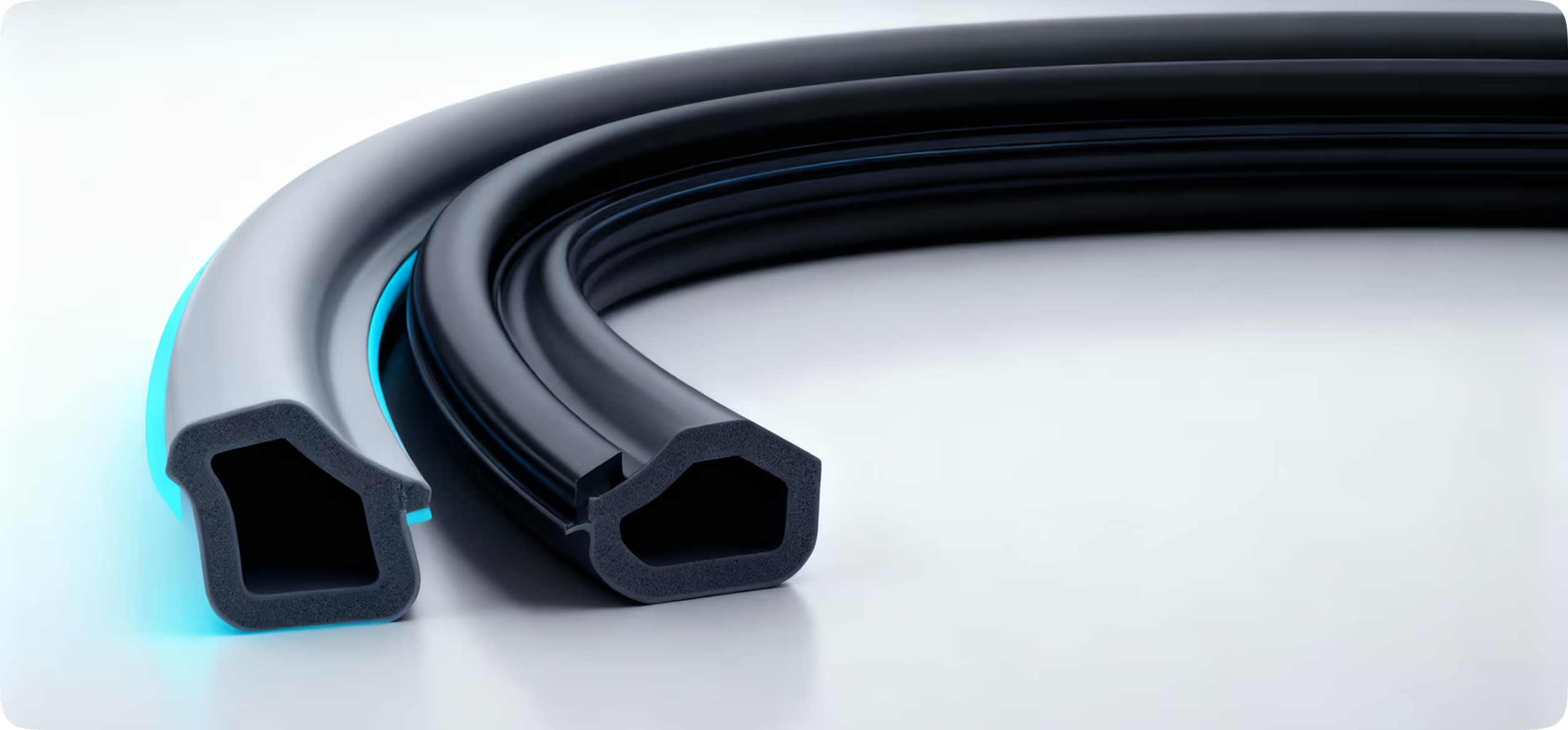
Five families cover most rail door applications. The sketch below shows the four basic cross-sections, and the list explains how each is normally used.

- Round or oval single-chamber tube - the simplest section, mounted into a groove or on a base. Good stroke for its size and straightforward to manufacture
- Flat or lay-flat section - folds flat when deflated and unfolds when inflated. Useful where retract space is very tight
- Bulb on a base - a sealing chamber on an integral base or retention foot, which is fitted into a channel or clipped to a carrier. Common where a sealing lip or wear surface is needed on the contact side
- Double-chamber or multi-chamber sections - two or more air chambers, giving more compliance across a variable gap or a second sealing line
- Sections with integral sealing lips or flocked contact faces - add a low-friction or secondary sealing surface to the inflatable body
| Profile Family | Typical Strength | Typical Limitation |
|---|---|---|
| Round or oval tube | Simple, good stroke, easy to terminate | Needs a well-fitted groove to stay in position |
| Lay-flat section | Very small retracted size | Less stroke for a given width, needs careful pressure control |
| Bulb on a base | Positive retention, can carry a lip or coating | More complex tooling and corner handling |
| Multi-chamber | Compliance across a variable gap | Higher cost and more complex inflation behaviour |
| Integral lip or flocked face | Lower friction and a secondary seal | Wear on the coating must be considered over life |
Many of these sections are produced from extruded or moulded rubber before the seal is reinforced and finished. If you are comparing a profile with a plain solid section or a cord, our article on rubber profiles versus rubber cord explains how the two differ, and our range of rubber extrusions and custom precision rubber extrusions shows what is possible in section geometry. Inflatable sections themselves are covered on our inflatable seals product page.
Retention: How the Seal Stays in the Groove
Retention is often where a profile succeeds or fails. The main methods are a dovetail foot pulling into a matching channel, a push-in or clip-in foot, a bonded base fixed with adhesive, or a bulb section held by a separate retaining strip. Each has implications for installation, replacement time and what happens if the seal is pulled during door movement.
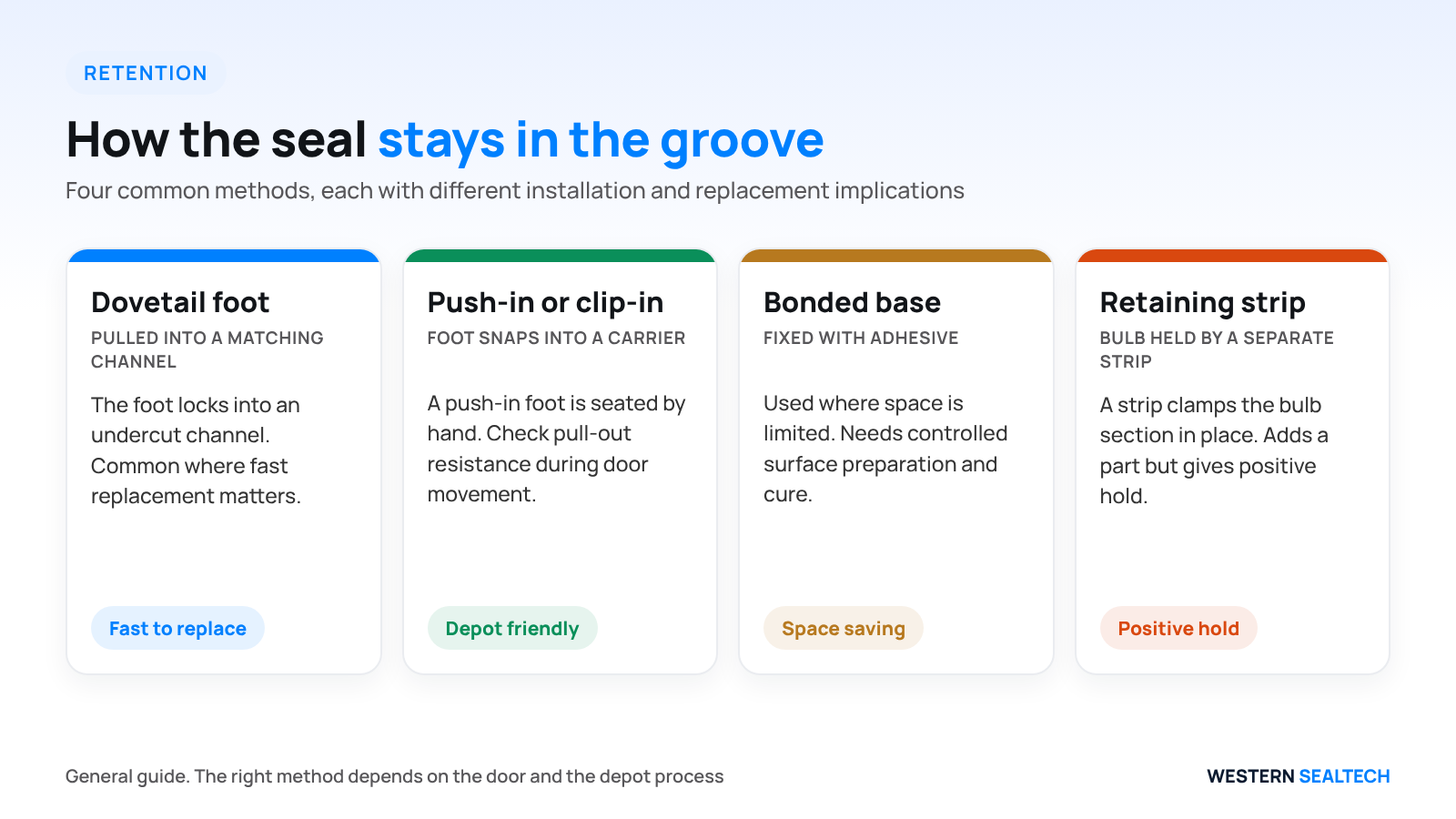
No method is better in every case. A dovetail or clip-in foot generally suits doors where depot replacement needs to be quick. A bonded base can save space but ties the replacement process to adhesive preparation and cure. A retaining strip adds a part but gives a positive hold on a bulb section. Retention methods are covered in more detail in our design series on seal retention.
📌 Note: Ask how the seal will be replaced in the depot, and what happens if it is pulled during door movement, before you commit to a retention method.
Wall Construction and Reinforcement
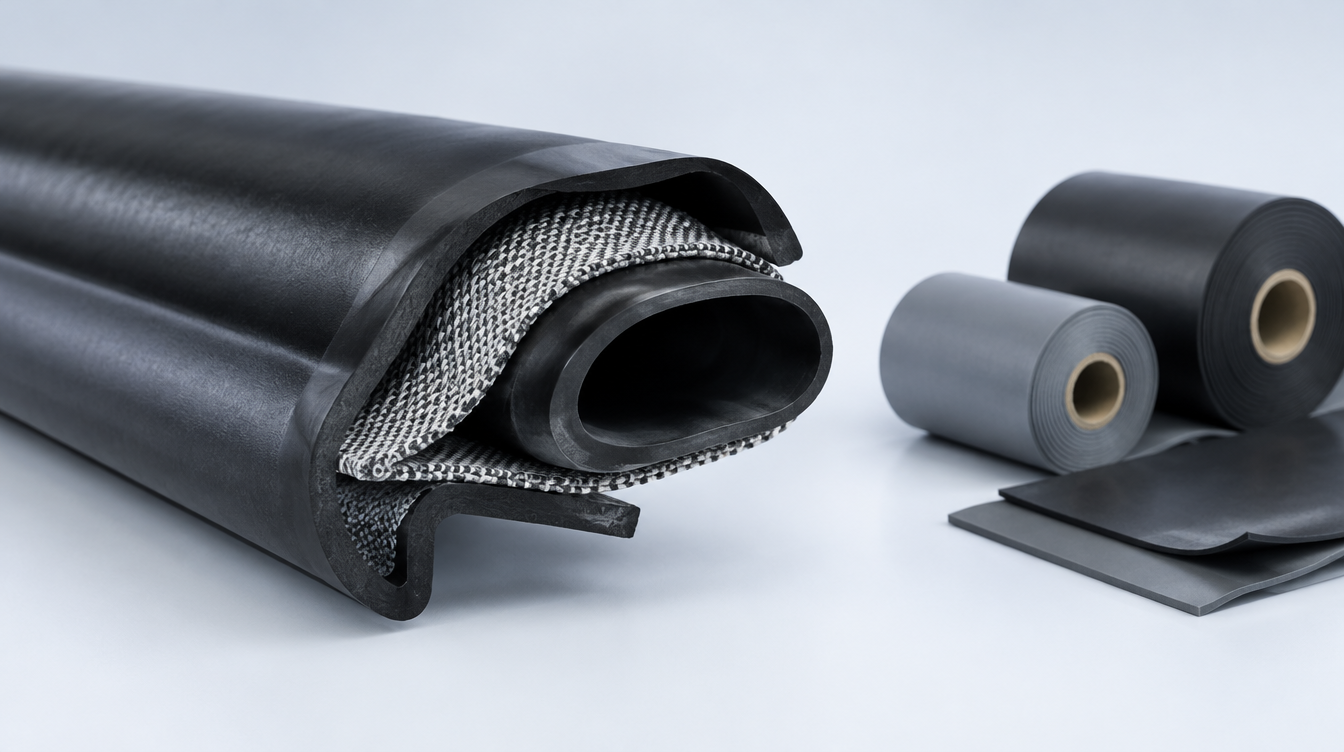
The tube wall is normally a laminated structure: an inner air-containing layer, one or more fabric reinforcement layers, and an outer cover. Fabric type, number of plies and wall thickness govern burst pressure, stroke repeatability and fatigue life, and should be specified together with the profile geometry rather than treated as separate choices.
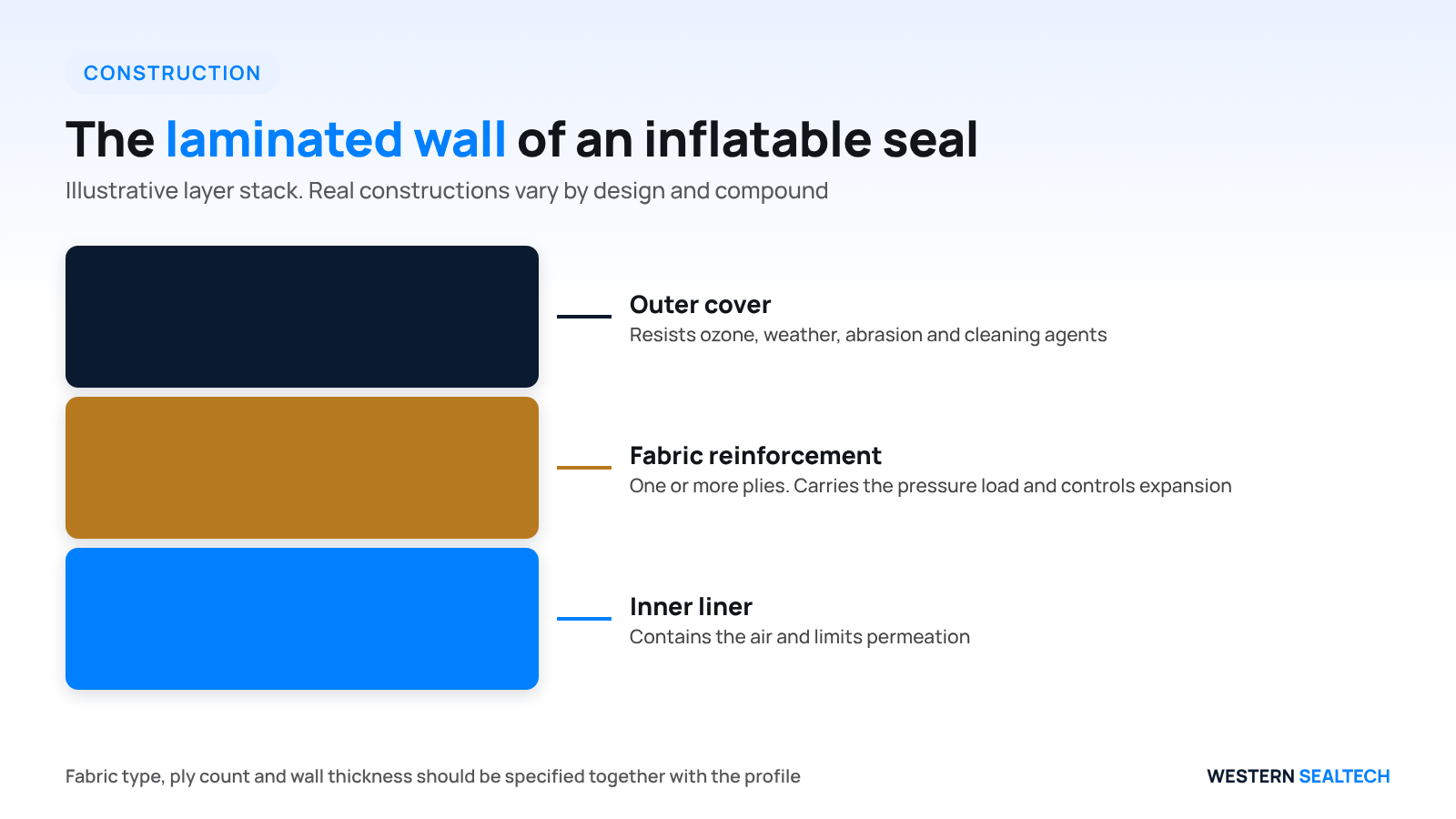
Reinforcement is what separates a pressure-bearing seal from a simple hollow extrusion. Our comparison of fabric-reinforced and non-reinforced inflatable seals explains when each is appropriate. The compounds chosen for each layer are covered in our article on inflatable seal materials and compound selection for rail, and the base polymer trade-offs follow from the service conditions of the door.
A practical point: the profile and the wall construction are developed together. A thicker or more heavily reinforced wall resists pressure better but is stiffer, which changes how the section folds when deflated and how much clearance it needs. That is one reason a profile copied from a sample should also be checked against the construction of that sample.
Choosing a Profile in Practice
The families above are easier to compare against a few typical situations. These are general patterns, not rules, and the final choice should always be checked against the door drawing and the operating conditions.
- Tight retract space. If the door runs close to the frame when the seal is deflated, a lay-flat or low-profile bulb section is usually the first option to review, with the stroke it can deliver checked against the real gap
- Variable or uneven gap. Where the gap changes along the door or between vehicles, a multi-chamber section or a wider tube may give the compliance needed, at the price of a larger groove and more complex inflation
- Frequent replacement. If seals are changed often in the depot, a dovetail or clip-in foot is normally preferred because it can be removed and refitted without adhesive
- High wear or friction at the contact line. A section with a lip or low-friction face can help, but the life of that surface should be discussed with the supplier
It also helps to think about what happens at the extremes. At full deflation the seal must stay in its groove and clear the door path. At full inflation it must fill the gap without being forced past the working pressure of its wall. A profile that only works at one of these extremes is not a good fit for a door that sees both on every cycle.
📊 Rule of thumb: Check the profile at both extremes, deflated and inflated, and at the smallest and largest real gap, before you approve a drawing.
Installation and Replacement Considerations
A good profile is also one that can be installed correctly by the people who will fit it. Corners should be formed to the radius the design allows, the foot or bulb should be seated fully along its whole length, and the seal should not be twisted or over-stretched as it is fitted. Over-stretching in particular reduces the wall thickness and can shorten life.
It is worth agreeing the replacement method at the design stage. Ask how long a change takes, whether special tools are needed and how the air connection is made and tested after fitting. A short, repeatable procedure reduces the chance of installation damage, which is one of the common causes of early failure.
Corners, Joints and Terminations
Inflatable seals are sensitive to how corners are formed. A corner that is bent too tightly concentrates stress in the wall, and a poorly made joint becomes a leak path. Where a door frame has corners, the seal is either moulded into a corner piece or joined by splicing and vulcanising, as described on our spliced and vulcanised seals page. The end termination, where the tube meets its air connection, deserves the same attention because it is where the seal meets the pneumatic circuit. The circuit itself is described in our guide to pneumatic control systems for rail inflatable seals.
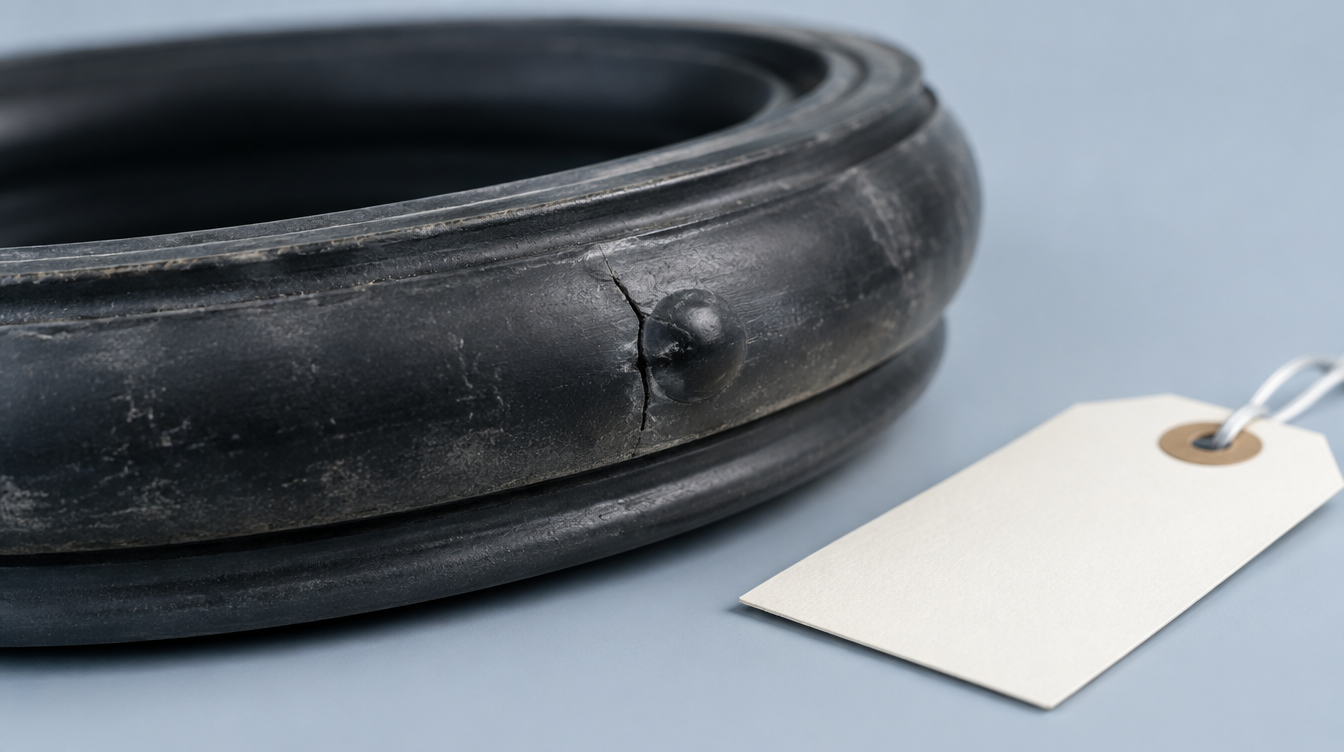
The way a profile fails also depends on where it is stressed. Our article on inflatable seal failure modes on rolling stock shows how wall folds, joints and terminations typically show wear, which is useful when deciding which features to simplify.
Does the Profile Affect Fire Compliance?
It can. Fire compliance is determined by the compound and the construction that were tested. A new profile or a different wall build may therefore need to be covered by an existing test report, or tested separately. Start by confirming the hazard level of the vehicle and the requirement set for the part, and ask the supplier which construction the report covers. For background on how compliant compounds are developed, see our article on how EN 45545 compliant compounds are formulated.
⚠️ Watch out: A report on a flat rubber sample does not automatically cover a laminated tube with fabric. Confirm which construction was tested.
What to Put in an RFQ
The more of the door context a supplier sees, the better the first proposal will be. The checklist below summarises what to send.

- Measured door gap range at several points around the perimeter, not only the drawing dimension
- Available groove or retention space, with a drawing or a sample of the existing seal
- Required retracted clearance during door movement
- Required stroke, inflation pressure available and expected cycle count
- Fire requirement: hazard level and requirement set
- End termination and air connection arrangement
- Corner geometry, since inflatable seals are sensitive to how corners are formed
✅ RFQ tip: A drawing or sample of the existing seal, together with measured gap values, helps us propose a suitable profile more accurately than dimensions alone.
If the project is for a rail vehicle, our rail and mass transit sealing page describes how we support fire-safe sealing across doors, windows and other openings, and our comparison of inflatable and static door seals can help confirm that an inflatable section is the right choice in the first place.
Key Takeaways
An inflatable seal profile has to hold itself in position, retract clear of the door path, expand to bridge the real gap and survive thousands of cycles. Round, lay-flat, bulb-on-base, multi-chamber and lipped sections each trade these jobs differently, and retention and wall construction matter as much as the shape. Put gap range, groove space, clearance, stroke, pressure, cycles, fire requirement and corner geometry into every RFQ.
Send us a drawing or a sample of your door seal and our engineers will propose an inflatable seal profile for your application.
Need a custom sealing solution?
Talk to our engineers about inflatable seals, rubber diaphragms and custom extrusions built to your exact spec. We respond within one business day.
Frequently asked questions
Can an inflatable seal profile be copied from an existing seal?
Often yes, from a drawing or a sample, but wall construction and reinforcement also need to be understood. We recommend sharing the sample together with the operating conditions and failure history.
Does a wider tube always give more stroke?
Not always. Stroke depends on wall construction, chamber shape and inflation pressure as well as width, and a wider tube can need a larger groove and more retract space.
Which retention method is best?
It depends on the installation and the replacement process. Dovetail and clip-in methods are common on doors where fast replacement matters, while bonded bases are used where space is limited.
Are multi-chamber profiles worth the extra cost?
Where the gap varies widely or a second sealing line is needed, they can be. For uniform gaps a single chamber is normally more economical.
Does the profile affect the fire compliance of the seal?
Compliance is determined by the compound and the construction tested, so a new profile or wall build may need to be covered by an existing report or tested separately.
Why does corner geometry matter for an inflatable seal?
A tight corner concentrates stress in the wall and a poorly formed joint can become a leak path, so corner radii and the joining method should be agreed early in the design.
What should I send with an RFQ for an inflatable seal?
Measured gap values, the groove or retention space, retract clearance, stroke and pressure, expected cycles, the fire requirement and the end termination. A drawing or a sample of the existing seal is the most useful addition.

Need a quote?
For custom rubber sealing solutions contact us. We will respond to you within 1 business day